Transistor as buffer ( this time with pnp :D )

Thread Starter

electronicsenjoyer089

Joined Feb 24, 2025
182
Hello all, yesterday i posted the same buffer with npn transistor, and i guess im a good point now. i fully understand it.

Today, im trying to simulate same circuit but with pnp transistor, but i had some questions to ask, and i guess i got some misunderstanding.

Basically im giving a 9V AC sine wave into input ( to the base of the transistor ), the emitter is connected to vcc, via a resistor of 1k ( so around 9V-the drop on resistor).

In this condition, the voltage on emitter is lower than base ( so it shouldnt conduct, remember the fact that a pnp conduct when Base < Emitter by 0.7V )

so my question is why do i see the AC sine wave still in output? the diode like that shouldnt be forward biased, in fact it shouldnt conduct no? cus if i understood well, what happens is that we use the D.C voltage for polarization ( and D.C wins against A.C), at this point the diode is forward biased and the signal can be seen in output+0.7V. But as i said in our case the emitter is lower than base , so it shouldnt conduct. Can someone explain me please? sorry for all of that.
 

Attachments

WBahn

Joined Mar 31, 2012
32,706
Hello all, yesterday i posted the same buffer with npn transistor, and i guess im a good point now. i fully understand it.

Today, im trying to simulate same circuit but with pnp transistor, but i had some questions to ask, and i guess i got some misunderstanding.

Basically im giving a 9V AC sine wave into input ( to the base of the transistor ), the emitter is connected to vcc, via a resistor of 1k ( so around 9V-the drop on resistor).

In this condition, the voltage on emitter is lower than base ( so it shouldnt conduct, remember the fact that a pnp conduct when Base < Emitter by 0.7V )

so my question is why do i see the AC sine wave still in output? the diode like that shouldnt be forward biased, in fact it shouldnt conduct no? cus if i understood well, what happens is that we use the D.C voltage for polarization ( and D.C wins against A.C), at this point the diode is forward biased and the signal can be seen in output+0.7V. But as i said in our case the emitter is lower than base , so it shouldnt conduct. Can someone explain me please? sorry for all of that.
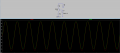
Your plot shows traces for nodes n003 and n002.

Unfortunately, my crystal ball is in the shop and my mind reading skills aren't what they used to be. Don't make people guess what you are trying to show them. At the very least, describe which node the red and the green traces are for.

Based on the shape of the traces, I'm going to guess that the red trace is the voltage on the base. I'm going to further guess that the green trace is the voltage on the emitter. It looks like, for most of the cycle, the emitter is roughly a volt higher than the base, which is more than you would expect for a PNP transistor in the active region, but that's because you insist on abusing that poor transistor. As the base voltage gets close to the upper supply voltage, the voltage across R1 gets less and less, and so less current flows. This results in less base current, which in turn results in a smaller and smaller voltage drop across the base-emitter junction. Eventually, the transistor goes into cutoff and the output clips at +9V as there is no current in R1.

But what happens as the source voltage goes negative? The collector side of the transistor is tied to 0 V via R2, so when the base voltage is negative, you are forward biasing both the emitter-base and the collector-base junctions and current is flowing from both to the base. This is an unusual, and usually avoided, region of operation. Mathematically, you have a negative gain (because the collector current is in the opposite direction from when it is in the normal active region) and the emitter current is all going to the base, meaning that it is essentially in a super-saturated condition, hence the higher than expected voltage drop across it.

Try looking at the base, emitter, and collector currents and see what happens to them as the base voltage goes negative.
 

WBahn

Joined Mar 31, 2012
32,706
Some PNP and NPN have a sub-category A,B or C. The BC547A NPN 1mA might be followed by a BC557C PNP 2mA, as a current buffer.
The C category has higher Hfe range, an improvement as a simple current buffer capable of handling a lower impedance output.
On the datasheet under charecteristics current gain the series C at 2mA has Hfe of 500.
BC556B, BC557A, B, C, BC558B - Amplifier Transistors PNP Silicon
And.... what does any of this have to do with what the TS is asking about?
 

WBahn

Joined Mar 31, 2012
32,706
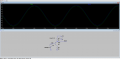
Here's a simulation showing the voltages and currents at all three transistor terminals.

Remember, the current at a terminal is positive for current flowing into the terminal.

Break this up into the different regions of operations and make sure that you understand what is happening in each.
 

WBahn

Joined Mar 31, 2012
32,706
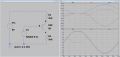
Here's the circuit and the sim results that I thought I had posted earlier.

1744950592479.png

Keep in mind that a positive current is a current flowing INTO a terminal.

Under "normal" operation, we therefore expect the emitter current to be positive while both the base and collector currents would be negative.

In the first half of the waveform, we see what we would usually expect. But when the base voltage goes negative, the collector current becomes positive, meaning that current is flowing from "ground" into the collector and then out the base.
 

Thread Starter

electronicsenjoyer089

Joined Feb 24, 2025
182
Here's the circuit and the sim results that I thought I had posted earlier.

View attachment 347365

Keep in mind that a positive current is a current flowing INTO a terminal.

Under "normal" operation, we therefore expect the emitter current to be positive while both the base and collector currents would be negative.

In the first half of the waveform, we see what we would usually expect. But when the base voltage goes negative, the collector current becomes positive, meaning that current is flowing from "ground" into the collector and then out the base.
yeah it flows in opposite direction, but i got another question, look i did the simulation again.

I read ur previous message " based on the shape of the traces, I'm going to guess that the red trace is the voltage on the base. I'm going to further guess that the green trace is the voltage on the emitter. It looks like, for most of the cycle, the emitter is roughly a volt higher than the base "

nope, in fact my doubt was on this, how the transistor has an output ( see sine wave on emitter, if it doesnt conduct?. on the emitter we are giving a voltage that is lower than base, in fact on the emitter we give 9VDC( so its the same voltage we give in input, lets say nothing drops by other side of resistor cus there is no current flowing(?)) but the simulation shows it still conducts, why so? i got some misunderstanding? thanks to all.
 

Attachments

Last edited:

Thread Starter

electronicsenjoyer089

Joined Feb 24, 2025
182
oh i guess i got it!, the transistor starts conducting cus the wave isnt static, its a sinewave, so what we gonna see is that when the sine wave assumes values from 8.4v and below, the transistor gonna conduct, and above that value, ideally the sine wave gonna be clipped, am i wrong?
 
Top