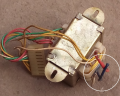
I've a transformer from my old DVD player. It's a multiple windings type, I knew this by measuring the voltage at each winding. My problem now is to determine the maximum current from the secondary or probably each winding.
hi,
Can you see the secondary copper wire, if Yes, then measure the diameter of the copper wire, post what you measure.
Also measure the cross sectional area of the transformers centre laminated limb. post the value.
E
hi,
Can you see the secondary copper wire, if Yes, then measure the diameter of the copper wire, post what you measure.
Also measure the cross sectional area of the transformers centre laminated limb. post the value.
E
I've a transformer from my old DVD player. It's a multiple windings type, I knew this by measuring the voltage at each winding. My problem now is to determine the maximum current from the secondary or probably each winding.
Depending on the age of the DVD player, it was probably a ~10W load --it should be written down somewhere on the transformer or the DVD. One can then measure the terminal voltage and the current is simply 10W/voltage measured.
In all fairness it should be noted that motor/generator sets have not necessarily been obsoleted by transformers for all applications. While transformers are clearly superior over motor/generator sets for AC voltage and current level conversion, they cannot convert one frequency of AC power to another or convert DC to AC or visa-versa.
I am just speaking in generalities but the last time motor/generator sets were used in quantity was almost 50yrs ago. Also, anything that a simple AC transformer can solve is superior to a motor/generator set as there are no moving parts, the efficiency can typically be greater than 90%.
It is true that an AC transformer cannot convert one frequency to another or even convert DC to AC or visa versa but this would most definitely be a wrong application for a transformer. Converting one frequency to another is not a trivial matter -- especially depending on the power to be converted. Yes, a DC motor can drive an AC alternator and create whatever frequency one needs. However, there too is much simpler solution using the latest power semiconductors -- lower overall weight/size, higher efficiency, and no moving parts, and probably much lower cost--(unless of course you happen to find a motor/generator set at a military surplus for free.)

 Facebook
 Google
 GitHub
 Linkedin