Facebook
 Google
 GitHub
 Linkedin

What a paragraph is:Hi,
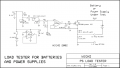
Yes, certainly you can estimate the current rating of a transformer winding if you measure the wire diameter, which you say is 2.7mm = 0.1063" which is AWG #10 Heavy Film magnet wire. The area is 10,400 circular mils, and for a large transformer (although you never said how large, large is), is likely designed at between 500 Circular Mils/Amp (C.M./A) to 600 C.M./A, making the current rating likely between roughly 17 Amps to 21 amps. Now, having said that, the actual current rating will depend heavily on the total DC resistance of that winding, which I do not know. If you can, please measure it, not with an ohmmeter, but with a good DVM or two. Procedure for measuring low-resistances with a DVM. Using a lab power supply, or a D-cell battery and a 1-Ohm, 5 watt resistor, if no lab power supply is available, connect the source positive (lab supply or D-cell) in series with the 1-ohm resistor, then connect the other side of the 1-Ohm resistor to one-side of the winding to be measured, and connect the other side of the winding to be measured back to the source (lab supply or battery) minus side. Connect DVM-1, set to the 2 VDC scale, across the 1-Ohm resistor and connect DVM-2, set to 200 mVDC Scale (or lower if it has a lower scale), across the terminals or wire ends of the winding to be measured. If you only have 1 DVM, that will do, but you'll need to work quickly by having it initially setup for DVM-1 above, take a reading as quickly as possible if using a battery (since it will almost immediately start to go down in voltage), then as quickly as possible, connect it as DVM-2 above and take that reading (don't forget to change the voltage scale unless you have an autoscale DVM). If you are using a lab supply, there is no need to hurry up. Compute the unknown winding resistance as follows: Take the DVM-2 voltage divided by the DVM-1 voltage and this equals the unknown winding resistance. Once you have the winding resistance, you can compute the power dissipated in that winding by Power=I^2*R, with I=Current in the winding, and R=the measured/computed resistance of the winding. From there, it really depends on how big the transformer is. In order to set a maximum output current spec for that winding, knowing the transformer size and the lamination (core) dimensions, I could make a calculated guess at how much power loss that winding could safely tolerate, then calculate the current (I) from the formula above: I = Sqrt(Power/Resistance). Since I don't know how large, large is but you do, I can't make an estimate that way. Even if I did know or had a picture, I would still need the winding resistance measurement. You may ask why you can't simply measure the winding resistance using your DVM. The answer is that it is an low-Ohm measurement and your DVM leads may very well have more resistance than the winding you are trying to measure. Therefore, you need a more accurate method. This method works well for most DVMs down to a few milliOhms with a 3.5 digit DVM and down to less than a milliOhm for a 4.5 digit or greater DVM. Good luck and if you get that data and would like me to tryh and estimate the winding current rating a bit more accurately than I did at first, please send me a private email so that I'll know you're ready. I don't always get to AAC very often as I'm usually very busy at work.
Regards,
Kamran Kazem
A paragraph is a group of words put together to form a group that is usually longer than a sentence. Paragraphs are often made up of many sentences, typically between four long sentences or 10 shorter ones.
Sometimes however, you might get a paragraph with only one or two long sentences. Paragraphs can begin with an indentation (about five spaces), or by missing a line out, and then starting again. This makes it easier to tell where one paragraph ends and another begins.
Now I am sure why I did not read your post.