Transformer output question

Thread Starter

Energy forever

Joined Sep 11, 2021
46
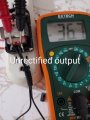
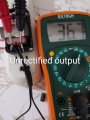
Ok, so, after doing some so called thinking, i multiplied the 36.7 rms unrectified voltage as shown in picture with original posted question by the square of 2 aka 1.41421356237 and got 51.901637738979. Even if the peak voltage gets through somehow uneffected by diode voltage drop, the cap shows 53.3. Sure this could be from tbe supply voltage ever so slightly increaseing and decreasing, but, i guess im wondering if its normal for peak voltage to be unaffected by diode voltage drop? Shouldn't peak voltage be reading at about 1.5 volts less on the output of a full wave rectifier? Also, considering the factors, why would a educated professional choose a cap to be installed in the mass production of a product that has a voltage essentially equal to and actually slightly less than the peak voltage of a tranformer?
 

MrChips

Joined Oct 2, 2009
34,809
You are referring to a load as internal resistance. If you wanna help me you can do so either by staying off my threads or learning how to speak to me properly.
I see you still have much to learn and you are not paying attention.
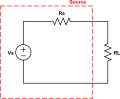
Voltage source internal resistance Rs is not the same as the load RL.

1633349136991.png


I will be more than delighted to stay off of your threads.
With your attitude I predict that you will not be here for long on AAC.
 

MrChips

Joined Oct 2, 2009
34,809
Ok, so, after doing some so called thinking, i multiplied the 36.7 rms unrectified voltage as shown in picture with original posted question by the square of 2 aka 1.41421356237 and got 51.901637738979. Even if the peak voltage gets through somehow uneffected by diode voltage drop, the cap shows 53.3. Sure this could be from tbe supply voltage ever so slightly increaseing and decreasing, but, i guess im wondering if its normal for peak voltage to be unaffected by diode voltage drop? Shouldn't peak voltage be reading at about 1.5 volts less on the output of a full wave rectifier? Also, considering the factors, why would a educated professional choose a cap to be installed in the mass production of a product that has a voltage essentially equal to and actually slightly less than the peak voltage of a tranformer?
Learn how circuits behave.
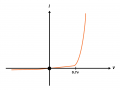
Diode forward voltage is assumed to be 0.7V at a specified diode current.
At zero current the diode forward voltage is zero.

1633349605058.png
 

ericgibbs

Joined Jan 29, 2010
21,440
Hi Ef,

Lets see if I can help.

I have a power adapter that says it outputs 23 volts dc. I opened it up and measured 30 some volts right off the transformer.

You measured 30Vrms, so Vpeak would be 30V *1.414 = 42.4Vdc

With a 50 volt capacitor and full wave rectifier hooked up, the output reads 50 some volts.

This would mean that the Vac rms would 36.75Vac [ already added the 1.4Vdiode drops]

So this Actual 36.75Vac – 30Vac measured = 6.75Vac

1: Why is this happening?

The most likely cause suggests that your meter is not reading the correct Vrms value.

E
 

Thread Starter

Energy forever

Joined Sep 11, 2021
46
Learn how circuits behave.
Diode forward voltage is assumed to be 0.7V at a specified diode current.
At zero current the diode forward voltage is zero.

View attachment 249498
You say one thing yet the real world says another. Why do my pictures prove you are lying to me? Im pretty sure trolls get kicked out of sites and not the ones they troll.
 

Attachments

MrChips

Joined Oct 2, 2009
34,809
Don't you just love trolls?

While we're on the subject, let's talk modern day precision for a moment.
You quote √2 as 1.41421356237. In my field 1.414 is good enough for me for all intents and purposes. In practice I simply use 1.4.

Did you know that multiplying Vrms x √2 only applies to certain waveforms?
Since we don't have any exact picture of the applied waveform, using a multiplying factor of 1.41421356237 is already off the mark whereas using Vrms x 1.4 is a good enough estimate.

Why would I lie to you? I have nothing to gain by doing so. You need to understand the difference between theory and practice. I quote another member's signature:

"In theory, there is no difference between theory and practice. In practice, however, there is."
 

MrChips

Joined Oct 2, 2009
34,809
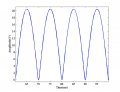
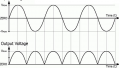
Here is a graph of what the output of a bridge rectifier circuit should look like in theory.

If your were to place a DMM set to read VDC across the output in order to measure the output voltage, in theory what voltage would you expect to read?

1633354655181.png
 

Thread Starter

Energy forever

Joined Sep 11, 2021
46
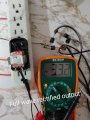
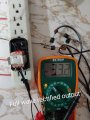
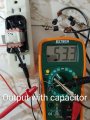
The full wave rectified voltage 33.2, includes the diode voltage drop, naturally, multiplied by the square root of 2 equals 46.951890270684. As shown in picture, when the cap is installed, the voltage is 53.3. The picture with the full wave rectified output in contrast to the unrectified output clearly shows a rectifier lowers the rms voltage and therfore lowers the peak voltage, for it is the peak voltage from which the rms is calculated, therefore multiplying the rms voltage of the rectified output by the square of two yields the peak voltage with diode voltage drop incorporated, naturally, yet, the cap charged up to 53.3 volts, which is 6.348109729316 volts higher than the peak output voltage. How is the cap charging to a voltage higher than the source?
 

Attachments

MrChips

Joined Oct 2, 2009
34,809
Do you know the meaning of rms?
Do you know how it is calculated theoretically and how it is determined in a DMM?
If not then I suggest that you look it up.

You did not respond to the question I asked in post #27.
If you don't know the answer then I suggest that you look it up.
 

BobTPH

Joined Jun 5, 2013
11,515
Of course we are all lying to you. You have discovered a free energy source and we are all part of conspiracy to suppress it. What did you expect?

Speaking of expect, I hope to get my checks from the coal and oil industries in today's mail.

Bob
 

Thread Starter

Energy forever

Joined Sep 11, 2021
46
MrChips, lets see if you can demonstrate self control by staying off all my threads, with any and every account that you have or create, if you can not, that is one example to show yourself and others you are not in control of yourself. A question to ask yourself at that point, if it occurrs, if not here, but somwhere else, "if i am not in control of myself, who or what is"?
 

shortbus

Joined Sep 30, 2009
10,050
MrChips, lets see if you can demonstrate self control by staying off all my threads, with any and every account that you have or create, if you can not, that is one example to show yourself and others you are not in control of yourself. A question to ask yourself at that point, if it occurrs, if not here, but somwhere else, "if i am not in control of myself, who or what is"?
Do you even realize your arguing with a moderator? You come here with a certain idea, one you came up with, and say that all of us other people doing this are wrong?

If that's the case just build YOUR circuits YOUR way.
 

MrChips

Joined Oct 2, 2009
34,809
Who's lying to you? No one is lying here.

Let me put it to you differently.
There is theory and there is practice.

theory <-----> practice

In science, we present a theory. Then we look at the real world evidence to see if the results support the theory. If they do not then we go back and examine the theory and see where we might have gone wrong. We also reexamine the evidence and see if we made a mistake or misinterpreted the results.

In our power supply example, the results support the theory. There is no dispute here.
The readings on the DMM agree with known established circuit theory. Perhaps you are misinterpreting the values indicated by the DMM. Or perhaps you are not using the correct applicable theory.
 

ThePanMan

Joined Mar 13, 2020
918
Curios thread here. So your transformer with no load (assumed) is outputting 36.7V. That's OK, it all depends on the input voltage. If that changes then so will the output. A transformer just changes one AC voltage to another by a ratio of number of turns on the secondary.

First thing I'm observing is the rectified output voltage of 33.2 volts. That shows a 3.5 volt drop just from the diodes alone. Something is amiss there. The voltage drop should only be 1.2 to 1.4 volts under normal conditions. But hey! What do I know.

Next, with the cap in circuit you should be seeing 46.9V, yet you're displaying 53.3 volts. My conclusion is that you can't trust your meter. Either your meter is wrong or ohms law is. Once I fought the law and the law one.

Get an old incandescent lamp and solder some wires onto it. Under those voltages it might not light. But that's OK. It's still a load. Test the voltage with just the lamp connected, then test voltage with the rectifiers in place. Finally, check the voltage with the cap in place. You might start seeing more meaningful numbers. I'm here a year and a half and I've found these guys to be rather helpful and integritous. They're not lying to you, they're telling you what they know from many years experience. Far more experience than I have. So if your numbers aren't adding up - try a different meter.
 

MrChips

Joined Oct 2, 2009
34,809
No. The meter is not lying. It is our misunderstanding of what the meter is indicating.

Let's give the meter some credit where it is due.

Suppose you were tasked to design and build a meter to readout the voltages of the following waveforms.
How would you do it?

1633359595021.png
 

MrChips

Joined Oct 2, 2009
34,809
MrChips OK. What am I not picking up on that others are?
The first question is what is the meaning of rms and how is it determined theoretically and in a measuring instrument?

The second question is, given a waveform with a changing voltage, what voltage ought to be displayed by a voltmeter?
 
Top