Toroidal coil and magnet question

Thread Starter

cmartinez

Joined Jan 17, 2007
8,780
Because you're up against a physical constant like, P=IE, and you're saying, "If I use some I and some E to run a motor to spin my magnet inside my coil, why can't I get more heat out than the power I put in? Because all you did was change the form of the power from electricity to heat. It doesn't matter how many machines you put in the path, the sum of all energy input to the system = the amount of energy the system has.
:eek: NO...no no no no no... God forbid *shudders* that what I propose to do is get more heat power than what I put in... I'm a law-abiding citizen and I'd never even think about even trying to break the second law of thermodynamics ... If that were the case then I'd really need an exorcist, and a psychologist, and a neurosurgeon to perform a lobotomy on me ...
It seems that I've certainly failed to explain myself all this time if all of you think that's what I intend to do ...

Stay tuned, I'll be back in a few more hours with a more precise diagram of what I want .
 

wayneh

Joined Sep 9, 2010
18,111
It seems that I've certainly failed to explain myself all this time if all of you think that's what I intend to do ...
I didn't think you were chasing perpetual motion, but I remain at a loss trying to figure out your plan. Converting shaft work to electricity or all the way to heat is a VERY over-worked topic. Not only are you unlikely to do anything new, it's unlikely you'll get anywhere near the efficiency of known technologies. I don't mean to imply anything about you - I mean it's very hard to find gold a century after the miners have moved on.
 

Thread Starter

cmartinez

Joined Jan 17, 2007
8,780
I didn't think you were chasing perpetual motion, but I remain at a loss trying to figure out your plan. Converting shaft work to electricity or all the way to heat is a VERY over-worked topic. Not only are you unlikely to do anything new, it's unlikely you'll get anywhere near the efficiency of known technologies. I don't mean to imply anything about you - I mean it's very hard to find gold a century after the miners have moved on.
That's another thing I'm not after... gold, that is. I'm just trying to find out a simple and cheap way of heating water in places where sunlight is scarce, and wind is available. BRB with a diagram.
 

wayneh

Joined Sep 9, 2010
18,111
Got it, thanks.

In that case, I would mount several disk magnets (with normal on-axis polarization) underneath a spinning disc brake immersed in water. The eddy braking will create a LOT of drag on the windmill. If you use gearing, you could even speed up the disk rpm.

Without magnets, you could just agitate the water, but that might be a lot of stirring.
 

Thread Starter

cmartinez

Joined Jan 17, 2007
8,780
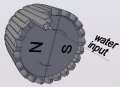
Alright, here's a different idea, but on the same track I intended since the beginning:


Capture.JPG


The objective:
  • Generate enough energy to heat water going through the square copper tube
  • Spin the magnet (or group of magnets, I don't care if it's one or many) with a windmill, directly coupled to the shaft. No gearing involved
  • Scale the turbine, magnet and tube so as to extract the maximum wind energy available. Again, without recurring to gearing.
  • Possibly couple a pump that will re-circulate the water coming from an insulated deposit
Obviously, this design is very different from the one I proposed at first... I just thought that a wacky idea such as a short-circuited toroid could take advantage of both eddy currents and induced electricity in the coil to generate heat... but judging by the (very enthusiastic) comments against it, I'm beginning to have second thoughts.

In this second example, the copper tubing is square and each stripe of tube is making electric contact with the next, thereby producing a solid wall of copper in the inner diameter of the arrangement, and forcing the apparatus to only produce heat through eddy currents on the copper's surface. This heat would then be directly transferred to the water circulating inside the winding.

Now let's consider the alternative:
  • An electric generator coupled to a windmill
  • That is coupled to a gearbox (diminishing efficiency)
  • That is connected to a heating element (again diminishing efficiency)
  • Which in turn heats the water
Which would be more efficient... and the key: less expensive?

Again... I'm not trying to go down in history for this, nor retire to Los Cabos with the money I know I'll never make... nor win a Noble Prize, nor have my preschool teacher put a star on my forehead... I'm just curious, and I value your input.

Edit: I forgot to mention that in my design there'd be no danger of an electric short circuit, and there'd be no wiring nor electric contacts involved.
 
Last edited:

wayneh

Joined Sep 9, 2010
18,111
I'd look for a configuration that doesn't require the lateral polarization of the magnet. Use multiple, smaller magnets with axial polarization. For one thing, big magnets are dangerous. I have some disks that are 1-3/8" in diameter and maybe 1/2" thick. I'd be reluctant to handle anything bigger.
 

GopherT

Joined Nov 23, 2012
8,009

MrAl

Joined Jun 17, 2014
13,711
Interesting to note that Wikipedia states Joule was a physicist and brewer. An important combination perhaps. How many good ideas started out in a pub?
Hi,

Oh so that is how he got all his cool ideas :)
It is interesting that although i can not condone drinking, beer does change your mindset a little so if you're stuck on a problem really bad sometimes taking a break with a nice cold one is just the thing that helps when you come back to it. For people that dont drink i dont advise them to start, but if they already drink beer then i guess it is ok.

I am getting the idea now that the purpose of this 'device' is to generate heat from mechanical energy in a more direct way.
Because of this i would think a generator and resistive heater would be pretty efficient, if the generator was liquid cooled so that ALL of the heat generated in the process would be participating in the raising of the temperature of the water.
We would assume no loss in the input shaft itself, then as the generator turns the windings,core, and bearings heat up, and with water cooling the heat from that would be carried away as an increase in temperature of the water, which would then meet up with the resistive element which would then heat the water more.
I dont see any 'loss' of heat in this scenario, that is, heat that escapes out into the atmosphere and so does not raise the temperature of the water. I suppose that the temperature of the water has to be reasonable here though, which brings up the question, just what is the requirement that the water has to heat up to, how hot, what max temperature?
 

Thread Starter

cmartinez

Joined Jan 17, 2007
8,780
I am getting the idea now that the purpose of this 'device' is to generate heat from mechanical energy in a more direct way.
Yes, that is exactly the idea. But if I were to use a generator, then the parts would be more expensive, and the generator would have carbon brushes, commutator and other wearable parts. In my design, the only wearable part would be the bearings, and all of the water would be in direct contact to the only surface being heated... That's another question that I have, I know about eddy currents and all. But is the magnet going through some heat/energy transfer itself too?

Anyway, I agree with your observation that beer is an excellent creativity liberating agent...
And if you need to solve a serious problem, I suggest you have one of these.
 

#12

Joined Nov 30, 2010
18,224
I think I have the picture now. You just want to convert mechanical movement into heat using the principles of electricity but without the generator and wires. More like a generator with a shorted winding, or even simpler if possible. The difficulty is to get high quality heat, not just a room temperature tub of water with paddles in it.

At least you know the answer is 3.413 B.T.Us per watt hour. The problem is to stuff a lot of them into your barrel.
 

Thread Starter

cmartinez

Joined Jan 17, 2007
8,780
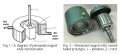
Never looked into wind powered eddy current heaters but it seems to be a workable idea.
http://www.bulipi-eee.tuiasi.ro/archive/2013/fasc.4/p12_f4_2013.pdf
"So, it is reasonable to convert wind energy into heat for the entire range of variation of wind speed. Such a heater may be the Joule machine or Permanent Magnet Eddy Current Heater"

There you go... my idea is not far off the mark, then.

Capture.JPG

This is almost exactly what I've been trying to explain all along.
 

wayneh

Joined Sep 9, 2010
18,111
One thing I don't see on that prototype is a solid way to mount the stator. The drag on the rotor will appear as torque on the stator, very much like viscous coupling in a transmission.
 

Thread Starter

cmartinez

Joined Jan 17, 2007
8,780
Guess I confused everyone at first with my toroid question... But this also seems to clarify that pure eddy current generation would be the most efficient approach.
 

#12

Joined Nov 30, 2010
18,224
Looks like it's been done. At least it is dated 2013 instead of 1913!
So...take the water jacket off to avoid the need for an electric water pump?

wayneh, there are cast ears on the bottom part, on the right of the photo.
 

wayneh

Joined Sep 9, 2010
18,111
I think that prototype was made by modifying a permanent magnet alternator. They pulled out the stator coils and replaced them with the heat exchanger, keeping the rotor and bearings unchanged. That would simplify your construction a lot.
 
Top