To dare or not to dare... that is the question. Can I plug the 40V batteries to the 24VDC inverter input

Thread Starter

Externet

Joined Nov 29, 2005
2,624
Greetings.

I have a 24VDC input ; 120VAC 4KW output modified-sine new inverter. I have several 40 VDC li-ion parallelable batteries with its solar charger.

Can I plug the 40V batteries to the 24VDC inverter input to guess if there will be no smoke or better abstain ? --- What would you do to match the unmatched 40V to 24 V (nominal*) ? Opening to see if input capacitors are rated to more than 40 VDC ? Measuring something if dare to connect ? Try an input resistor :rolleyes: ?

*guessing, 24V nominal rated can accept 28V or perhaps 30VDC. But 36V, 40V is a better-not ? What to check inside in components before risk it ? Overloading the output is not going to happen, will not be abused at that end.
 
Last edited by a moderator:

WBahn

Joined Mar 31, 2012
32,703
What do the specs on the inverter say is acceptable for the input? If the max input voltage is at least 40 V, you are good. If it isn't, then don't do it. It really is pretty much that simple.
 

MisterBill2

Joined Jan 23, 2018
27,172
40 volts will more than double the power dissipated in all of the series resistive elements, and all of the forward biased junctions. So all of the overheating will happen quite rapidly. The semiconductor over-voltage failures will be complete within milliseconds.

Now, since the inverter is new, I am guessing that it is in a known functional condition. 40 volts will probably change that condition rapidly.
What other power sources do you have available?? AND, what information do you have that came with the inverter???
 

WBahn

Joined Mar 31, 2012
32,703
Thank you.
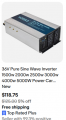
Specifications booklet in it say 2500W - 5000W peak
High voltage cut-off DC30 +/- 2V
Low voltage alarm DC21 +/- 0.5V
Low voltage cut off DC 20.3 +/- 0.5V
Range DC20 - 30V

----> https://www.amazon.com/Cantonape-In...er-Outlets/dp/B0CPP5L3QM?ref_=ast_sto_dp&th=1
Looks like you've pretty well answered your question. It is only rated for input voltages between 20 V and 30 V. Furthermore, if you get above 30 V (±2 V), the device will cut the input off.

So, no, you can't go hooking your 40 V batteries to it and expect it to work.
 

Thread Starter

Externet

Joined Nov 29, 2005
2,624
What modification would it take to accept a higher input DC voltage ? I suppose there is a circuit that shuts it off to comply and not exceed some components capabilities that would need upgrading..

How do these inverters work without transformer ?
1762824499946.png
1762825350318.png
 
Last edited:

MisterBill2

Joined Jan 23, 2018
27,172
If those inverters do not have an output frequency transformer, they will have a much higher frequency transformer driven by an inverter. THEN, probably a class A or possibly class AB stage using transistors in a linear or close to linear mode. OR MAYBE, a very high frequency PWM scheme to synthesize what becomes a sine wave after passing thru a low pass filter. THAT would explain the LARGE HEAT SINKS on the large transistors. Producing sine waves, or reasonably close waves, efficiently is a serious challenge.
 

WBahn

Joined Mar 31, 2012
32,703
First, you need to reverse engineer the inverter circuitry and analyze it so that you know what components need to be changed so that you get the correct functionality and so that everything can handle the voltage, current, and power that it will need to.

This you determine whether it is feasible to modify the existing unit to make those changes. The answer may very likely be no, at which point you layout a new PCB for the modified schematic, get all of the parts, have the board fabbed, populate it and test it.

Or, you could just get an inverter that is intended to operate at the voltage you need. Most 36 V inputs will cover 40 V and some 48 V input units will. The 36 V units will probably be a better match.
 

MisterBill2

Joined Jan 23, 2018
27,172
The degree of complexity will depend on what scheme the inverter uses to produce the output. If the inverter system includes a large transformer the change may involve changing that transformer to one with a different turns ratio. THAT makes the modification into quite a big deal.
 

Thread Starter

Externet

Joined Nov 29, 2005
2,624
Thanks.
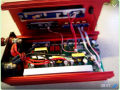
Inspected the guts and found capacitors across the DC input being 35V. So nope, will buy another inverter and sell this one.

1762869506139.png

There is four equal sections each contributing probably 500W ---- Interesting, the electrolytics do not have their can wrappers connected to any terminal. Only the radial pins have. Warns me that modern electrolytics may not be a ground reference when probing on their tops.
 

MisterBill2

Joined Jan 23, 2018
27,172
Interesting about four sections. If they are isolated between input and output, you might be able to put the inputs of each two in series with the outputs connection unchanged, and have a 48 volt input package. THAT would be safe for a 40 volt input. The concept might be worth doing a bit of investigating.
 

Tonyr1084

Joined Sep 24, 2015
9,744
Peanut Gallery here - what about getting a buck converter to drop the input voltage to an acceptable level? How many amps that may take is beyond me but this might be worth a single thought or brain cell's worth to consider.
 

WBahn

Joined Mar 31, 2012
32,703
Peanut Gallery here - what about getting a buck converter to drop the input voltage to an acceptable level? How many amps that may take is beyond me but this might be worth a single thought or brain cell's worth to consider.
While technically feasible, it probably defeats the purpose. If he's going to spend money to get a buck converter to get the input voltage down to an acceptable level (and suffer the inevitable losses due to efficiency), then that money is probably better spent just getting the right inverter to begin with. I think the goal was to avoid spending that money by trying to get away with abusing the existing inverter or doing some quick and cheap modification to it.
 

Tonyr1084

Joined Sep 24, 2015
9,744
The stark reality here is that 40VDC will not work. Some means of lowering the voltage as cheap as possible may be the goal, but the reality is - money will be spent.

Just a thought and probably a stupid one - but what about a diode stack? You ARE losing 10 volts by using 17 diodes with a 0.6Vf, and yes, that, too, is going to be inefficient. The diodes will be converting a lot of power into heat. Any way you look at it - the best advice is to "Dare Not".

Is the goal merely to be able to use the inverter from the stock of 40V batteries? If the goal is merely to be "Able to" - the answer is "No". If the stock of batteries is not needed for any particular purpose, like an electric lawn mower or other yard equipment - or maybe hand power tools - then modifying the batteries is not feasible. But if the batteries are a bulk stock of merely batteries then disassembling the batteries to get 30V without going over the cutoff voltage then 7 cells in series should give you a max of 29.4V at full charge. Keep in mind I'm thinking the Li-Ion batteries that are "PROBABLY" being discussed here can have a total charge of 4.2V (if that's the right full charge voltage). At 3.8V seven batteries would be 26.6 volts.

The real question isn't "Dare or not to dare" but rather "How to achieve a usable voltage". OR "Should I just buy the right batteries?" Or "Should I get a different inverter?"
 
Top