TLC555 with 2 Timing Modes Via Switch

Thread Starter

tvist21

Joined Jun 11, 2021
26
I'm trying to make a circuit that has two timing modes (45 minutes and 1.5 hours). Pin 6&7 need to be connected to different RC circuits. I'm using a SPDT switch to control which RC circuit is connected to pin 6&7 but the RC circuits are connected together at VCC and Gnd. What is the correct way to design this so that my RC circuits are completely isolated from one another?
 

MrChips

Joined Oct 2, 2009
34,628
The two RC circuits are not coupled and hence the SPDT switch will work.

However, even a SPST switch will work. All you need to do is switch in a second capacitor of equal value.
 

crutschow

Joined Mar 14, 2008
38,316
I'm trying to make a circuit that has two timing modes (45 minutes and 1.5 hours)
It is problematic to reliably generate such long delays with a TLC555 due to the leakage currents of the capacitors required for the large RC timing values.

Better to use a higher frequency oscillator driving a counter.
It uses a much smaller RC value, and is easier to measure and tweak the oscillator frequency to get the desired output times.
This can be done with a CD4060 counter which has a built-in circuit for the oscillator (example).
The two time-output values can be selected by a switch from two adjacent counter outputs which vary in time by a factor of two (for example pins 13 and 15 in the referenced circuit).
 

sghioto

Joined Dec 31, 2017
8,633
What is the correct way to design this so that my RC circuits are completely isolated from one another?
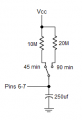
One way using the SPDT switch.
Note that 20meg is the maximum practical value timing resistor for a TLC555.
Hence the minimum value capacitor is appx 250uf to get 90 minutes.
Timing accuracy as crutschow mentioned is highly dependent on the quality of the capacitor.

1737136069132.png
 

AnalogKid

Joined Aug 1, 2013
12,043
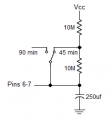
Leakage and tolerance issues aside, this can work with just a SPST switch.

Start with the #4 schematic.
Replace the two parallel resistors (Reference Designators!) with two 10 M resistors in series
Use a SPST switch to short out one of the resistors.

ak
 

Thread Starter

tvist21

Joined Jun 11, 2021
26
It is problematic to reliably generate such long delays with a TLC555 due to the leakage currents of the capacitors required for the large RC timing values.

Better to use a higher frequency oscillator driving a counter.
It uses a much smaller RC value, and is easier to measure and tweak the oscillator frequency to get the desired output times.
This can be done with a CD4060 counter which has a built-in circuit for the oscillator (example).
The two time-output values can be selected by a switch from two adjacent counter outputs which vary in time by a factor of two (for example pins 13 and 15 in the referenced circuit).

Thanks for your input. This is for a non-critical timing application so it is fine if the timing is off. Would you mind critiquing the rest of my circuit?

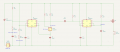
DP3T switch turns the circuit on. The timer start switch pulls pin 2 low for a short period which triggers timer 1 to start. The reset button pulls pin 4 of timer 1 low at any time to reset timer 1's count. After 45 or 90 minutes, pin 2 of the second timer gets pulled low for a brief period which trigger's timer 2 to activate a buzzer for ~3 minutes. Ideally, I'd like to find a way to get the power to be completely disconnected from the circuit after the buzzer has gone off for 3 minutes.


1737251689349.png
 
Last edited:

sghioto

Joined Dec 31, 2017
8,633
When power is first applied it appears the buzzer will activate because the output of U3 is Low.
Q1 driving the buzzer is not configured correctly
What is the battery voltage?
 
Last edited:

Thread Starter

tvist21

Joined Jun 11, 2021
26
When power is first applied it appears the buzzer will activate because the output of U3 is Low.
Q1 driving the buzzer is not configured correctly
What is the battery voltage?
The battery is a 3V CR2032. Q1 is an N-Channel Enhancement mode mosfet so it needs a high signal to activate.
 

sghioto

Joined Dec 31, 2017
8,633
Q1 is not wired correctly and 3 volts may not be enough voltage to activate.
What part number is Q1?
The buzzer will activate for the 3 minutes when power is first turned ON.
The reset switch is not wired correctly and if it is when pressed during the timing cycle the buzzer will also activate.
The Start switch is also wired incorrectly. It will only operate once since C6 has no discharge path.
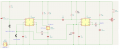
Modifications required and using momentary push button switches for Start and Reset.

1737258708193.png
 
Last edited:

Thread Starter

tvist21

Joined Jun 11, 2021
26
Q1 is not wired correctly and 3 volts may not be enough voltage to activate.
What part number is Q1?
The buzzer will activate for the 3 minutes when power is first turned ON.
The reset switch is not wired correctly and if it is when pressed during the timing cycle the buzzer will also activate.
The Start switch is also wired incorrectly. It will only operate once since C6 has no discharge path.
Modifications required and using momentary push button switches for Start and Reset.

View attachment 340688
Oh, yes you're right it should be between the buzzer and ground. The mosfet is SI2302-TP which has a gate threshold of 1.2V
 

Thread Starter

tvist21

Joined Jun 11, 2021
26
That mosfet should be fine.
Did you see the other mods I posted?
1. What is the purpose of the 100ohm resistors you put on the output of 6&7?
2. Yes it makes sense that we'd want both timer's reset tied to the reset button. Why doesn't the first timer need a pull up resistor on the reset pin? Edit: Oh because it's tied to the second timer's pull up resistor. Got it.

Not sure why I had a capacitor below the start switch. Dumb mistake.
 
Top