TL431 not working properly as tunable negative reference by the datasheet

Thread Starter

yef smith

Joined Aug 2, 2020
1,445
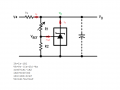
Hello, I am using TL431 in the configurations below to tune the negative voltage for the Vg1 port of PMA5-83-2W.
I know that TL431 is generaly used as positive tunable reference voltage.
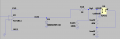
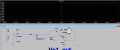
I have been suggested the following configuration shown in the LTSICE where the input is -12V.
but as you can see in the simulation now cathode is connected to GND and the resistors in the formula are switched in the order.
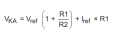
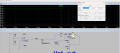
So my Vref=-2.5V R_load3=2k R_load2=1k V_ka=-2.5(1+R_load3/R_load2)=-7.5V as shown below.
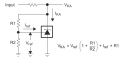
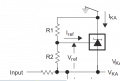
The resistor order is exactly the opposite than the forumla in the data sheet.
Is it a valid configuration to use in real life because in the simulation it works?
Thanks.

LTspice file is attached.
https://www.minicircuits.com/pdfs/PMA5-83-2W+.pdf
1727830502484.png


1727830004209.png
 

Attachments

Last edited:

crutschow

Joined Mar 14, 2008
38,316
Also the 1k and 2k seem low. Try 10k and 20k.
The REF current is up to 4µA (below) so you want to keep the equivalent resistance at the point low enough for that current to not cause an unacceptable change in the Vref voltage.
10kΩ and 20kΩ give an equivalent resistance of 6.67kΩ, which will cause a worst-case apparent shift of Vref by 27mV or 1%, so the circuit reference voltage will also shift by that percentage (75mV for the TS's circuit reference setting of 7.5V).

So whether those resistor values are acceptable depends upon if a worst-case additional 1% error in the reference voltage is a concern in the application.

1727834113676.png
 
Last edited:

MrAl

Joined Jun 17, 2014
13,667
Hello, I am using TL431 in the configurations below to tune the negative voltage for the Vg1 port of PMA5-83-2W.
I know that TL431 is generaly used as positive tunable reference voltage.
I have been suggested the following configuration shown in the LTSICE where the input is -12V.
but as you can see in the simulation now cathode is connected to GND and the resistors in the formula are switched in the order.
So my Vref=-2.5V R_load3=2k R_load2=1k V_ka=-2.5(1+R_load3/R_load2)=-7.5V as shown below.
The resistor order is exactly the opposite than the forumla in the data sheet.
Is it a valid configuration to use in real life because in the simulation it works?
Thanks.

LTspice file is attached.
https://www.minicircuits.com/pdfs/PMA5-83-2W+.pdf
View attachment 332840


View attachment 332838
Another problem could be that the resistance ratio of the sum of Load 2 and Load 3 vs R13 may be too low. That 1k series resistor and Load 2 and 3 cause a maximum voltage at Vg1 of 3/4 times the voltage at the top of D1. That's just 75 percent of the available voltage before the chip gets to regulate anything. That could cause a problem.
For example, if the voltage at the top of D1 is -10 volts, the maximum voltage the 431 chip will have to work with would be just -7.5 volts. That means that if you need -8 volts you can't get it because that much will never reach the chip with your choices of R13, Load 2, and Load 3. You either have to increase Load 2 and 3 or decrease R13.
You didn't give any information about what you needed from this circuit though, so you'll have to decide if this is really an issue or not.

Note with that -10v example it would actually be a bit higher (maybe -7.4v) because of that parallel 100k resistor.
If you can't change Load 2 and/or Load 3 then you have to change Load 1. If you can't change any of those then you have to lower R13. You do have to watch out for the max current of the 431 chip too though.
 

ronsimpson

Joined Oct 7, 2019
4,645
Hello,what intuitio said to increase ten times the resitances?
Go back to the schematic in post #1. With the TL431 out of circuit there is a 1k, 1k, 2k that make a voltage divider. Maybe you want that I don't know.
My thought was to change to 1k, 10k, 20k to lessen the effect of the divider.
 

MrAl

Joined Jun 17, 2014
13,667
Go back to the schematic in post #1. With the TL431 out of circuit there is a 1k, 1k, 2k that make a voltage divider. Maybe you want that I don't know.
My thought was to change to 1k, 10k, 20k to lessen the effect of the divider.
Hi,

Yes, but what else bothered me about this question was that all the resistors other than R13 are labeled as "Loads" and so I had to wonder if any of those three could actually be modified. If not that would leave just R13 as the one to be modified, but only if the 25 percent loss in voltage was not acceptable.

I have not actually calculated any other voltages or currents so that would have to be checked too. The 431 chip has some basic specs also that have to be recognized.
 

Thread Starter

yef smith

Joined Aug 2, 2020
1,445
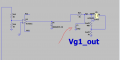
Hello crutschow, when i measured the current going into ref pin i got 2uA as shown below.
Where exactly can i see the problematic current in the circuit?
Where in the datsheet can i see the Iref and Ianode currents needed for proper functioning?
even in the 1K 2K case which you say is problematic I have 2uA, so why its bad?
Thanks.
LTspice file is attached.
1727880485572.png
1727877748974.png
 

Attachments

Last edited:

crutschow

Joined Mar 14, 2008
38,316
Where exactly can i see the problematic current in the circuit?
The current goes through the parallel value of load2 and load3 resistors, and thus slightly affects the voltage at the Ref input, depending upon that parallel value.
even in the 1K 2K case which you say is problematic I have 2uA, so why its bad?
I was showing the effect of changing them to 10k and 20k, as ronsimpson suggested.
The effect for using 1k and 2k would be 1/10th of the voltage I calculated, or 2.7mV.
Where in the datsheet can i see the Iref and Ianode currents needed for proper functioning?
Below is from the data sheet for the minimum cathode (to anode) current for regulation:
The Iref current is shown in the data sheet value you referenced.

1727881382952.png
 

Thread Starter

yef smith

Joined Aug 2, 2020
1,445
Hello, those resistor are in series why you said they are in parralel?
Where do see the current junction what "resistance" you see at the ref port?
Is there a way Icould calculate the shift in the result based on the resistors value.
Thanks.
1727883297069.png
 

crutschow

Joined Mar 14, 2008
38,316
Hello, those resistor are in series why you said they are in parralel?
Where do see the current junction what "resistance" you see at the ref port?
Yes they are in series from the anode to ground, but from the Ref input viewpoint, there is one resistor to ground and one to the anode which makes them appear to be in parallel.
Is there a way Icould calculate the shift in the result based on the resistors value.
Of course.
The shift in the apparent Ref voltage is the equivalent (parallel) resistance at the Ref input times the Ref input current.

You need some additional study of parallel resistance and Thevenin equivalents, if you don't understand the above.
 
Last edited:

MrAl

Joined Jun 17, 2014
13,667
Hello, those resistor are in series why you said they are in parralel?
Where do see the current junction what "resistance" you see at the ref port?
Is there a way Icould calculate the shift in the result based on the resistors value.
Thanks.
View attachment 332905
You can avoid some of the theory if you just do a network analysis.

Here is an equation that relates the various variables (see attachment):
9.97b-4*Rs*R2=-3.0b-6*R1*R2+Vs*R2-6.0b-6*Rs*R2-2.5*R2-2.5*R1-2.5*Rs

This assumes some common specs:
1. The reference voltage is 2.500 volts.
2. The reference current is 3ua (it's something like 2ua to 4ua so I used the mid value of 3ua to make it simpler).

That equation can be solved for either R1, R2, Rs, or Vs.
If we solve for Vs given R1=1k, R2=2k, and Rs=1k, we get:
Vs=6.006 volts (that's a minimum for proper regulation).

I'll double check that equation a bit later too, and go into more detail if you like. Have to run for now.
 

Attachments

MrAl

Joined Jun 17, 2014
13,667
Hello, those resistor are in series why you said they are in parralel?
Where do see the current junction what "resistance" you see at the ref port?
Is there a way Icould calculate the shift in the result based on the resistors value.
Thanks.
View attachment 332905
Hello again,

Here is a more complete picture of what is going on.

First, the difference between using 10k and 20k vs using 1k and 2k is about 2.3 percent. That means the voltage will change by about 2.3 percent if you go up in value for the 1k and 2k resistors.

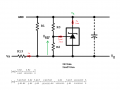
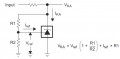
Second, here are a couple formulas for calculating Vk and the minimum Vs (source input voltage). These formulas are written in terms of the unsigned voltages because they are both negative and it's simpler to think of a voltage increasing or decreasing when its value is unsigned.

If you do not like dealing with the Iref input requirement, then just imagine it as 0.000 amps and place a resistor in parallel with the input Vref. The resistor value will always be 833333 Ohms for an Iref requirement of 3ua. For calculating with some other trial Iref, the value will be Rp=2.5/Iref, which is simply the reference voltage for this device (2.5v) divided by the reference current you want to check. This makes it a little easier to calculate Vk as well as imagine how this value comes about, as then it becomes just a voltage divider problem with a constant 2.5v output and where we just want to calculate the input source voltage for that divider.

The data sheets vary a little on what the minimum cathode current is, the highest seems to be 1ma so that's what I used for calculating the minimum source input voltage Vs. It could be less in practice so the unsigned value for Vs could go down meaning less input required in practice. Usually though we want to look at worst case so I used 1ma.

See the attachment for the circuit and the formulas. The formulas are simpler when we hold the two currents at a constant value so it's easier to calculate the minimum Vs requirement. The formulas with no restraints like that are more complicated so I did not post them but if you would like to see them I can post them also.
Note again those voltages are both negative.

Another little thing to note is that the Vref voltage with the negative output circuit is not longer Vref referenced to ground, it is Vref referenced to the output voltage Vo. This is indicated with the green arrow. It's still 2.5v, but it has to be referenced to Vo now because of the different topology than that used for the positive output circuit.
 

Attachments

crutschow

Joined Mar 14, 2008
38,316
the difference between using 10k and 20k vs using 1k and 2k is about 2.3 percent. That means the voltage will change by about 2.3 percent if you go up in value for the 1k and 2k resistors.
Where do you get 2.3%?
In my post #4, I calculated about 1% with 4µA of Vref current.
If you do not like dealing with the Iref input requirement, then just imagine it as 0.000 amps and place a resistor in parallel with the input Vref. The resistor value will always be 833333 Ohms for an Iref requirement of 3ua.
By parallel, I assume you mean from the Vref input to the anode.
 

MrAl

Joined Jun 17, 2014
13,667
Where do you get 2.3%?
In my post #4, I calculated about 1% with 4µA of Vref current.
By parallel, I assume you mean from the Vref input to the anode.
Hi there,

Thanks for the reply if I made a mistake I certainly want to know about it. I will go over my calculations soon.
It could be that we calculated the variation at different nodes. Which node did you calculate the 1 percent at?

Yes parallel to Vref (the actual voltage not that pin alone), and Vref does connect from the Vref input pin on the chip to the anode pin of the chip which is normally ground. It makes the calculation a little simpler if we replace Iref with a resistor like that because then we just have parallel resistors which is easy to deal with. I just calculated 2.5/Iref where Iref is the value taken for the reference current, which is the midpoint value on one of the data sheets (I noticed some of the data sheets vary themselves a little here) for the typical current draw for that pin.
 

Thread Starter

yef smith

Joined Aug 2, 2020
1,445
Hello, I have made a configuration for -2.5V.
As you can see in the photos and attached LTSPICE files.
My currents are 1uA in the Iref and 9 mA to the I_anode=is it a good resistor configuration to create -2.5V?
Thanks.

1728066720415.png
1728066756922.png
1728066781325.png
 

Attachments

MrAl

Joined Jun 17, 2014
13,667
The Vref pin.
Hello,

Oh, that's interesting, but why would you expect Vref to change, or do you mean the pin itself in the negative output circuit?
The voltage on the pin itself referenced to ground is actually Vo+2.5 volts in the negative output circuit.

I calculated the minimum input voltage required to maintain regulation not the Vref pin voltage. Making the resistors 10 times greater than in the original schematic changes the minimum input voltage required. It came out to 2.3 percent.

For the negative output voltage Vo, I calculate that to change by about 0.72 percent which is a little less than 1 percent. It goes slightly more negative with the larger resistors.

This is of course when holding Iref equal to 3ua and the voltage between the Vref pin and anode to be 2.5 volts.
 

MrAl

Joined Jun 17, 2014
13,667

Thread Starter

yef smith

Joined Aug 2, 2020
1,445
Hello , I need to tune my voltage around this value , for tuning I do need two resistors.did my currents in post 16 are ok ?
Thanks .
 
Top