Tips on de-soldering components off board which soldered on both sides

Thread Starter

Yami

Joined Jan 18, 2016
354
Hi guys, could you share tips on how to de-solder components of board which is soldered on both sides. Mainly I have trouble with de-soldering IC's rather than components. I tried solder suckers, wicks -what only worked for me is heating and pulling but that sometimes causes the solder pads to lift or the trace to lift.
What temperature would you recommend having the iron set at?

Thanks in advance for the help.
 

Ya’akov

Joined Jan 27, 2019
10,234
The problem with something that has a lot of pins is keeping them all liquid at once. As @narkeleptk mentioned, hot air is the easiest method. A hot air station can be very cheap, rhoda is an example: https://www.amazon.com/Tek-Motion-Display-Soldering-Station/dp/B01MR2IWBN/

The “858D” is a generic station, you can find them all over. Do check the reviews for the one you are buying, they vary in quality especially at the low end.
 

Thread Starter

Yami

Joined Jan 18, 2016
354
Thanks for the response @narkeleptk , @Yaakov - I didn't know about the heat gun solution, I thought it was only used for surface mount components. So it should work with through hole stuff? and do I need to heat it from the bottom only or the top as well?. I have been saving up to buy a hot air station :)


@AlbertHall - neat idea.
 

Ylli

Joined Nov 13, 2015
1,092
You can heat from either the top or bottom, depending on what other components are where. The leads/solder/plated holes act as heat conduits to get the solder to flow on both sides.

Without the heat gun, you can be successful using solder wick, but it takes practice.
 

Thread Starter

Yami

Joined Jan 18, 2016
354
You can heat from either the top or bottom, depending on what other components are where. The leads/solder/plated holes act as heat conduits to get the solder to flow on both sides.

Without the heat gun, you can be successful using solder wick, but it takes practice.
Ahh thanks, solder wick only from the bottom or top as well? When I was using the solder wick I only used it on the bottom and then I noticed the solder flowed on top aswell I used the wick to take some off the solder from the top too, but that's not always possible depending on the component placement.
Do you have the iron set at a higher temp when dealing with double sided solder joints? I remember someone saying that.
Thanks
 

Ylli

Joined Nov 13, 2015
1,092
Whether to take the solder off the top vs trying to get it all from the bottom... you might need to try both routes, depends on the clearances in the through-hole. You need solder in the hole to get good heat transfer, so sometimes the solder wick actually works better when you first add solder to the joint. I would typically use a higher temp setting to try and get 'all' the solder to melt before it started flowing into the wick.
 

Ya’akov

Joined Jan 27, 2019
10,234
To be clear, when using hot air on through-hole components, you are going to have the most success by removing as much solder as you can first. The hot air then only needs to melt the tiny bits tacking the part into the holes. Plates through holes can make desoldering very tough.
 

dl324

Joined Mar 30, 2015
18,326
Mainly I have trouble with de-soldering IC's rather than components.
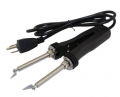
I'd give one of these a try:
upload_2019-4-21_19-33-26.png
I bought one with several larger tips with the intention of using them to remove DIP IC's.
upload_2019-4-21_19-35-20.png

If you don't intend to salvage the DIP IC being removed, you can cut all leads from the body and deal with them one at a time. Just make sure the solder is completely melted, or you can lift pads and pull out through hole plating. You can use a wet toothpick, or something similar, to clear any solder out of the holes.
 
Top