Timer for shower pump.

Thread Starter

Pader

Joined Jul 17, 2010
31
A 220 Ohm resistor at R2 simulates at 14,85V (without load) and provides 5.58V at a 6V relay coil when energised. Thank you for the pulse circuit but am I correct that it provides a positive pulse? As I understand the circuit diagram, the switch grounds the circuit, that is it should be negative going. The power supply that I am using is a laptop supply at 19V, 4.74A and should therefore be fairly stable.

Would it be possible to have a negative going pulse using the spare contacts as in circuit 2 then I would have primary control using circuit 2 and the over run provided by circuit 1? Also, is it possible to cascade two further circuit 1's to provide a delay then a further activation of the pump.
 

Alec_t

Joined Sep 17, 2013
15,121
Thank you for the pulse circuit but am I correct that it provides a positive pulse?
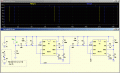
It provides a positive-going pulse when the switch is closed. You would suppress that by using a diode from 'trig' to the positive rail, so the 555 would be unaffected. More importantly it provides a negative-going pulse (12V >> ~1V, as shown in the plot) when the switch is opened. That pulse triggers the 555.
Yes, you can cascade 555 circuits, using similar pulse circuits to the one in post #20, to give further timed periods. Here's how (component values are merely examples to demonstrate the principle) :-
Cascaded555s.gif
 

Thread Starter

Pader

Joined Jul 17, 2010
31
Hello Alec,
I have been playing around with the various circuits that you and others have kindly suggested but eventually went back to the KISS principle and used the flip-flop time using a relay as in post 19. I realised afterwards, that I only had to use one follow up run on after the relay had reset. I bought some of the modules that I mentioned in post 15 and found that if I used just one of them, it could be set to have a 5 minute turn on delay then turn on the relay for around a further 15 seconds which appears to be about right. I may increase the turn on delay of the module at a later date to make sure that all of the water has drained off the shower walls and collected at the outlet.

However, in use, I have found another possible problem. The pump is of the DC impeller type and although the makers suggest that the inevitable hair from showering will not bother the pump, I did once have a problem with the pump seizing up. I found that it was quickly solved by reversing the polarity of the pump for a short while to clear it. Which brings me to another problem. It is inconvenient if the pump seizes when I am in the shower as my first indication that it has occurred is when the shower tray starts to fill with water (it is a very shallow, low height tray) and I have to get out, soaking wet to clear the blockage. I am also worried that the resultant surge will either damage the pump or the power supply (or both).

Do you, or any other kind soul here know of a SIMPLE (I am not at all knowledgeable) method of detecting the current surge to the power supply that will operate an intermediate DPDT relay to reverse the polarity of the pump automatically for around 5 seconds?

I forgot to mention, I now have a 24V, 90W laptop power supply as I found that the 18V version did not allow the pump to clear the water quick enough if I turned the shower full on.
 
Last edited:

Thread Starter

Pader

Joined Jul 17, 2010
31
I recommend solving the problem mechanically with a filter/strainer on the inlet, instead of with electronics.
It is not possible to fit a strainer, the outlet is a purpose built unit for low height shower trays and only has a 15mm outlet to the pump.
 

wayneh

Joined Sep 9, 2010
18,111
Any chance to see a photo?

Current can be detected by two common means: 1) A low ohms resistor will show a voltage of a few mV across itself. If that mV rises above a preset reference, a comparator will trip and control a MOSFET which in turn controls a relay or such. 2) A Hall effect sensor replaces the shunt resistor. This is non-invasive to the circuit, so a tad more elegant. But either can work. You could also trigger off of a flow rate sensor or off a ∆P sensor, but I think those would not be as simple.
 

John P

Joined Oct 14, 2008
2,063
You could put the strainer near the pump rather than in the shower tray--assuming there aren't space constraints there. But then you'd have to be willing to look at the strainer occasionally to make sure it's not filling up.

I'm not convinced that reversing the pump would solve the problem, anyway. What would happen, it would ingest a hairball, eject it again, then suck it back in, back and forth forever?
 

Thread Starter

Pader

Joined Jul 17, 2010
31
Any chance to see a photo?

Current can be detected by two common means: 1) A low ohms resistor will show a voltage of a few mV across itself. If that mV rises above a preset reference, a comparator will trip and control a MOSFET which in turn controls a relay or such. 2) A Hall effect sensor replaces the shunt resistor. This is non-invasive to the circuit, so a tad more elegant. But either can work. You could also trigger off of a flow rate sensor or off a ∆P sensor, but I think those would not be as simple.
I understand roughly what a comparator is but I am afraid that I would have no idea how to incorporate such an item whether it be a resistor or a hall effect sensor. Incidentally, I thought that a hall effect device detected changes in a magnetic field? Please correct me if I am wrong. Perhaps you would be good enough to suggest how the circuit could be incorporated into the pump power feed (24V) that I could play around with in my copy of 'Livewire' simulator?
 
Last edited:

Thread Starter

Pader

Joined Jul 17, 2010
31
You could put the strainer near the pump rather than in the shower tray--assuming there aren't space constraints there. But then you'd have to be willing to look at the strainer occasionally to make sure it's not filling up.

I'm not convinced that reversing the pump would solve the problem, anyway. What would happen, it would ingest a hairball, eject it again, then suck it back in, back and forth forever?
The pump in question has quite a high flow rate (8 lpm) and would not normally allow individual hairs to accumulate into a 'hair ball' as the outlet pipe is too small to allow to large a mass of hair to go through it. I assumed that it might have been hair that caused the seizure but it may, just as easily, have been a small piece of detritus from elsewhere that jammed the impeller momentarily but freed itself when polarity was reversed for a short period. The pump input from the 15mm waste goes through a 30mm trap/reservoir and then into the pump. There is a similar trap/reservoir on the outlet side too which is connected in turn into a 40mm waste pipe. I should imagine that any piece of detritus that can go through a 15mm pipe would normally fit between the impeller blades unless it should be in exactly the right position to be between an impeller blade and the housing. I am betting that repeated reversals of the pump would eventually move the detritus to a position between impeller blades and hence out of the pump.

In any case, the pump is in the bottom of a cabinet at floor level and as I mentioned at the start of this thread that I am disabled; manual clearance of a filter other than in the tray outlet would be extremely uncomfortable for me. As the tray outlet is not customisable to incorporate a filter, that too is a moot point.
 

wayneh

Joined Sep 9, 2010
18,111
Perhaps you would be good enough to suggest how the circuit could be incorporated into the pump power feed (24V) that I could play around with in my copy of 'Livewire' simulator?
We're talking about 24V DC, right?

A MOSFET is a type of transistor well suited to switching a large DC load like a pump. You can compare it to a relay, which is another approach to switching power. Relays are great for infrequent switching of AC power, for instance. A MOSFET has some advantages; it needs almost no current to operate (a relay needs current to energize its coil, to make an electromagnet), it can be switched incredibly fast and it lasts forever because it has no moving parts. Oh, and MOSFETs are very cheap.

So picture your pump. Place an N-channel MOSFET between the ground line of the pump and ground, so that the MOSFET is switching the ground return line. (A P-channel MOSFET could be used for switching the +V line to the pump, but let's forget about that.) The "drain" pin of the MOSFET faces your pump, the "source" pin goes to ground, and the "gate" pin goes to a controller to be described later, one that produces a signal that is either "off", 0V compared to ground, or "on", +10 to +15V. When the MOSFET is turned on, it presents almost no resistance and current flows in the pump. When the MOSFET is turned off, it presents a very high resistance and no current flows.

Your pump is an inductive load and that means it can produce a high voltage at the instant it is shut off. To protect the MOSFET from that pulse, you place a diode across the 2 poles of the pump in "reverse bias", an orientation that passes no current in normal operation, only when the spike is generated.

Now you need a a control signal for the gate of the MOSFET, one that is 0V or +10.
 

wayneh

Joined Sep 9, 2010
18,111
Aww nuts, you want to reverse the pump, not just turn it off. Well everything above is true, but not enough. You need a thing called an H-Bridge. This is an arrangement of MOSFET switches that can reverse the polarity of the power to the pump. I would look on e-bay for an H-bridge motor controller with ratings well in excess of your motor's needs. (You want a good safety factor, and also to make up for some exaggeration on the part of the seller.) Other folks here may have some recommendations for you.

Much like the single MOSFET switch I described above, your H-bridge will need a control signal. You'll want forward, neutral (off) and reverse. You do NOT want to switch from one direction to the other without allowing the pump to stop first.
 

Thread Starter

Pader

Joined Jul 17, 2010
31
That is why I thought a DPDT relay was the simplest switching arrangement. What I had intended was that the supply lines went to the NC poles for normal operation then the + and - lines crossed over to the NO poles and the pump fed from the common poles. With this arrangement, the pump is disconnected before polarity is changed. I also thought that by connecting normal operation through the NC contacts there should be no problem with contact arcing and that the changeover would be so infrequent so as not to cause a problem when the NO contacts closed onto the common contacts.

The pump is rated at 2.4 Amps which I presume is the 'start-up' current which will be much lower in operation. The power supply is 24V at 4.7Amps. What has come to mind is that the over-current detector comparator is used to drive a transistor to operate the relay from the incoming 24V supply.

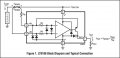
Snap 2015-02-21 at 21.23.10.jpg I came across this circuit using an LT6106 which has a maximum input voltage of 44V. Is it possible to connect a relay with say a 3-6V coil directly to the output? If so, could you suggest suitable resistor values to operate the coil within the parameters required?
 

wayneh

Joined Sep 9, 2010
18,111
No, that's not meant to drive a relay directly. It produces a proportional or analog response, you want a digital on/off output. You could convert the output to on/off using a comparator, but that same comparator could be used directly with the current-sense resistor.

A DPDT relay is a perfectly good alternative to an h-bridge, for this application. You would switch the current in the relay coil with a transistor. A MOSFET or a Darlington transistor (two transistors in one) would be fine.
 

wayneh

Joined Sep 9, 2010
18,111
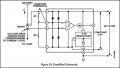
That would work. Like the simpler LM339 comparator (4 in one pkg), its 1mA output cannot drive much on its own but it can control the voltage on the gate of a MOSFET, for instance, which in turn could control your DPDT relay.
 

Thread Starter

Pader

Joined Jul 17, 2010
31
The AD8124 would give me a smaller footprint although more expensive. Am I correct in thinking that the voltage divider resistors can be substituted by a 1K, precision potentiometer to vary the tripping current? If so, what would be a suitable shunt resistor? Also, would I need extra components between the output and the MOSFET? Another thought occurs to me that there should be a slight delay before the relay reverts to normal else the obstruction may not have enough time to clear the impellers.
 
Last edited:

ebeowulf17

Joined Aug 12, 2014
3,307
Don't you also need delays for each reversal, during which you'd interrupt power to the pump? As someone mentioned above, reversing the motor before it's stopped completely puts a lot of stress on the motor and associated electronics.
 

Thread Starter

Pader

Joined Jul 17, 2010
31
As I have mentioned before, I am not very knowledgeable about electronics but what I have read about 'H' Bridge circuits only requires a complete momentary isolation between reversals. This is what using a DPDT relay would do. None that I have read, and please connect me if I am wrong, suggests anything but a momentary isolation between polarity reversals that would cause harm. Also, as I understand things, the relatively low torque of the pump motor should not be a major problem if reversal occurs. What comes to mind is the major torque reversal that occurs in a 'strategic' reversal of drive in an automatic drive car which has to overcome several tons of inertia yet does not rip out the transmission.

Having said that, yes, ideally it would be a good practice to insert a delay before each reversal to reduce torque pressure to the pump motor but I am less concerned with that as it will, hopefully, occur very infrequently and to introduce delays in both directions would unnecessarily complicate the circuit. My first inclination would be to worry about the obstruction causing a repetitive cycle of the relay because the obstruction is not clearing the impeller of the pump despite whatever direction it is turning.
 

Thread Starter

Pader

Joined Jul 17, 2010
31
Thanks to everyone who has tried to help me. Contrary to my earlier protestations about using Arduinos, I overcame my earlier reticence about using micro controllers since I came across the 'Genie' range based on PIC microprocessors but also include a ready made circuit board and, most importantly, a free assembly programme which writes the routines to the preloaded PIC 16F88 simply by simple selection of functions just like a 'flowchart'. With it, I was able to use the (up to) 8 darlington outputs to directly drive relays for the pump together with all necessary timing requirements.

I had a great deal of help also from Dave Johnson who used to run the discovercircuits.com website and did most of the refining to a finished circuit that now turns the pump on and off as required with the required timing sequences.

Once again, many thanks to all that contributed to help me in my minescule knowledge of electronics.
 
Top