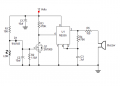
Timer Didnt work (Fridge Alarm Door)

Alec_t

Joined Sep 17, 2013
15,121
Just because a simulator with perfect components shows a circuit functioning is not a verification that the circuit will work in the real world. And, given that the complaint is that the alarm starts immediately tends to imply that it is more than a time constant issue.
Agreed, on both counts.
This must be a very special simulator in that it can make even incorrect circuits function correctly.
LTS and I don't believe the circuit is incorrect (apart from a time-constant tweak), if wired exactly as shown in the schematic. However, we don't as yet have enough clues to know if there is a wiring error or not. It would be helpful to know what are the min and max voltages reached on C1, and also have confirmation that pin 6 (Thr) of U1 is actually conected rather than floating. If the circuit is assembled on a breadboard, wiring errors and poor connections are common culprits.
 

sghioto

Joined Dec 31, 2017
8,634
How is it possible for timer U2 in the circuit of post #1 to function as an oscillator with discharge terminal 7 not connected to the circuit?
As an oscillator it can be wired either way. Pin 3 provides a charge/discharge path the same as pin 7 using a pullup resistor.
 

PeteHL

Joined Dec 17, 2014
580
As an oscillator it can be wired either way. Pin 3 provides a charge/discharge path the same as pin 7 using a pullup resistor.
Thanks. In the texts that I have, configuration of the 555 as an astable always shows pin 7 connected to discharge the capacitor.
 

Alec_t

Joined Sep 17, 2013
15,121
Pin 3 provides charge and discharge paths for the cap. Think of pin7 as a rapid discharge booster. This is handy if you want, say, a sawtoth waveform rather than the usual rectangular waveform, or if you need to sink a fair bit of current.
 

crutschow

Joined Mar 14, 2008
38,526
The circuit should work as shown, so there appears to be a miswire.
I suspect D1 is backwards.

Edit: I do see a likely problem unrelated to the instant start.
Connecting the charge resistor, R2 to the output signal means the first 555 will turn off after a number of seconds when capacitor C1 charges through R2 to above the TH reset trigger point.
If the desire is to keep the buzzer sounding as long as the door is open (after the 20s delay) as I suspect, then R2 should be connected to ground, not the 555 output.
Then the 555 will reset when the light goes out and the LDR resistance goes back high, which rapidly charges C1 to above the TH voltage through D1.
 
Last edited:

Alec_t

Joined Sep 17, 2013
15,121
Connecting the charge resistor, R2 to the output signal means the first 555 will turn off after a number of seconds when capacitor C1 charges through R2 to above the TH trigger point.
Yes. But after some more seconds it turns back on. Rinse and repeat. The on/off alternation might actually be quite useful for drawing attention, plus it extends battery life.
 

crutschow

Joined Mar 14, 2008
38,526
Yes. But after some more seconds it turns back on. Rinse and repeat. The on/off alternation might actually be quite useful for drawing attention, plus it extends battery life.
Yes, that makes sense.
It becomes an astable multivibrator.
 
Last edited:

PeteHL

Joined Dec 17, 2014
580
With regard to the thread starter's circuit shown at his post #1-

With LDR1 not illuminated, presumably this makes voltage drop at the trigger and threshold of timer U1 greater than 2/3 times the supply voltage making output pin 3 of U1 residing at ground. Pin 3 of U1 is connected to the reset pin of U2 and so the oscillator including U2 is disabled.

Illuminating LDR1 causes voltage at pins 2 & 6 to become < 1/3 times the supply voltage sending output pin 3 of U1 high which enables the oscillator including U2. This occurs until the voltage drop across C1 increases to greater than 2/3 times the supply voltage. So when LDR1 is initially lighted, the buzzer immediately sounds. After that perhaps output pin 3 of U1 goes to ground as voltage drop across C1 becomes great enough, but the voltage at pin 3 of U1 is also the voltage supplied to the string R2-R3-C1.
 

sghioto

Joined Dec 31, 2017
8,634
The voltage at pin 2 and 6 will not drop immediately because of the diode. The 20 second delay is the time it takes the cap to discharge through pin 3.
It's a proven design, the TS most likely had a wiring error.
 

PeteHL

Joined Dec 17, 2014
580
The voltage at pin 2 and 6 will not drop immediately because of the diode. The 20 second delay is the time it takes the cap to discharge through pin 3.
It's a proven design, the TS most likely had a wiring error.
LDR1 not illuminated causes output pin 3 of U1 to reside at ground. Thus when LDR1 is illuminated, there is 0 volts at the junction of C1 and R3 (C1 is completely discharged) and the voltage at pins 2 and 6 of U1 becomes the voltage drop across LDR1 minus a diode drop which is less than the lower threshold voltage. This maybe agrees with the problem that the TS was asking about.
 
Last edited:

crutschow

Joined Mar 14, 2008
38,526
LDR1 not illuminated causes output pin 3 of U1 to reside at ground. Thus when LDR1 is illuminated, there is 0 volts at the junction of C1 and R3 (C1 is completely discharged)
No.
If LDR1 is not illuminated, it is a high impedance, so C1 charges to near V+ through R1-D1, with the pin 3 output low.

Then when LDR1 is illuminated, it becomes low impedance, causing the voltage at the left side of the diode to go low.
C1 now discharges through R1 until the TR threshold is reached (the initial delay), setting the output high.
 
Last edited:

MisterBill2

Joined Jan 23, 2018
27,563
It would be simpler to eliminate that first timer and simply have the LDR start charging a capacitor connected to the reset- terminal of IC two. When the voltage would reach the level that no longer asserted the reset command the oscillator will start. Of course, when the door was closed and the light turns off it will take a bit of time for the sound to stop.
OR, consult one of those "555 Timer" Cookbooks that contain exactly the circuit to do the project. But those appeared in the mid 1970's era so they may be a challenge to find.
 

PeteHL

Joined Dec 17, 2014
580
No.
If LDR1 is not illuminated, it is a high impedance, so C1 charges to near V+ through R1-D1, with the pin 3 output low.

Then when LDR1 is illuminated, it becomes low impedance, causing the voltage at the left side of the diode to go low.
C1 now discharges through R1 until the TR threshold is reached (the initial delay), setting the output high.
Okay, yes, you are correct, including C1 discharged by R2 and R3 in series connected to pin 3 residing at ground.

Well, I'm not an engineer, not even a retired one, but my remaining dispute with the design is the output voltage state of the timer is the voltage applied to the string R2-R3-C1 and the voltage across C1 determines the timer's output voltage. This I think at least would produce inconsistent operation?
 
Last edited:

sghioto

Joined Dec 31, 2017
8,634
It would be simpler to eliminate that first timer and simply have the LDR start charging a capacitor connected to the reset- terminal of IC two
That is feasible using a FET to replace the 555 U1, parts count about the same. Circuit below draws appx 6ma on standby but does sound the alarm continuously after the 20 second delay.
1650745038865.png
EDIT: Change R3 to 470K
 
Last edited:

MisterBill2

Joined Jan 23, 2018
27,563
Would that not make the time dependent upon the amount of illumination falling on the LDR.
Certainly the time delay will be dependent on the amount of light on the LDR, no question about that. BUT since the light will be the internal illuminating light of the refrigerator that will be rather a constant value, easily accounted for. In addition, this is not a precision timing application and if the alarm takes 30 seconds to sound , that should not be any problem.
And why in the world make the thing so complex as adding an FET to the circuit??? The reset-bar input is active low, but it is not TTL logic and if it rises a bit slower that is not an issue. Adding components and logic inversions does not offer any improvement. And once again, this is not a precision timing application. Also, with that FET needing to stay conducting to pull down the reset line, that adds a constant draw from the supply. Not a big deal if it is mains powered, but it is if it is battery powered.
 
Top