Timer circuit with three triggers for three durations.

Thread Starter

ipanos

Joined May 7, 2010
41
You could do it with a single 555 and a 4066 or 4016.
Interesting... I guess you mean replacing the SCRs with a 4016, right? So how do you latch it (i.e make it stay on after the button is released)?

Your original circuit...
Sorry, by original circuit I meant the one I based mine on (this one). Basically I saw the problem dannyf is describing here:
let's say that the timer is armed for the longest duration. now if you press S2/S3, the corresponding SCR shorts one of the resistors and shortening the timing.
So, instead of powering the switches from the +ve rail, I am thinking of powering them from an inverter linked to the output. This way if the output is high the switches have no effect. Is this wrong? And if it isn't, is there a point on the circuit that already inverts the output, or shall I create one?
 
Last edited:

Tonyr1084

Joined Sep 24, 2015
9,744
Peanut gallery here:

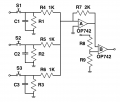
Here's what I came up with:

3 TIMES DELAY.png

Timing circuits S1, S2 and S3 comprise the three different time periods you seek. R1/C1 form the first RC time constant, as does R2/C2 and so on. OpAmp TL742 is a dual op amp. A forms a summing amplifier while B forms a comparator. R8 & R9 form a voltage reference. R7 (2K) and the other three resistors (R4, 5 & 6) form the operational amplification ratio. In this case it's 3:1.

When you push S1, C1 instantaneously (not really, but for the sake of discussion, assume it does) takes a charge. R1 begins bleeding that charge off. Depending on the RC circuit it will take X1 time to decay below a certain point. 741 A amplifies that signal and sends it to the comparator (741 B), where it is compared to a voltage reference. As long as the non-inverting input (+) is higher than the inverting input (-) the output at 741 B remains high. When C1 voltage deteriorates below a certain level, OP741 A drops its output. When that output drops below the R8/R9 reference, output at OP741 B goes low.

Few components makes this an easy build. However, there is one major drawback of this circuit. If (for instance) you set the time constant of S/R/C1 to 4 seconds, the timing period will begin as soon as you RELEASE S1. That means that if you hold S1 for 10 seconds the output at OP741 B will be high for 14 seconds. Same is true of all three timing circuits, the timing countdown begins when you release the button. Also keep in mind that C1 (for instance) does NOT charge up instantaneously. So if you push S1 for a duration less than is necessary for C1 to fully charge then your timing output will be affected by the percentage of the duration of which you pushed and held S1. So short pushing the button will result in an under timing condition while over pushing S1 will result in an overtiming condition.

Depending on how accurate a timing circuit you want this circuit will fulfill that need IF you don't need precise timing. However, if you DO need precise timing then I'd suggest some sort of programmable system, There you can gain accurate timing regardless of how long or short you press S1.

Some resistance values were omitted because it will depend on exactly how long you want timing to be. Also understand that this circuit timing will drift due to temperature changes.

What are you building? Is this a timer for a resistance welder you're making out of an old Microwave transformer?
 
Last edited:

Thread Starter

ipanos

Joined May 7, 2010
41
It looks good and simple.

That means that if you hold S1 for 10 seconds the output at OP741 B will be high for 14 seconds.
This is not a problem at all. Buttons will only be pressed momentarily, this is assured by the nature of the application. Nevertheless, under some circumstances, more buttons might be pressed before timing has finished and those button presses must be ignored. How does this circuit handle multiple button presses?

if you push S1 for a duration less than is necessary for C1 to fully charge then your timing output will be affected by the percentage of the duration of which you pushed and held S1
Well... Buttons will always be pressed momentarily, but for an almost constant duration. In that case I guess you can still get a RC combination for the required timing output.

What are you building? Is this a timer for a resistance welder you're making out of an old Microwave transformer?
This will probably answer most questions. What I am trying to built is a carnival horse racing game such as this one:


Under the center line of each isle there are three switches one after the other inline with the ball's return path. If a ball drops in a red hole, the ball will trigger S1, S2 and S3 (output high for the longest duration). If it drops in a gray hole only S2 and S3 are triggered (output high for medium duration). Yellow only triggers S3 (output high for the shortest duration). This is why I am trying to disable all additional triggers after the first one.
 

Tonyr1084

Joined Sep 24, 2015
9,744
How does this circuit handle multiple button presses?
In this case it will not work for what you want. Each time you push the button you charge the capacitor. That means if the capacitor has drained only 22% and the button is pressed again it will reset the capacitor to full charge.

Well, I tried.

Why not try a counting circuit instead? Since a ball will fall into a red hole, it can pass through three photo sensors (instead of switches), and count up three pulses. The grey ball will fall and only intersect two photo sensors, thus, counting only two pulses, and the yellow will only count a single pulse.

At least, if this were what I was building I think this is the approach i'd take. Since it's a race, each time you pulse three pulses the horse can advance three steps. So the player who consistently gets the most pulses will win the race.

It always helps to know what a builder is attempting to accomplish.
 

Thread Starter

ipanos

Joined May 7, 2010
41
Well, the more I am thinking about it, the more I tend to go towards a counting approach. In this case three photo sensors (or push buttons) will have to be connected in parallel, right? Cos they will all do the same thing, advance a counter by one.

But somehow the counts will still have to be translated in time the output spends high. Because what is called "jumps" or "steps" in a carnival horse race, it is actually time the horse motor spends activated.

The problem is, I do not have the knowledge to design such a circuit, although I understand the principles behind it when explained to me (as you kindly did in you reply #22). I also feel very confident building it at the end, but this is a far as I can go without additional help.
 

Tonyr1084

Joined Sep 24, 2015
9,744
Three 555's can overlap, and thus, fail to move the horse as far as it would if they didn't overlap.

I'm not sure if the motor is a DC motor or a stepper motor. If it's a stepper motor then the counting way is the sure way to go. If a DC motor is involved, then perhaps the counts can charge a capacitor that has an increasing time count the more the buttons are pushed. OR a PWM control that is charged by the number of hits a button takes. As the charge decays the PWM shortens and slows the motor.

Honestly, to design a proper circuit we need to know everything about the system. To simply answer "How to make pulses" can never cover the complete project. It's up to the thread starter to define exactly what is wanted and needed, AND what the parameters are. Voltages need to be known as well as the motors that are driving the racers.
 

Tonyr1084

Joined Sep 24, 2015
9,744
[three 555's can overlap] Don't understand that.
If three 555's are pulsing high and the wave form from one 555 is high when the next goes high - that's the overlap I'm talking about. Suppose that one ball rolls down the 2 point track, followed by a 3 point ball. While the 2 point ball is hitting the last button, it's possible the 3 point ball can be hitting the first button. Because the signal is already high the second pulse is not counted as a positive going trigger.

That's what I'm trying to figure out a solution for.
 

Thread Starter

ipanos

Joined May 7, 2010
41
At the moment, it is an old electromechanical system, very old and ingenious design that worth studying as a novelty item :p . It is beautiful (if you are a romantic), served its purpose for decades and now belongs in a museum as it consists of over 50 3P2T relays and timer relays. I am very confident servicing it, I've done it for years and I do understand it (electromechanical automations is my thing), but it is time to replace all of it now and I think it should become electronic given the chance of replacement.

one ball rolls down the 2 point track, followed by a 3 point ball
Good thinking, but that will never happen. In any case, the possible button scenarios are (exclusively in the order mentioned bellow):

1) No button pressed (the ball does not fall in a hole)
1) S1, S2, S3 (the ball goes in red, long run)
2) S2, S3 (the ball goes in gray, medium run)
3) S3 (the ball goes in yellow, short run)

But even a long run will run out before the ball returns to the player, is thrown again and goes back in a hole (this is taken care from the slope of the return path, underneath the isles. There is no way to hit any two buttons in less than 4 seconds and the long run should be no more than 3 seconds, otherwise the game ends too soon for good (or more likely lucky) players. So, no way to re-trigger while the timer is still running.
 

Tonyr1084

Joined Sep 24, 2015
9,744
I'm wondering now if the first circuit I drew WOULD be better. If you're rolling the balls too fast you could be loosing counts, so your horse might go faster if you score higher but don't try to stuff so many balls down the chute. Since the balls are going to roll across micro switches, each can charge a cap. Even if the cap has not fully drained, charging it again will just make your horse go a little bit further.

And the way the circuit is drawn, if you push S1, the RC circuits of S2 & S3 are acting as parallel resistances that may increase the drain on C1, causing it to time out faster than if S2 and S3 are pressed. So hitting all three buttons would produce the longest motor drive pulse, while hitting only two or just one would produce shorter motor drive pulses. So MAYBE it will work for your purpose.

The only way to know for sure would be to build one of them and see what happens with just one button being pressed, two, and finally all three being pushed.

I wasn't aware that more than one ball was active at a time.
Actually, I'm assuming the player may have up to three balls to throw at any given time. I assume a player could conceivably throw two balls at once as well.
 
Last edited:

eetech00

Joined Jun 8, 2013
4,705
OK to use PB's with 1 NO and 1 OC contact?
Then the NC contact could be daisy chained so only one PB could be active at a time, and it would help simplify the circuit.
 

GopherT

Joined Nov 23, 2012
8,009
In the old days, it was done with relays and a switch that is depressed by the ball weight. the slope to roll the ball off the switch was a different angle for each hole. The steeper the slope, the less the horse would move.
 

Thread Starter

ipanos

Joined May 7, 2010
41
NC contact could be daisy chained so only one PB could be active at a time
Unfortunately, PBs might be pressed sequentially, but never 2 at the same time.

3 separate timers, each output to an OR gate longest pulse wins
I am leaning towards this one now, some more info on this would be highly appreciated, as is any of the valuable assistance I have already received in this topic.
 
Top