Timed DC power supply

Thread Starter

belmar

Joined Nov 10, 2017
9
Hi! I am working on a schematic to power a DC low pressure UVC mercury lamp (GTL-2).
The datasheet says the operating power of the lamp is 10V with 0.22A current.
The clue is to operate the lamp at the beginning with a higher voltage and a higher current to preheat the mercury to achieve
the ignition of an electric arc. After igniting the arc i have to provide the 10V operational voltage.
I suppose that the resistance of the lamp acts like one of an gas-discharge lamp having a cold resistance of 20ohm and a resistance when ignited of 45ohm.
So my idea is to put a small resistor in series with the light bulb to have a voltage divider. The output voltage of the divider
will be compared to a reference voltage with the help of a comparator. If the reference voltage is reached (an the bulb is ignited) the comparator switches a transistor/mosfet to switch a resistance parallel to one of the resistors that are defining the feedback voltage of an DC-DC converter (that powers all) and this will drop the output voltage of the DC-DC converter to a smaller value (operational voltage).

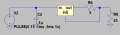
I tried to simulate on spice with no luck.
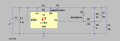
pic.png
Do someone have an other idea to ignite and operate this UVC lamp?

What are my restrictions:
  • 5 Volt DC power supply
  • No use of a microcontroller

 

crutschow

Joined Mar 14, 2008
38,504
A mercury lamp, as is typical of most gas discharge lamps, must be operated from a constant current, not a constant voltage, to prevent excess current in the lamp and damage to the lamp.
This is typically done with a ballast circuit tailored to the particular lamp, that allows only the required current to flow (in this case 0.22A).
This could be a constant-current or current-limit circuit set to 0.22A.
 

Thread Starter

belmar

Joined Nov 10, 2017
9
Thank for the reply! A constant-current circuit set to 0.22A did the job.
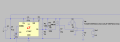
I used a LM317 like in the figure.
Capture.PNG
The voltage on the lamp (R8) drops to 10.5V in the moment the lamp ignites the arc.
The LM317 is getting hot because of the voltage drop trough it.
How could i improve this circuit to have less dissipation?
In future i would drive the hole with a DC-DC stepup converter and i was thinking to change the feedback resistor of the DC-DC (by switching a resistor parallel) to provide a lower voltage after arc ignition.
 

crutschow

Joined Mar 14, 2008
38,504
How could i improve this circuit to have less dissipation?
The only way is to reduce the input voltage to the LM317.
i was thinking to change the feedback resistor of the DC-DC (by switching a resistor parallel) to provide a lower voltage after arc ignition.
That could work if you really are concerned about power.
Is this to be battery operated?

Have you read this about how to power a similar but slightly larger bulb?
 

Thread Starter

belmar

Joined Nov 10, 2017
9
Is this to be battery operated?
I am restricted to a 5V power supply, so a step up converter is essential.
I will try to change the step up output voltage after the voltage drop on the bulb because of the electric arc ignition.
This will reduce the input power of my constant current source to save power and the heat dissipating in the LM317.
Have you read this about how to power a similar but slightly larger bulb?
Thank you for the link and your support!
I will report after my simulations and testing on board.
 

Thread Starter

belmar

Joined Nov 10, 2017
9
Hi,
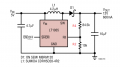
i had a new idea to use a DC/DC stepup converter where i place my bulb as the R1 feedback resistor.
Whit the choice of R2 i determine the constant current that would flow through R1 and R2.
In the feedback pin nearly no current flows in/out.
Simply divide the feedback voltage (1.265V for this LT1935) with the R2 value to get the current.
Capture.PNG
What do you think about this setup?
 

Thread Starter

belmar

Joined Nov 10, 2017
9
If you need a direct current source, then this is
View attachment 139914
Thank you for your help. I am doing it the same way as you do with the LT1935 and it is working! The lamp glows like it should.

What are the benefits of the MC33063A compared to the LT1935 converter?
Did you build the model in LTSpice of the MC33063A by your own or you downloaded it?
 

Bordodynov

Joined May 20, 2015
3,431
Thank you for your help. I am doing it the same way as you do with the LT1935 and it is working! The lamp glows like it should.

What are the benefits of the MC33063A compared to the LT1935 converter?
Did you build the model in LTSpice of the MC33063A by your own or you downloaded it?
Just an older chip should be cheaper. The new chip is certainly better. I downloaded the model from the site ltwiki.org.
 

Thread Starter

belmar

Joined Nov 10, 2017
9
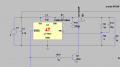
Ok. I am searching a DC/DC step up converter that has a real output disconnect build in with a reasonable price...
If i dont find it i will make a schematic like it follows that disconnect the input output path if the SHDN pin is set to ground.
Capture.PNG
The ground is switched by a mosfet in dependence of a timer 555 timing.
To prevent open circuit (situation where the load/lamp is taken out) i want to make this:
Captu2re.PNG
This schematic is taken from here.
What do you think?
 

Thread Starter

belmar

Joined Nov 10, 2017
9
Thanks for your input crutschow! Now i disconnect the input and it works good.
But there is a new problem incountered.
Do to the need of igniting the arc in the bulb and my dcdc booster working as a constant current source a high voltage is needed at the beginning (igniting process).
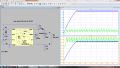
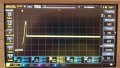
The voltage at the lamp looks as follows after a startup.
U_Lampe_Kaltzündung.jpg
It took approx 1 second to ignite the mercury arc and then the voltage drops afterwards to the desired operational voltage.
So i have a maximum of 25V at the lamp. That equals to 7.5 Watt when considering 0.3A of constant current with the dcdc booster.
(i changed the lamp bulb, this bulb is a little bit powerfuller)
Adding the not perfect efficiency of the booster i have a 2.5A need at 5V at the main input of the whole circuite to ignite the bulb (12.5W).
I want to drive everything with an USB Wall adapter as power supply and the most give only 2A at 5V.

What could i do to resolve this problem?
I could raise the constant current, but i dont know how sensible a mercury lamp is to a higher current flow then the current written in the specs... will it decrease the life time?
 
Top