Thyristor keeps turning on...

sghioto

Joined Dec 31, 2017
8,634
If the design is using 3 comparator circuits isn't there 1/2 of a LM393 not being used?
If so how are the unused inputs connected or are they not connected?
 

Thread Starter

Vilius_Zalenas

Joined Jul 24, 2022
192
Update,

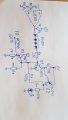
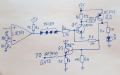
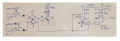
I moved to the NPN and PNP transistor latch configuration (circuit bellow), also added some series 1N4007 diodes to make the latching transition harder... This configuration lights up the red led, and keeps it shining even after the overcurrent condition is gone. So the Q1-Q2 parts seems to be working alright (this time I face no non-linearities with the comparator, there are no undefined voltage zones.) But it would be almost too good to be true...

I face a problem with the MOSFET latching. When there is no overcurrent event, the IRF9540 gate sits at 0 V as it should be...

When the overcurrent event is triggered, I get only around 0.2V on the mosfet gate (so as across the R8 resistor of 1K.) I verified my Q3 is getting 4.5V at the collector. I also verified that I am getting 0.78V across my R9 of 11k when the overcurrent is triggered. In other words, voltage on the base of Q3 is just what I would expect for a PN junction of a transistor. And I still get only around 0.2 V on the emitter of Q3 when the overcurrent event is triggered. I changed the Q3 to another 2N2222 transistor with a hope, that one was defected, but brand new 2N2222 behaved just the same. I also tried disconnecting the IRF9540 gate, but without any load, I got same 0.2V at the emitter. It is pure magic, how can 2 transistor sharing same base (Q1 and Q3) behave differently to a same base signal (Q1 seems to be working just fine.) Any ideas?
 

Attachments

ElectricSpidey

Joined Dec 2, 2017
3,336
Two transistors sharing a base connection is not as straight forward as it seems.

First thing is they now have to share the drive current.

Second is one is common collector and the other is common emitter.

And so forth...
 

Thread Starter

Vilius_Zalenas

Joined Jul 24, 2022
192
If you want to keep your design try this mod. Add R10 and change values of R5 and R7. Without R10 I'm surprised you haven't damaged Q1 and Q2. Did you try my suggestions in post 62
View attachment 290137
No, I have not tried 62 circuit.

I removed the Q3 and got the mosfet gate working properly (removed all series diodes and connected mosfet gate via pulldown resistor at the emitter of Q2) It seems my circuit is getting ready for deployment once again (latching is completely stable, no undefined voltage regions). The only problem is that when the overcurrent latch activates itself, my Q1 is getting really hot (No current is flowing through the mosfet, but my Q1 is getting so hot that after 30s it is hard to keep the finger on the transistor, after around 50s, smoke starts to come out. Q2 gets barely warm) Was it because of the resistor values?
 

Thread Starter

Vilius_Zalenas

Joined Jul 24, 2022
192
No, I have not tried 62 circuit.

I removed the Q3 and got the mosfet gate working properly (removed all series diodes and connected mosfet gate via pulldown resistor at the emitter of Q2) It seems my circuit is getting ready for deployment once again (latching is completely stable, no undefined voltage regions). The only problem is that when the overcurrent latch activates itself, my Q1 is getting really hot (No current is flowing through the mosfet, but my Q1 is getting so hot that after 30s it is hard to keep the finger on the transistor, after around 50s, smoke starts to come out. Q2 gets barely warm) Was it because of the resistor values?
Yup, seems the resistor update solved the heating problem. Alright, thank you one more time
 
Last edited:

Thread Starter

Vilius_Zalenas

Joined Jul 24, 2022
192
Just a quick side question... Pretty sure I would solve it myself sooner or later, but I guess you may see the problem straight away.
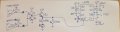
If there is no overcurrent or undercurrent condition, I want to light up my green led and get a 1-1.5 s duration single high state signal for further circuitry. For that signal I am using 555 timer. The signal should come only once, no matter how long the green led is on for, and it should come only when the green led is on. You dont have to analyze the 555 part, but my problem is that with a reset configuration like in the circuit my 555 never gets activated... My green led works perfectly, so I am definitely getting solid signal through the Q2 transistor, also my timer works just as good if I pull the reset to VCC (my timer outputs the required signal, but pulling reset to VCC is possible only for testing.) The datasheet says maximum reset pin current can reach 1 mA, so 500 Ohms across 4.2V (it is verified voltage on the RESET pin) should pull the reset up when Q2 is opened. But it doesnt... Any observations?
 

Attachments

Last edited:

Thread Starter

Vilius_Zalenas

Joined Jul 24, 2022
192
Move R7 to the emitter of Q2.
View attachment 290172
Yes, after the last post I tried this configuration. Also I tied RESET straight to VCC. Unfortunately, a large undefined voltage region appears at around 30-50 mA when both blue and green diodes turn on... Is the TRIG input drawing so much current? Because the LM555 has no other connection with the comparators...
 
Last edited:

Thread Starter

Vilius_Zalenas

Joined Jul 24, 2022
192
Not sure what that means.
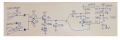
Can you post a complete current schematic including the OP290, comparators and this 555 circuit?
I will post the whole circuit tomorrow. What I meant was LM555 is not an object to comparator and opamp measurement. LM555 is just an output indicator of the 30-70 mA. LM555 is not involved in any feedback of the comparators, how can it influence the measurements?
 

Thread Starter

Vilius_Zalenas

Joined Jul 24, 2022
192
If you remove the 555 circuit but use Q1 and Q2 for the green LED do the comparators function correctly?
Yes, exactly. Even If remove the connection from transistors to the TRIG, and just tie TRIG via 50k/2.2uF RC network to VCC. What I get is perfectly working comparators with sharp cut off edges and correct latching (and of course the signal at the 555 output independently of the current)
 
Top