Thyristor keeps turning on...

MisterBill2

Joined Jan 23, 2018
27,645
My idea was to delay the turn on of the 5 volts for the comparator pull-up and the pull-up transistor shown in post #1. It seems that the problem willbe solved if the SCR is not triggered befor the comparator is stabilized. So just an initial turn-on delay of the +5 for those two points, The emitter resistor/trigger pull-down will need to be a higher value, though.
 

Thread Starter

Vilius_Zalenas

Joined Jul 24, 2022
192
Alright, I tested and modified your last circuit schematic (removed C1, put 470 nF across R2 and changed C2 to 100 nF), now (I really hope) I can say that I solved it all. I get no initial latch up (tested more than 100 times) and my voltage divider is set correct.

As you may remember, this is only the overcurrent event comparator, I also have 2 additional comparators driving the undercurrent and normal current led indicators. All those comparators are driving leds via 2N2222s, but I noticed there is considerable overlapping region, when 2 leds shine at the same time. My undercurrent limit is set at 10 mA, normal current is 10-100mA, but I get both leds shining in the 9.5-14 mA region (blue led dies at around 14 mA)

Same thing goes with overcurrent. The latch up happens at around 96 mA, but the red led starts to shine at around 84-86 mA, the green led dies only after the latch up. I understand that every component (including the multimeter) has a tolerance, but could this be a result of poor accuracy comparators? Are there any comparators with sharper on-off transition edges (smaller leakage currents)? Thank you.
 

MisterBill2

Joined Jan 23, 2018
27,645
A comparator circuit without any hysteresis, (positive feedback) will usually tend to oscillate at the switch threshold. That will cause an output indicator LED to do just what you describe. Try adding a high value resistor from the output back to the positive input. a value between 470K to one megohm should help.
 

sghioto

Joined Dec 31, 2017
8,634
but I noticed there is considerable overlapping region, when 2 leds shine at the same time.
MisterBill2 is correct by adding some hysteresis.
Since there are three comparators being driven by the output of the OP290 they would need to be isolated.
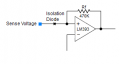
Add a series diode to the + input and Rf. Readjust the reference voltage on the minus input as needed.
The over current comparator already has a series diode (D1) and you could try replacing D2 with a schottky diode like a BAT42
1678549985963.png
 
Last edited:

Thread Starter

Vilius_Zalenas

Joined Jul 24, 2022
192
Alright, I added the feedback resistors (680K were the closest I had, still used 1N4148), now it seems like my circuit is ready for deployment. I really hope I wont need to come back to this thread, but it is so nice to know that there are people like you, that I can trust and rely on... Thank you all again, you saved me....
 

Thread Starter

Vilius_Zalenas

Joined Jul 24, 2022
192
MisterBill2 is correct by adding some hysteresis.
Since there are three comparators being driven by the output of the OP290 they would need to be isolated.
Add a series diode to the + input and Rf. Readjust the reference voltage on the minus input as needed.
The over current comparator already has a series diode (D1) and you could try replacing D2 with a schottky diode like a BAT42
View attachment 289536
Sadly, I have to come back to this thread one more time... I was asked to adjust the overcurrent event limit. I was asked to make the overcurrent latching point at 70 mA, or in other words around 1.89V (sense resistor is 0.5 Ohm, the opamp gain is 54, so 1.89V depicts 70 mA.) I have recalculated my voltage reference divider (taking into account the diode drop, which was measured at around 0.235V (1N4148)) So 1.65V should have been the latching point. However, when I put those 40k and 80k resistors just like in the schematic, I was latching the circuit at around 35 mA... Could it be a mistake in the calculations, or some mysterious leakage parameter? I took out the R5, and soldered a 100k (linear) pot instead to adjust the reference manually.

I applied constant 70 mA load and started searching for the latching point by adjusting the pot... This is where the magic starts...

When I find a latching point, at constant 70 mA, that latching point becomes 35-40 mA latching point, when the circuit is turned on again (same resistance value)

If I do very tiny increments on my pot, and keep turning the circuit on and off, waiting until it latches, there is no 70 mA latching point at all. I can adjust the pot so that the circuit latches anywhere in the 0-50 mA region and I can make the latching point 90 mA+. There is no 50-90 mA latching point region. 100k pot may sound like a very crude device for this, but I repeated both methods 30+ times turning the pot fractions of a millimeter every time. Am I cursed, or should I just get an Arduino Nano and latch the circuit digitally, according to the ADC read of the Opamp?
 

Attachments

sghioto

Joined Dec 31, 2017
8,634
Is that schematic in post #5 accurate? If so I see a gain of 92 for the second stage of the OP290. (9.1K / 100) +1 = 92.
One thing to check is the voltage reading on the output of the LM393 after powered ON before any latching occurs.
 
Last edited:

Thread Starter

Vilius_Zalenas

Joined Jul 24, 2022
192
Is that schematic in post #5 accurate? If so I see a gain of 92 for the second stage of the OP290. (9.1K / 100) +1 = 92.
One thing to check is the voltage reading on the output of the LM393 after powered ON before any latching occurs.
I have adjusted the gain to 54 since post #5. But everything else is the same. I also adjusted the other 2 voltage references on the comparators (undercurrent and normal current event ones), they are working perfectly, so I guess there is no problem with the gain...

I have verified that the negative terminal of LM393 is getting 1.66V reference.
When the current is way under 30 mA, the output of the overcurrent LM393 is 0.24V, I guess that is normal.
When the current increases, the voltage on the positive terminal increases to around 1.15-1.2V and it latches (It should latch only when it is equal to the reference...)

After the latching event, voltage on the positive terminal stays constant at 2.9V
 

Thread Starter

Vilius_Zalenas

Joined Jul 24, 2022
192
Does the voltage on the minus input stay steady at 1.66 volts?
Possible some noise from the OP290, try a 100nf cap across R1.
,, Does the voltage on the minus input stay steady at 1.66 volts? "
Yes, it does.

Noise from the OP290? I will try... However, this is a precision opamp, it can not generate such noises. Moreover, I have diodes from both sides, what could possibly cause 250 mV+ noise?
 

MisterBill2

Joined Jan 23, 2018
27,645
The diodes are at least part of the problem!! They are EXTREMELY NON-LINEAR, which is what I see as the problem. Replace D1 with a resistor, 10K should work well, and replace D2 with a much higher value resistor , at least 0ne megohm.
Only a small amount of hysteresis is needed, What is created by the two diodes is an entirely different function. There is no need for diode isolation , although a slight adjustment of the voltage divider might be required. Consider that the voltage at the inverter output is zero until it is triggered, and so the effect will be only from the 1 Meg resistor load, (not much).
 

sghioto

Joined Dec 31, 2017
8,634
D1 was required for isolation because there are three comparator circuits with hysteresis driven by the output of the OP290.
Noise not generated by the opamp but from some source that is amplified by the OP290.
 

Thread Starter

Vilius_Zalenas

Joined Jul 24, 2022
192
D1 was required for isolation because there are three comparator circuits with hysteresis driven by the output of the OP290.
Noise not generated by the opamp but from some source that is amplified by the OP290.
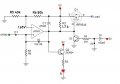
Alright, I do see a fair point with the diode non-linearity problem, but I can not omit the diodes also... I think I have squeezed everything out of this circuit... What do you think, if put an additional opamp buffer after the LM393 output (circuit in the attachments). My idea behind that is: LM393 would work in its normal conditions without any latching, the buffer would do the latching, but so to speak in binary condition.... I will either have (relatively) strong 5V signal or strong GND, hopefully, that could latch the circuit more predictably. Before soldering all this, I want to know, what do you think about this circuit...
 

Attachments

MisterBill2

Joined Jan 23, 2018
27,645
An alternative is to use the inverting input to the comparator and then the transistor inverter on the output. Then the hysteresis will be on the non-inverting input, along with the reference. The circuit is becoming ear to complex.
Besides that, the comparator circuits do not need the isolation, that is provided by the 10K series resistor. Try it and see, if the circuit is already assembled it will be simple.
 

Thread Starter

Vilius_Zalenas

Joined Jul 24, 2022
192
An alternative is to use the inverting input to the comparator and then the transistor inverter on the output. Then the hysteresis will be on the non-inverting input, along with the reference. The circuit is becoming ear to complex.
Besides that, the comparator circuits do not need the isolation, that is provided by the 10K series resistor. Try it and see, if the circuit is already assembled it will be simple.
I tried with 10k series and 1.2 Meg feedback resistors. Result was the following: 10K did not isolate the comparator and I was still not getting a stable latching point, in fact, the circuit was hardly latching at all (tried to play with the reference voltage, but I have not achieved anything worth mentioning). Moreover, even with the feedback resistor of 1.2 Meg I was getting my red led to shine really soon (at around 40 mA.)

It looks that latching circuit with 2 diodes worked the best for now, but I still have to solve the stability issue. I am not afraid to add more complicated components to my circuit (except digital design), but I need the stability. Maybe there are some circuit configurations (doing just what described), you could offer? Any other observations, how to improve stability? Thank you one more time...
 

MisterBill2

Joined Jan 23, 2018
27,645
I tried with 10k series and 1.2 Meg feedback resistors. Result was the following: 10K did not isolate the comparator and I was still not getting a stable latching point, in fact, the circuit was hardly latching at all (tried to play with the reference voltage, but I have not achieved anything worth mentioning). Moreover, even with the feedback resistor of 1.2 Meg I was getting my red led to shine really soon (at around 40 mA.)

It looks that latching circuit with 2 diodes worked the best for now, but I still have to solve the stability issue. I am not afraid to add more complicated components to my circuit (except digital design), but I need the stability. Maybe there are some circuit configurations (doing just what described), you could offer? Any other observations, how to improve stability? Thank you one more time...
I did mention that the reference voltage would need a bit of adjusting. and now I am certain that there is some other issue that is not seen, because the circuit with that positive feedback should snap very well. So while I am not able to evaluate the arrangement, I am sure there is some other element that is unknown, but causing a problem.
 

sghioto

Joined Dec 31, 2017
8,634
Agree with MisterBill2. Unfortunately I can't do a lot to help presently as I am traveling in the RV but will try to help when I have more time.
 
Top