Thevenin's theorem in steady state analysis

Thread Starter

rudderauthority

Joined Jul 25, 2011
1
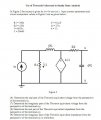
Hello all. I've been working at this problem for way too long (at least 8 hours) and I just seem to be stuck.

I tried doing nodal analysis and didn't get correct answers, with mesh analysis I got stuck and everything I try doesn't seem to be working. I really don't understand how to hand the dern dependent source right in the middle of the problem. Any help would be greatly appreciated!
 

Attachments

narasimhan

Joined Dec 3, 2009
72
You made a simple mistake. Never convert a branch which has a dependent voltage or current. i.e the branch that carries "i1" should remain as it. So you should not change "is" to a voltage source.
 

blah2222

Joined May 3, 2010
582


As the previous poster mentioned, since there is a dependant voltage source reliant on the current i1 passing through R1, it wouldn't make sense to perform a source transformation, but otherwise that may well of helped.

First you need to find the open circuit voltage between nodes, X and Y

1. Dependant current equation:

\(i_{1} = 27 - i_{0}\)

2. Going around the first KVL:

\(-29i_{1} + j7.54i_{0} + 12i_{1} = 0\)

\(-29(27 - i_{0}) + j7.54i_{0} + 12i_{1} = 0\)

\(-783 + 29i_{0} + j7.54i_{0} + 12i_{1} = 0\)

\(i_{0}(29 +j7.54) + 12(27 - i_{0}) = 783\)

\(i_{0}(29 - 12 + j7.54) = 783 - 324\)

\(i_{0}(17 + j7.54) = 459\)

\(i_{0} = \frac{459}{17 + j7.54}\)

3. Open source voltage equation:

\(V_{oc} = -j26525i_{2}\)

4. Going around the second KVL:

\(-12i_{1} + 23i_{2} + V_{oc} = 0\)

\(-12(27 - i_{0}) + 23i_{2} - j26525i_{2} = 0\)

\(12i_{0} + i_{2}(23 - j26525) = 324\)

\(i_{2}(23 - j26525) = 324 - 12i_{0}\)

\(i_{2}(23 - j26525) = 324 - 12(\frac{459}{17 + j7.54})\)

\(i_{2}(23 - j26525) = 324 - \frac{5508}{17 + j7.54}\)

\(i_{2}(23 - j26525) = \frac{5508 - 5508 + j2442.96}{17 + j7.54}\)

\(i_{2}(23 - j26525) = \frac{j2442.96}{17 + j7.54}\)

\(i_{2} = \frac{j2442.96}{(17 + j7.54)(23 - j26525)}\)

\(i_{2} = \frac{j2442.96}{200391 - j450952}\)

\(V_{oc} = -j26525(\frac{j2442.96}{200391 - j450952})\)

\(V_{oc} = \frac{64799514}{200391 - j450952}\)

\(V_{oc} = 53 + j120\)


Now you need to determine the short circuit current (i2) between nodes X and Y. The short prevents current form passing through the capacitor impedance.

Same procedure as last time, you can check these for yourself but here are the equations to save space:

\(i_{0} = \frac{459}{17 + j7.54}\)

\(i_{2} = \frac{12}{23}(27 - i_{0})\)

\(i_{2} = \frac{324}{23} - \frac{5508}{23(17 + j7.54)}\)

\(i_{2} = 2.32 + j5.22\)

\(I_{sh} = i_{2}\)

Therefore,

\(Z_{th} = \frac{V_{oc}}{I_{sh}}\)

\(Z_{th} = \frac{53 + j120}{2.32 + j5.22}\)

\(Z_{th} = 22.96 + j0.05 ~= 23 ohms\)
 

t_n_k

Joined Mar 6, 2009
5,455
I believe there's a short cut in solving the problem.

Notwithstanding there is a dependent source one may still deduce the Thevenin impedance as

Zth=R2||(-jXc)=23||(-j26.526k)=22.999-j0.002 Ω=22.999 @ -0.0496°

That is, one may treat the dependent source as a short for the purposes of finding Zth looking into the XY terminals.

In a similar manner it is convenient to note that

Is=I1+(R1*I1-K*I1)/jXl
Is=I1+(29*I1-12*I1)/j7.54
Is=I1(1+17/j7.54)
Is=27=I1(1-j2.255)

Hence I1=27/(1-j2.255)=10.947 @ 66.08°

Also, given R2 & -jXc form a voltage divider to extract Vth from the dependent source.

Vth=K*I1*[-jXc/(R2-jXc)]
Vth=12*I1*[-j26.526k/(23-j26.526k)]
Vth=(131.36 @ 66.08°)*[0.999 @ -0.0497°]=131.36° @ 66.03°=53.37+j120 Volt

Which agrees well enough with blah2222's values.

More accurate values turn out to be

Zth=22.999983 - j0.0199428 ohms
Vth=53.361583 + j120.03316 Volts
 
Last edited:
Top