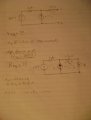
Thevenin equivalent- help

Thread Starter

alamri

Joined Jul 9, 2009
6
Hey guys,
I have a problem solving two of my homework problems..

It's about thevenin equivalent. I get the voltages right on both of them. but I can't get the Rth right for some reason! ( I'm pretty sure it's because both problem have dependant sources).


Please show me how you can get the RTh. Thanks!
 

hgmjr

Joined Jan 28, 2005
9,027
Since the dependent voltage source has a zero resistance you should be able to replace it with a short-circuit.

hgmjr
 

Thread Starter

alamri

Joined Jul 9, 2009
6
But if i combine the two resistors I still get wrong answer! :S I'm really confused, I tried combining them in series and parellel but didn't work!
 

The Electrician

Joined Oct 9, 2007
2,986
Since the dependent voltage source has a zero resistance you should be able to replace it with a short-circuit.

hgmjr
I think it's a dependent current source, hgmjr.

Besides, when you're calculating a Thevenin equivalent, you can't eliminate dependent sources like you can the independent sources.

alamri, do you know the nodal method for solving networks?

Number the nodes along the top edge of the circuit, from left to right.

The top of the 200V source will be node 1, the top of the dependent current source will be node 2, and the output will be node 3.

Can you set up the 3 nodal equations?
 

Thread Starter

alamri

Joined Jul 9, 2009
6
I really don't.
I know that I can work it out by doing the node analysis and the mesh current analysis.. I don't really know what u mean by the nodal method
 

hgmjr

Joined Jan 28, 2005
9,027
It seems that the twist to this problem lies in the presences of the VCCS (voltage-controlled current source). Due to its presences in the circuit, the Thevenin's Equivalent voltage is not a constant but will need to contain a term that account for the this load dependent factor.

As for the Thevenin's Equivalent resistance, a VCCS is a current source and so to calculate the Thevenin's Resistance, the impedance of the VCCS can be replaced by a open circuit.

At least that is my take on this interesting circuit.

hgmjr
 
Last edited:

Ratch

Joined Mar 20, 2007
1,070
hgmjr,

...the Thevenin's Equivalent voltage is not a constant but will need to contain a term that account for the this load dependent factor.
It sounds plausible, but it isn't so. The Thévenin equivalent I worked out previously of 200 volts in series with 1.9 ohms, and no other term, works for all values of resistance you can hang on points a,b.

Ratch
 

Ratch

Joined Mar 20, 2007
1,070
The Electrician,

With it, Rth would be either 1.9Ω or 3.1Ω, depending on how the polarity of Vx is taken.

I think you got it backwards.
I decided to define the polarity of Vx by the direction of the assumed current and the voltage from the common point or "ground". Your point is valid, and it is easy to compute the answer with Vx as negative.

Ratch
 
The Electrician,
I decided to define the polarity of Vx by the direction of the assumed current and the voltage from the common point or "ground". Your point is valid, and it is easy to compute the answer with Vx as negative.

Ratch
But why would you make that decision ('I decided to define the polarity of Vx ... from the common point or "ground".') when the polarity of Vx is indicated on the schematic?
 

Ratch

Joined Mar 20, 2007
1,070
The Electrician,

But why would you make that decision ('I decided to define the polarity of Vx ... from the common point or "ground".') when the polarity of Vx is indicated on the schematic?
That's an easy question to answer. I am used to seeing voltages on a schematic defined as a designated positive value, not a negative one. If the computed value turns out to be negative, then fine, but its designation is still positive. Notice that no matter which way the voltage across Rvx is interpreted, Vx's value proves to be positive. I am also used to seeing a controlling voltage current source (CVCS) with a negative controlling voltage to be written as -0.4Vx or 0.4(v2-v1), which is much clearer. Therefore I thought the bass-ackwards designation of Vx was an error, which I corrected. I hope this answer clears up why I did what I did. It is really the method that the OP was looking for, not the interpretation.

Ratch
 
Last edited:
When I saw the - and + designations on Vx, I thought "this would be an easy thing to lose a few points on." When I saw your answer was the other one (1.9 instead of 3.1), I thought I had messed up, but on checking again, I think the correct answer is 3.1, for the designation shown. Do you agree?
 
Top