Thermostat Circuit Transfer Function

Thread Starter

Sean Kelly 1

Joined Apr 19, 2017
1
I am working on a Control Systems project and I need to come up with a transfer function for a thermostat circuit. I've tried using nodal analysis and Mathematica to solve for a system of 6 equations but I'm not having any luck. Any assistance would be GREATLY appreciated.
Thanks,
Sean
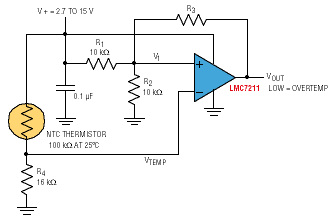
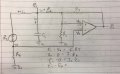
image1 (1).JPG
 

RBR1317

Joined Nov 13, 2010
715
The analysis should be simpler once you realize that the capacitor is just a power supply bypass or decoupling capacitor used to suppress high frequency noise, it is not part of the circuit that needs to be analyzed. Also, the circuit has only two nodes that you can write node equations for. So don't try to solve more than two equations.
 
Last edited:

Jony130

Joined Feb 17, 2009
5,598
But this circuit is using positive feedback only.
So you cannot assume that the non-inverting input voltage = inverting input voltage.
To analyze this circuit you must include the op amp power supply and the opamp positive and negative saturation voltage.

If fact this is a very simple circuit with has two stable output state (try to google Schmitt trigger)
https://forum.allaboutcircuits.com/...ns-but-im-troubled-by-them.64696/#post-444315

The voltage at non-inverting input can by found like this:

First I assumed that the op amp output is at positive saturation (Voh = Eo = Ei - 0.2V ) typical for LMC7211) and solve for non-inverting voltage:

Vp1 = Ei * (R2||R3)/(R1 +R2||R3 ) + Voh*(R1||R2)/(R3 + R1||R2) or we can write a nodal equation

(Vp1 - Ei)/R1 + Vp/R2 + (Vp1 - Voh)/R3 = 0 and solve for Vp

Vp1 = (R2*(Voh R1 + Ei R3))/(R1 R2 + R1 R3 + R2 R3)

Voh = Eo - when op amp output is at positive saturation state.

Or if we assume Voh = Ei

Vpi = Ei *R2/(R1||R3 + R2)

NTC together with R4 form a temperature dependent voltage divider.

And the circuit will change his state only when Vp1 = Vn.

Vn - inverting input voltage = Ei *R4/(R_NTC + R4)

Hence as temperature rise NTC resistance drop, therefore, Vn voltage rises and when Vn ≥ Vp1 the opamp will change his output state (from high to low). The opamp output voltage is negative saturation (Vol = 0.2V).

And again we have to solve for Vp2 - non-inverting voltage when opamp is at negative saturation state.

Vp2 = Ei * (R2||R3)/(R1 +R2||R3 ) + Vol*(R1||R2)/(R3 + R1||R2)

or

Vp2 = (R2*(Vol R1 + Ei R3))/(R1 R2 + R1 R3 + R2 R3)

or if wee assume Vol = 0V we will have

Vp2 = Ei*(R2||R3)/(R1 + R2||R3)

So the circuit will change his state (from low to high ) only when Vn ≤ Vp2.
 
Last edited:

RBR1317

Joined Nov 13, 2010
715
But this circuit is using positive feedback only.
So you cannot assume that the non-inverting input voltage = inverting input voltage.
I had not considered the issue of circuit operation, but if I had checked that the LMC7211 was a CMOS comparator then that would have been a clue.

Nevertheless, the analysis is still accomplished with the same two node equations, and one must assume that the non-inverting input voltage equals the inverting input voltage because these will be the switching points in each case, i.e. when Eo is at its HIGH value and when Eo is at its LOW value.
 
Last edited:

MrAl

Joined Jun 17, 2014
13,704
Hi,

Yes the simple view is that this is just a circuit with two voltage dividers, and the voltage out of each divider is compared to find the switchover points. The second voltage divider has three resistors that's all, and since one of them connects to the output the voltage at VA changes quickly (jumps) when the output switches state.
I have not checked to see if this particular comparator outputs a logic level LOW and a logic level HIGH or just a logic level LOW and an open collector (or open drain). Many comparators have an open collector output during the HIGH logic state so that would mean when the output goes high there is no feedback current through the feedback resistor. Someone could check the data sheet.
 

Jony130

Joined Feb 17, 2009
5,598
Nevertheless, the analysis is still accomplished with the same two node equations, and one must assume that the non-inverting input voltage equals the inverting input voltage because these will be the switching points in each case, i.e. when Eo is at its HIGH value and when Eo is at its LOW value.
Normally when we are dealing with the opamp circuit with negative feedback we assume Vn=Vp and solve for Vout. But if we have only a positive feedback opamp circuit this strategy do not work. We in the first place need to include the power supply limitation and the opamp saturation voltage.
 

RBR1317

Joined Nov 13, 2010
715
Normally when we are dealing with the opamp circuit with negative feedback we assume Vn=Vp and solve for Vout.
Normally when we are dealing with the comparator circuit with hysteresis we assume that Vout is in one of its two states (HI or LOW) and solve for the threshold voltage where Vn=Vp.
 
Top