Thermal analysis in TPS7A3001DGNT

Thread Starter

engr_david_ee

Joined Mar 10, 2023
362
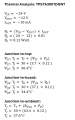
I have some questions regarding thermal calculation for the voltage regulator TPS7A3001DGNT.

\[ P_D = ( V_{IN} - V_{OUT} ) ( I_{MAX}) + (V_{IN} ) ( I_Q) \]

What is \[ I_Q \] in the equation above ?
 

Thread Starter

engr_david_ee

Joined Mar 10, 2023
362
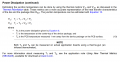
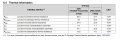
Also, the equation (10) it says.

\[ T_T : is \ the \ temperature \ at \ the \ center \ top \ of \ the \ device \ package.\]

\[ T_B : is \ the \ PCB \ temperature \ measured \ 1 \ mm \ away \ from \ the \ device \ package \ on \ the \ PCB \ surface. \]

Are these both temperatures representing temperatures at power off state ? which can be lab's room temperature ?
 

Attachments

Last edited:

Papabravo

Joined Feb 24, 2006
22,078
I have some questions regarding thermal calculation for the voltage regulator TPS7A3001DGNT.

\[ P_D = ( V_{IN} - V_{OUT} ) ( I_{MAX}) + (V_{IN} ) ( I_Q) \]

What is \[ I_Q \] in the equation above ?
It is the quiescent current required for the operation of the regulator. You can find this value in the datasheet.
 

Papabravo

Joined Feb 24, 2006
22,078
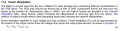
Also, the equation (10) it says.

\[ T_T : is \ the \ temperature \ at \ the \ center \ top \ of \ the \ device \ package.\]

\[ T_B : is \ the \ PCB \ temperature \ measured \ 1 \ mm \ away \ from \ the \ device \ package \ on \ the \ PCB \ surface. \]

Are these both temperatures representing temperatures at power off state ? which can be lab's room temperature ?
No. Those temperatures are when the device is in operation. Neither of those temperatures are the ambient or room temperature.
 

Thread Starter

engr_david_ee

Joined Mar 10, 2023
362
Regarding T_T and T_B, you mean when the device running with full load ? then it will be much higher. If we don't have the PCB, actual hardware then how do we find these temperatures when working on schematic and PCB design ?
 

Papabravo

Joined Feb 24, 2006
22,078
Regarding T_T and T_B, you mean when the device running with full load ? then it will be much higher. If we don't have the PCB, actual hardware then how do we find these temperatures when working on schematic and PCB design ?
You estimate them and provide for some safety margin. You can usually get junction to case or junction to ambient thermal resistances from the datasheet. For example if you have a maximum junction temperature of 125 °C and a thermal resistance of 62.5 °C/watt for junction to ambient and the device is producing 0.75 watts at a room temperature of 25 °C, then your estimated junction temperature would be:

\( 25\;°\text{C} \; +\;0.75(62.5\;°\text{C/watt})\;\approx\;72\;°\text{C} \)

Since this is well below the maximum junction temperature you would be safe in not using a heat sink.

ETA: That does not mean you should put your fingers on it for test purposes since you might still get a NASTY burn.
 
Last edited:
Top