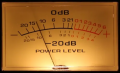
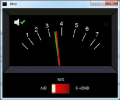
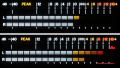
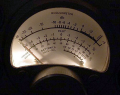
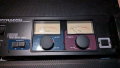
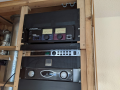
The VU meter...

schmitt trigger

Joined Jul 12, 2010
2,056
Very interesting, thanks for sharing.
When I built my first solid state amplifier, one of the first add-ons was to incorporate a VU bargraph meter employing the venerable LM3916. Not because the amp required it, but because it looked good!
 

Ya’akov

Joined Jan 27, 2019
10,226
One thing that seems to be missing from much of the "content creation" that appears on platforms like YouTube and Instagram is calibration of the audio chain to any standard level.

A simple test tone from the source device that reads 0VU, even on a poorly calibrated but consistently used VU meter will allow for consistent and undistorted signal levels. I haven't seen anyone using a tone, even when they are readily available.
 

Thread Starter

Externet

Joined Nov 29, 2005
2,628
Hi.
The tone being sinewave will yield a something sensible on the scaleless meter (for test/calibration). But audio voice/music/whatever is not a sinewave tone. Then, a diarrhea of "standards" rules. In modern times, audio is not on a 600Ω circuit chain, making the pointer voltage deflection worse, making the meter more of an adorn.
 

Ya’akov

Joined Jan 27, 2019
10,226
Hi.
The tone being sinewave will yield a something sensible on the scaleless meter (for test/calibration). But audio voice/music/whatever is not a sinewave tone. Then, a diarrhea of "standards" rules. In modern times, audio is not on a 600Ω circuit chain, making the pointer voltage deflection worse, making the meter more of an adorn.
Yes, but in practice, having a 0VU tone on each recording allows for relative level setting when mixing sources. When I worked in recording studios, even the best of them didn't necessarily have the discipline to calibrate the signal chain, but with a tone set to the relative 0VU point on the target recording device getting good mixes was possible.

Without it, the problem you mention of music and speech being non-uniform made getting those levels right much more work.
 

MisterBill2

Joined Jan 23, 2018
27,316
At one time I cam across what claimed to be the definition of a VU (Volume Unit) the Zero VU level was stated to represent the voltage level of one milliwatt across 600 ohms. The claim was that the units were exactly the same size as Decibels, being the ratio os power relative to that one millivolt signal.
 

schmitt trigger

Joined Jul 12, 2010
2,056
At one time I cam across what claimed to be the definition of a VU (Volume Unit) the Zero VU level was stated to represent the voltage level of one milliwatt across 600 ohms. The claim was that the units were exactly the same size as Decibels, being the ratio os power relative to that one millivolt signal.
That is called dBm.
Decibel-milliwatt, when referenced to 600 ohm.
 

nsaspook

Joined Aug 27, 2009
16,273
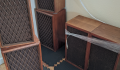
What the all knowing AI says about my modded (pro-sound drivers) classic RadioShack Nova speakers. Retro lattice grilles were common on lots of speakers back them.
1761673485833.png
 

Thread Starter

Externet

Joined Nov 29, 2005
2,628
Hi. Is there any 'solid state' analog equivalent for the EM84 tube ?

---->

I know of electroluminescent capacitors 'ELC' , (Have a bunch that cannot remember where they were used in) but unsure how fast is the response speed. And can modulate its luminosity with audio but not sweep an area.


1761781874191.png


No clue on how to select/control "which areas to illuminate" as said above. Anyone knows ?
 
Last edited:

ronsimpson

Joined Oct 7, 2019
4,662
Why I use meters. Both peak and average.
In broadcast, recording and just driving an amplifier it is important to not distort, or clip. (over modulate)
I use a peak meter to only indicate when we have too much on the peaks.
I also use an average (RMS) meter to tell how loud it sounds to the ear.
These are two very different things.

I have a peak limiter on many things. If the peaks are too high the amplifier might have a LED that lights. In my case the limiter sits on that peak and tells me how much it limited. Yes, limiting adds distortion but much less than just letting the amp or recorder distort.

On live events people want to hear everything. If I am awake, I can adjust the volume on each mic, but we know with 20 inputs and three people talking to me it is hard. For live events I have a compressor/limiter to do several jobs. The limiter part keeps the amps from distortion. I have the compressor set up to try to keep the sound level right for the room.

If there are many mics I often put an expander function on to kill any mic that is not in use. This also helps with feedback.

Example: There is an unused mic on stage. I don't need it picking up noise, so the expander drops it gain down 20db or more. I don't want to kill the mic because someone will come out and want to use it and I will not see that in time. Now someone grabs the mic. I don't see and do not respond but the expander turns up the gain to some reasonable lever. The person yellows "can you hear me?" The peak limiter extremely fast jumps on the peaks and rounds them off without much distortion. Then the compression/limiter with slower response pulls the gain down to a listenable level. Hopefully I wake up and pull the gain down on that channel, so the limiters have little to do.

When I did audio, I might have 100 meters in front of me.
 

nsaspook

Joined Aug 27, 2009
16,273
When I did radio voice audio we just adjusted the levels until it was 'clear'. After any processing, the levels were set to the standard 0 DBm for transmission via landlines or radio.
1761786054261.png
1761786369367.png
1761786099617.png1761786160916.png
 

drjohsmith

Joined Dec 13, 2021
1,579
interesting difference between the ppl meter and the vulnerable with voice and music .

the bbc philosophy was cording to my instructor in the 60s.

to not overload the circuits or transmitters, to avoid distortion and potential damage ,
they also wanted to ensure consistent apparant loudness/ clarity of signal
thy noticed that a set power of speech, the same power of a single tone and the same power of music, appeared different loudness to the listener.

thats why the ppm has a defined attack and decay rate, and frequency coverage .

this is in contrast to the vu,
which was 'critisised' for having any attack / decay rate tge manufacturer felt like , and was only accurate for a fixed tone.

we had demonstrated different recordings , done with vu and ppm which seemed at the time to bear this out
 

MisterBill2

Joined Jan 23, 2018
27,316
Probably that has some relationship with the meters calibrated in dB costing more than the VU meters, and why a cheap recorder has VU meters, while a broadcast console has dB meters.
 
Top