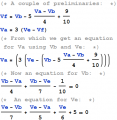
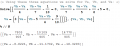
I tried to solve it without taking node g and h into consideration but it gave me different Answers
How can it be solved by taking node A,B,C,D,E,F into consideration
Or to Rephrase
Should I consider a supernode at f and d and if yes what should be written
If you still have problems we can look at another circuit with similar components and show you exactly how the equations for nodal are written. Once you do a few of these it starts to get easier so dont give up hope
I tried to solve it without taking node g and h into consideration but it gave me different Answers
How can it be solved by taking node A,B,C,D,E,F into consideration
Or to Rephrase
Should I consider a supernode at f and d and if yes what should be written
Well when you are doing a full nodal analysis that means you want to solve for every node in the system. Since node G is a node, you have to solve for Vg. That equation just means the same thing as Vg=Vf-150 of course, but in keeping with the mechanics of nodal you would first write Vf-Vg=150.
The idea here is not to jump ahead and try to take short cuts until you become more familiar with circuit analysis. Get the mechanics of it down pat, then start thinking about how to reduce your work. If you dont do this you'll have more to think about and that might get confusing. I suggest this because it has less variability from circuit to circuit so you'll be able to do any circuit without much trouble.
Note that it is not easy to see why the 150v source can be eliminated except for the fact that node G has no other influence on the circuit, but that might not be apparent to you until you do several other examples and get familiar with these techniques. In the mean time if you write one equation for each node you'll never have a problem, once you learn how to do that.
I tried to solve it without taking node g and h into consideration but it gave me different Answers
How can it be solved by taking node A,B,C,D,E,F into consideration
Or to Rephrase
Should I consider a supernode at f and d and if yes what should be written

 Facebook
 Google
 GitHub
 Linkedin

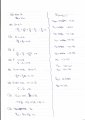 203.2 KB Views: 4