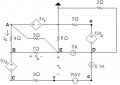
Yes, it's ok. You must take it at node F in order to have a definition for Vx.
You may not need to calculate the voltages at nodes G and H, but I labeled them on the circuit just in case it is necessary.
You may need to have a node equation summing the currents into node F. The current coming from the left through the 9 ohm resistor is easy to calculate, and coming from the right it's just the 0.1 amp current source.
Yes, it's ok. You must take it at node F in order to have a definition for Vx.
You may not need to calculate the voltages at nodes G and H, but I labeled them on the circuit just in case it is necessary.
You may need to have a node equation summing the currents into node F. The current coming from the left through the 9 ohm resistor is easy to calculate, and coming from the right it's just the 0.1 amp current source.
Yes, it's ok. You must take it at node F in order to have a definition for Vx.
You may not need to calculate the voltages at nodes G and H, but I labeled them on the circuit just in case it is necessary.
You may need to have a node equation summing the currents into node F. The current coming from the left through the 9 ohm resistor is easy to calculate, and coming from the right it's just the 0.1 amp current source.
Please post the voltages you got for all the nodes. Some of us who a following along may have tried to solve the network ourselves and we would like to see if we got it right.
Please post the voltages you got for all the nodes. Some of us who a following along may have tried to solve the network ourselves and we would like to see if we got it right.
you asked where Vx is pointing to. The answer you got was that "Vx- is the junction of the 150V source and the 9Ω resistor".
Going by this image:
It appears that Vc is only equal to Vf only if there is no current through the 9 ohm resistor. But there must be 0.1 A through the 9 ohm resistor due to the 0.1 A current source between Vd and Vg. That current source causes 0.1 A to flow through the 150 V source, the 9 ohm resistor and the 5IΔ source. Don't you agree? Then it must be true that Va=3(Ve-Vf).
Yes these results posted from post #26 do not look correct:
Vb=-8.3551 Vc=-12.41124 Vd=-24.06439 Ve=-14.11
One of them is off by about 3 volts i wont say which one yet.
I will give one exact result with only three significant figures:
Va=-8.62, Vb=-11.15
I used 16 digit precision math for the numerical calculations.
Someone else could verify this.
BTW, the equations seem to come easier once we place an anisotronic jumper across each of the three voltage sources. Granted, this isnt the simplest circuit in town so it would be assumed that you had worked several simpler exercises previous to this one.
I used integer arithmetic for the numerical calculations with the following results: View attachment 115629
Tried to do some verification but got tired of looking at it.
Ok good, it looks like our results agree for Va and Vb which was all i wanted to post right now. I dont like to give all the results out like that until the OP has more time to try it.
I also made a typo in my previous post stating the value of Vb instead of Va. I corrected that and here are the two results with limited precision:
Va=-8.62 (previously incorrectly stated as "Vb")
Vb=-11.15
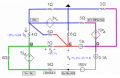
If I'd known we were in agreement on the results, then probably would not have posted my numerical results. Rather would have shown the setup for writing the node equations. I prefer to code the diagram prior to writing the node equations by:
a. Color-coding the super-nodes
b. Annotating the super-node voltage offsets
c. Expressing control variables in terms of the node voltages
Then all info necessary for writing the node equations will be conveniently on the diagram.
When i dont use my simulator i do something like that too, but i like to back the sim up with some hand written notes too. I dont actually modify the schematic i just write a set of lines of equations the first three of which are:
-ve/6+(vb-ve)/7+(va-ve)/5=5
-vh/3-vd/2+4.9=0
vb-vc=5*ik
then i just solve them ("ik" is "i sub delta").
It is somewhat simple but much care has to be used to make sure to get everything right like the signs.
Only 3 node equations are necessary for nodes B, D, & E.
However, before one can write the 3 node equations, it is necessary to first express i(delta) in terms of voltage variables, and then express Vx in terms of the three node voltages.
Because you are supposed to use Nodal on this i would suggest that you start with pure Nodal with no shortcuts just yet. That will allow you to learn the way this works. Shortcuts are for the people who understand circuits from the standpoint of how things work together while with pure Nodal you can apply it in a more mechanical way. Once you've done a hundred circuits you'll start to see shortcuts, but i dont think that will help you as much right now because shortcuts are different for every circuit.
With that in mind using pure Nodal you have 8 nodes therefore you need to write 8 equations. These 8 equations will be easier to write than if you try to use shortcuts anyway and the ideas needed will apply to any circuit you can find, not just this one.
And with that also in mind, i also have to suggest that because you are having a little difficulty with this circuit that we start with ONE node and just write the equation for that node, then move to the next, and see if you start to catch on.
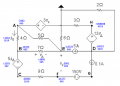
The circuit drawing posted by Electrician looks the most clear so i suggest that we also use that one. That one has nodes labeled A through H. We were all using the variables Va though Vh so i would suggest we do that also. If you have any objection to this then speak up now.
Using that drawing, we look at the node E. We should start with that one.
Looking at the things connected to that node E and starting with the 7 ohm resistor and moving clockwise around the node we see:
7 ohm resistor,
5 ohm resistor,
6 ohm resistor,
5 amp current source.
So we have four elements to deal with, and their other ends are connected to nodes:
A,B,0,D in that clockwise order. Since the 5 amp current source tells us what the current is outright, we dont need the node D but we need the other nodes because we just have impedances which do not tell us the current through them directly, so we need nodes A, B, and 0 (0 is ground).
The current through the 7 ohm resistor is:
i7=(Vb-Ve)/7
so it is just the difference in voltage divided by the resistance, and note that we subtract the node voltage we happen to be doing at the time which here is for node E so we used Ve. We used node voltage Vb because that was the voltage of the node on the other end of the resistor.
The currents through the other resistors are:
i5=(Va-Ve)/5
i6=(0-Ve)/6
so you see how mechanical this becomes. We do the same thing for each node using the appropriate node voltage and the node voltage for the node we are working on Ve.
We also have the 5 amp source, which is pointing away from the node, so it is negative:
i5A=-5
Now we sum all the currents we found and equate them to zero:
i7+i5+i6-5=0
and that is the equation for node E. See how easy that was?
You can not check your results until you have all the nodes done, but here you can check right away because the numerical solutions have been given in other posts.
Do you understand up to this point now or not? If not then you should mention what does not seem clear yet.
If you do understand then that means you checked your result using the previously posted numerical results and when you summed those currents above you got zero or very close to zero (numerical sums do not always add to exactly zero even if they are zero, but will be close depending on the precision being used. Typical results might be 1e-12 or -1e-12 using high precision. Using all integer results may show an actual zero amps.).
Taking just a slightly different approach that RBR1317 (though very much along the same lines), consider the following:
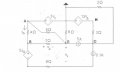
Some of the components have zero impact on the answer -- in particular, a resistance in parallel with a voltage source or components in series with a current source. This is not to say that they can't impact the answer -- it depends on what you are looking for. If we didn't care about Vx, then we could eliminate the 9 Ω resistor, the 8 Ω resistor, the 150 V source, and the CCVS from the bottom part of the circuit entirely. But since we DO care about Vx, we need to keep just those components that will let us determine it. But we can eliminate the 1 Ω resistor, the 8 Ω resistor, and the 150 V source. We can also swap the order of the right-hand VCVS and the 3 Ω resistor to simplify our node equation set up a little bit.
This leaves us with the following (I labeled Node H hoping that none of the other diagrams has such a node.
Now pick the low hanging fruit -- we can write Va and Vh direction.
Va = 3·Vx
Vh = -13·VΔ
Now write control signals, Vx, VΔ, and IΔ in terms of the node voltages.
VΔ = Vb - Ve
IΔ = (Va - Vb) / 4 Ω
Vx = Ve - (Vb - (5 V/A)·IΔ + 0.9 V)
Vx = Ve - (Vb - (5 V/A)·((Va - Vb) / 4 Ω) + 0.9 V)
Vx = Ve - (Vb - (5/4)(Va - Vb) + 0.9 V)
Vx = 1.25·Va + 0.25·Vb + Ve + 0.9 V
Now you just have three very straight forward node equations to write: Vb, Ve, and Vd. Keep in mind that for Vb you don't have to worry about the CCVS since we KNOW that it is simply delivering 0.1 A of current into that node.
Because you are supposed to use Nodal on this i would suggest that you start with pure Nodal with no shortcuts just yet. That will allow you to learn the way this works. Shortcuts are for the people who understand circuits from the standpoint of how things work together while with pure Nodal you can apply it in a more mechanical way. Once you've done a hundred circuits you'll start to see shortcuts, but i dont think that will help you as much right now because shortcuts are different for every circuit.
With that in mind using pure Nodal you have 8 nodes therefore you need to write 8 equations. These 8 equations will be easier to write than if you try to use shortcuts anyway and the ideas needed will apply to any circuit you can find, not just this one.
And with that also in mind, i also have to suggest that because you are having a little difficulty with this circuit that we start with ONE node and just write the equation for that node, then move to the next, and see if you start to catch on.
The circuit drawing posted by Electrician looks the most clear so i suggest that we also use that one. That one has nodes labeled A through H. We were all using the variables Va though Vh so i would suggest we do that also. If you have any objection to this then speak up now.
Using that drawing, we look at the node E. We should start with that one.
Looking at the things connected to that node E and starting with the 7 ohm resistor and moving clockwise around the node we see:
7 ohm resistor,
5 ohm resistor,
6 ohm resistor,
5 amp current source.
So we have four elements to deal with, and their other ends are connected to nodes:
A,B,0,D in that clockwise order. Since the 5 amp current source tells us what the current is outright, we dont need the node D but we need the other nodes because we just have impedances which do not tell us the current through them directly, so we need nodes A, B, and 0 (0 is ground).
The current through the 7 ohm resistor is:
i7=(Vb-Ve)/7
so it is just the difference in voltage divided by the resistance, and note that we subtract the node voltage we happen to be doing at the time which here is for node E so we used Ve. We used node voltage Vb because that was the voltage of the node on the other end of the resistor.
The currents through the other resistors are:
i5=(Va-Ve)/5
i6=(0-Ve)/6
so you see how mechanical this becomes. We do the same thing for each node using the appropriate node voltage and the node voltage for the node we are working on Ve.
We also have the 5 amp source, which is pointing away from the node, so it is negative:
i5A=-5
Now we sum all the currents we found and equate them to zero:
i7+i5+i6-5=0
and that is the equation for node E. See how easy that was?
You can not check your results until you have all the nodes done, but here you can check right away because the numerical solutions have been given in other posts.
Do you understand up to this point now or not? If not then you should mention what does not seem clear yet.
If you do understand then that means you checked your result using the previously posted numerical results and when you summed those currents above you got zero or very close to zero (numerical sums do not always add to exactly zero even if they are zero, but will be close depending on the precision being used. Typical results might be 1e-12 or -1e-12 using high precision. Using all integer results may show an actual zero amps.).

 Facebook
 Google
 GitHub
 Linkedin