The most basic DC motor control

Thread Starter

Telephos

Joined Jun 16, 2023
3
Hi All,

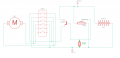
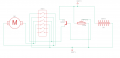
I'm trying to create the most simple example of DC motor control using an H-bridge and a BJT transistor. I want a middle-schooler with no electronics knowledge at all to be able to understand it. I'm just illustrating how to control direction and motor speed. I've created this circuit physically and it works fine, but I'm wondering if there's any revision you'd recommend. I know this doesn't prevent shorts--the power supplies (not batteries), I'll be using will have current limits. This is what I have for it.
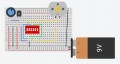
1686927208699.png

1686927270234.png
Thank you!
 

sghioto

Joined Dec 31, 2017
8,633
I would change RPO12 to a 10K or even a 5K. The value is dependent on the current draw of the motor and the gain of the npn transistor
.
 

nsaspook

Joined Aug 27, 2009
16,251
That's a simple voltage/source/emitter follower circuit, not an H-bridge. It works just fine if you limit the supply current and heat-sink the transistor to handle the dissipation.
 

MaxHeadRoom

Joined Jul 18, 2013
30,562
That is more of a lesson on how a transistor works than motor control, as this method would not realistically be used in the real world.
A simple PWM type input would demonstrate it better.
 

Reloadron

Joined Jan 15, 2015
7,857
I would drop the dip switches and replace with a simple DPDT switch with center off. Make sure the switch can handle motor load current. I would also drop using the transistor since it serves no purpose. Using a pot to control motor speed is not a good idea but can be done.

Ron
 

Thread Starter

Telephos

Joined Jun 16, 2023
3
I would change RPO12 to a 10K or even a 5K. The value is dependent on the current draw of the motor and the gain of the npn transistor
.
Thanks! Yeah, the pot won't be 250k. I didn't notice that on the sketch until you pointed it out.

That's a simple voltage/source/emitter follower circuit, not an H-bridge. It works just fine if you limit the supply current and heat-sink the transistor to handle the dissipation.
Thanks! I'll be using a MOSFET rather than a BJT. The dip switch is being used to make an H-bridge to allow the motor to run forward or backward.

That is more of a lesson on how a transistor works than motor control, as this method would not realistically be used in the real world.
A simple PWM type input would demonstrate it better.
I would drop the dip switches and replace with a simple DPDT switch with center off. Make sure the switch can handle motor load current. I would also drop using the transistor since it serves no purpose. Using a pot to control motor speed is not a good idea but can be done.

Ron
Thank you both for your responses! This is supposed to serve as a very rudimentary introduction to electronics (for middle-schoolers) with something a bit more applicable than just resistors and LEDs. I did want to include something about PWM, but adding Arduinos to the demonstration would be too much. I was thinking I would just point out that what the voltage divider is doing could be replicated by a duty cycle and leave it at that. I'm doing a series of 40 minute sessions so time is limited to explain the concepts and have them build the circuit. I'm now reconsidering whether to include a transistor at all, since I think a discussion on semiconductors is way beyond an average middle-schoolers capabilities.

Reloadron, that's a good recommendation. Thanks!
 

nsaspook

Joined Aug 27, 2009
16,251
Thanks! I'll be using a MOSFET rather than a BJT. The dip switch is being used to make an H-bridge to allow the motor to run forward or backward.
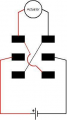
I know they call it a H-bridge today (IMO that's fuzzy thinking because a H-bridge usually involves PWM to justify the increase in possible complexity) but it's the electrical equivalent of a DPDT switch that IMO would be much easier to illustrate and explain to electrical beginners.
1686946984905.png
 
Last edited:

Ya’akov

Joined Jan 27, 2019
10,226
Are you particularly demonstrating motor control, or did you choose motor control as an example of using circuits to do things?
 

MaxHeadRoom

Joined Jul 18, 2013
30,562
Maybe pique their interest and show how a (DC) motor will generate, place a LV low wattage bulb across the leads and spin the motor , either with a hand drill or with a cord wound around the shaft. :cool:
ALA T. Edison.
 

Thread Starter

Telephos

Joined Jun 16, 2023
3
I know they call it a H-bridge today (IMO that's fuzzy thinking because a H-bridge usually involves PWM to justify the increase in possible complexity) but it's the electrical equivalent of a DPDT switch that IMO would be much easier to illustrate and explain to electrical beginners.
Oh, interesting. I think I will make this revision to the circuit.

If you make the DPDT switch a center-off type, then you can control on-off as well as direction, in the circuit proposed by nsaspook.
Yeah, I think this will be a better set-up. Thank you!

Are you particularly demonstrating motor control, or did you choose motor control as an example of using circuits to do things?
Mostly the latter. I wanted to introduce circuits concepts but not have a plain old water-analogy talk. It also has to be easily assembled (again, by a middle-schooler) and hopefully do something sort of interesting.

Maybe pique their interest and show how a (DC) motor will generate, place a LV low wattage bulb across the leads and spin the motor , either with a hand drill or with a cord wound around the shaft. :cool:
ALA T. Edison.
I'm trying to avoid magnetism lol! I have to mention it some in the context of the motor, but if we really get into induction and those topics I just think it could be too much. But maybe drop the semiconductor talk and cover this instead. Honestly, I really don't know what a middle-schooler is able to understand so I'm struggling with what to include.
 

nsaspook

Joined Aug 27, 2009
16,251
...
I'm trying to avoid magnetism lol! I have to mention it some in the context of the motor, but if we really get into induction and those topics I just think it could be too much. But maybe drop the semiconductor talk and cover this instead. Honestly, I really don't know what a middle-schooler is able to understand so I'm struggling with what to include.
Magnetism is IMO fundamental to a simple brushed DC motor but induction can be left out initially.
The middle-schooler principle of magnetism states that unlike poles are attracted to one another while like poles repel. This makes things physically move/affect their movement, so kids love magnetism demos. The generation of electromagnetism in a brushed DC more like flipping a attract/repel switch on a solidly connected (physical commutation) magnetic-coil circuit than classical induction that depends on changing/rotating magnetic fields that attract/repel flipping to induce EM energy into a non-physically (electrical/electronic commutation) connected magnetic-coil circuit. A brushed DC motor does have induction effects that generate (B)EMF in conductors that limit current draws and speeds but those are not fundamental to understanding basic brushed motor operation.

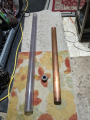
This is one of my old Magnetism/Induction demos for my kids (their teachers let me class demo for their science lessons).
1686960596794.png
https://youtube.com/shorts/ffIZhntqgwc?feature=share
https://youtube.com/shorts/FnjAH4lk90A?feature=share

We would then talk about why there is a difference in the drop speeds.
 

ElectricSpidey

Joined Dec 2, 2017
3,312
You realize you can short that transistor with the wrong set of switches closed.

I know you mentioned making the change to the DPDT switch, but you are still showing the DIP switch in your schematic.
 
Top