The Jokes thread

WBahn

Joined Mar 31, 2012
33,074
Sadly - it is in the eyes of the world.

No living president is allowed to have US currency with his image on it. Only past - DEAD - presidents are afforded that privilege. Same is true of Mount Rushmore.
Not quite correct -- and the 'not-quite' is particularly relevant. First off, being president has nothing to do with it (we have non-presidents on plenty of currency and coins, such as Benjamin Franklin and Susan B. Anthony).

31 U.S. Code § 5114 (b): United States currency has the inscription “In God We Trust” in a place the Secretary decides is appropriate. Only the portrait of a deceased individual may appear on United States currency and securities. The name of the individual shall be inscribed below the portrait.

This prohibition (originally 14 Statute 25) was first passed in 1866 following Spencer Clark managing to have his portrait appear on the 5-cent note. But he wasn't the only person to have appeared on currency while alive, but Clark's appearance was seen by Congress as being blatant self-promotion and abusing his position to do so, prompting them to pass the legislation.

The tricky part is that 31 U.S. Code § 5114 applies to currency and securities, but not to coins, which are treated under a different statute, namely 31 U.S. Code § 5112. The prohibition against living individuals appearing on coins are not blanket, and instead each type of coin has it's own rules. In particular, the prohibition does not apply to commemorative coins and there is precedent, including the 1926 commemorative half dollar depicting Calvin Coolidge, who was not only living, but was the sitting president. Making it an even more relevant precedent is the fact that that coin was issued as part of the Sesquicentennial (150 year) celebration.
 

WBahn

Joined Mar 31, 2012
33,074
No living president is allowed to have US currency with his image on it. Only past - DEAD - presidents are afforded that privilege. Same is true of Mount Rushmore.
I'm not sure where you are getting your information about the same being true for Mount Rushmore.

To the best of my knowledge, there is NO statutory or regulatory limitation on who could be added to that monument -- they could put someone else up there whether they are living or dead, have been a president or not, or have accomplished anything of note. If they wanted to, they could put Neil Armstrong up there, or they could pick a name from a hat and declare that that person represents the "Every Day American". Originally, Mount Rushmore was a state-level project aimed at promoting tourism to South Dakota. It was the brainchild of a state historian who wanted to use regional historical figures like Lewis and Clark, Sacagawea, and Red Cloud. The sculptor argued that the monument should have a national theme and chose four presidents not so much because of what they did as individuals, but because, in his view, they represented four stages of the growth of the nation -- a theme that the park emphasizes to this day. Washington symbolizes the birth of the nation, Jefferson represents the growth of the nation, most notably via the Louisiana Purchase, Lincoln symbolizes the preservation of the nation, and Roosevelt the development and transformation of the nation into a world power.

Mount Rushmore falls under the National Park System, which is administered by the Department of the Interior. Any major alteration would require congressional authorization and appropriation, which makes it very unlikely that the addition of a living person would get approved. In fact, it's very unlikely that the addition of anyone will ever be approved. First, there is the political ramifications of changing such a treasured and world-known landmark. But perhaps even more importantly, numerous surveys of the monument have concluded that the remaining granite is simply not suitable for adding another full-scale face without risking severe damage to the existing monument. In fact, this is a large part of why the current monument only has the faces, since the original plan was to include significant portions of the torsos, plus engravings of the key historical events in the nation, plus a Hall of Records in the rock behind the carvings.
 

cmartinez

Joined Jan 17, 2007
8,830
I'm sorry about veering a little off topic here ... but this really ripped a good old hearty laugh out of me. In the following video:

You can find the following quote:

... (3:37) Faced with this unusually vague answer, I had to do the only other thing possible, and that is to manually browse the internet to find the facts, by comparing information from multiple different sources.

I know, eww. Of course, within milliseconds I ended up on the forums. The treasure trove of online credibility. And after spending some time on forums such as Adventure Rider or Thumpertalk, I came to the following conclusion: The higher the number of posts of a forum member, the higher the chances that member has mental and/or social issues.
 

ThePanMan

Joined Mar 13, 2020
945
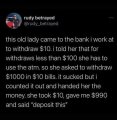
I had a paycheck drawn on X bank. Went to X bank but they wouldn't cash it unless I paid a teller fee or had an account. So I opened an account, deposited the check then closed the account with all my cash. Had they just paid the check they would have spent less time and resources just paying it in the first place. And they didn't even get a tellers fee.
 

joeyd999

Joined Jun 6, 2011
6,435
I had a paycheck drawn on X bank. Went to X bank but they wouldn't cash it unless I paid a teller fee or had an account. So I opened an account, deposited the check then closed the account with all my cash. Had they just paid the check they would have spent less time and resources just paying it in the first place. And they didn't even get a tellers fee.
Grok says:

**Yes, in the United States, a bank can generally charge a "teller fee" (or non-customer check-cashing fee) to cash a check drawn against one of its own accounts if the person presenting the check is not an account holder at that bank.**

### Key Details
- **Legal Basis**: There is no federal law requiring banks to cash checks for non-customers at all, and if they do, they may charge a fee. This applies even to "on-us" checks (drawn on the bank itself). Federal preemption (via the National Bank Act and OCC interpretations) overrides many older state laws that once required banks to pay such checks "at par" (full face value without deduction).
- **Court Precedents**: Cases like *Wells Fargo Bank of Texas, N.A. v. James* (5th Circuit) and *Baptista v. JPMorgan Chase Bank, N.A.* (11th Circuit, covering Florida) upheld national banks' rights to charge these fees. Florida and other states later amended laws to align with this for state-chartered banks as well.

### Common Practices
- Fees typically range from **$5 to $10** (e.g., Bank of America ~$8, Wells Fargo ~$7.50, Chase ~$8 for checks over certain amounts), though they vary by bank, check amount, and location.
- The bank verifies funds and identity (usually with government-issued ID) before cashing.
- Some banks may refuse to cash for non-customers entirely to reduce fraud risk.

### Exceptions and Notes
- **Account Holders**: If you have an account at the bank, cashing your own bank's checks is usually free (subject to your account terms).
- **Paychecks/Wages**: A few states have specific rules requiring employers to pay wages in a way that allows fee-free cashing (e.g., at the issuing bank). Check your state's laws if this applies.
- **Credit Unions**: Similar rules often apply.
- **Alternatives**: Use the check issuer's bank (if convenient), mobile deposit (if you have an account elsewhere), ATMs (for some checks), or services like Walmart, grocery stores, or check-cashing outlets (which may have their own fees).
 

WBahn

Joined Mar 31, 2012
33,074
Grok says:

**Yes, in the United States, a bank can generally charge a "teller fee" (or non-customer check-cashing fee) to cash a check drawn against one of its own accounts if the person presenting the check is not an account holder at that bank.**

- **Alternatives**: Use the check issuer's bank (if convenient), mobile deposit (if you have an account elsewhere), ATMs (for some checks), or services like Walmart, grocery stores, or check-cashing outlets (which may have their own fees).
Ah, yes. An alternative to cashing a check at a bank where the check is drawn against one of its own accounts is to use the check issuer's bank (but only if it is convenient).

So I guess after they refuse to cash it without a teller's fee you walk out the door and walk back in and try again?

Thanks for the suggestion, Grok.
 

joeyd999

Joined Jun 6, 2011
6,435
Ah, yes. An alternative to cashing a check at a bank where the check is drawn against one of its own accounts is to use the check issuer's bank (but only if it is convenient).

So I guess after they refuse to cash it without a teller's fee you walk out the door and walk back in and try again?

Thanks for the suggestion, Grok.
You read it wrong. Grok suggested exactly:

So I opened an account, deposited the check then closed the account with all my cash.
"Use the check issuer's bank (if convenient)" == "Open an account"

@ThePanMan literally used the bank -- in every sense of the word.
 
Last edited:

WBahn

Joined Mar 31, 2012
33,074
You read it wrong. Grok suggested exactly:


"Use the check issuer's bank (if convenient)" == "Open an account"
How does using the check issuer's bank equate to opening an account???

If Widgets Inc gives me a check drawn on 33rd National Bank, then the check issuer is Widgets Inc and the check issuer's bank is 33rd National Bank.

That is completely independent of whether I have an account at that bank or not.
 

joeyd999

Joined Jun 6, 2011
6,435
How does using the check issuer's bank equate to opening an account???

If Widgets Inc gives me a check drawn on 33rd National Bank, then the check issuer is Widgets Inc and the check issuer's bank is 33rd National Bank.

That is completely independent of whether I have an account at that bank or not.
Context.

If I ask you, "@WBahn, which bank do you use?" do you reply "First Federal" since you once received a check from a customer that uses First Federal and you went there to cash it?
 

WBahn

Joined Mar 31, 2012
33,074
Context.

If I ask you, "@WBahn, which bank do you use?" do you reply "First Federal" since you once received a check from a customer that uses First Federal and you went there to cash it?
Totally unrelated and irrelevant.

If you walk into First Federal and try to cash a check drawn on another bank and the teller recommends cashing it at the check issuer's bank, do you really believe that they are telling you to open an account at that bank? Of course not, they are suggesting that you take the check to the bank where the check issuer has the account that that check was drawn upon. The check issuer is the person/entity that wrote the check.

Notice that the word "use" is distributed in that sentence as in "use one of the suggestions in the following list"
 

joeyd999

Joined Jun 6, 2011
6,435
I read "Use the check issuer's bank (if convenient)" as "open/have an account at the check issuer's bank if it is convenient to you").

This is a simple -- and silly -- disagreement, in the Jokes Thread nonetheless, and I stand by my reading of the text.

The rest of Grok's text was enlightening, IMHO, assuming it's accurate (which I didn't check). I did not know that there were once state laws requiring "at par" check cashing, and that they've been superseded by Federal preemption. If true, I've possibly learned something today. If this ever becomes important to me, I know what to look for to verify it.
 

WBahn

Joined Mar 31, 2012
33,074
I read "Use the check issuer's bank (if convenient)" as "open/have an account at the check issuer's bank if it is convenient to you").

This is a simple -- and silly -- disagreement, in the Jokes Thread nonetheless, and I stand by my reading of the text.

The rest of Grok's text was enlightening, IMHO, assuming it's accurate (which I didn't check). I did not know that there were once state laws requiring "at par" check cashing, and that they've been superseded by Federal preemption. If true, I've possibly learned something today. If this ever becomes important to me, I know what to look for to verify it.
You are certainly free to apply whatever twisted reasoning you want to in order to claim that Grok is correct.

Colorado was one of the states that required banks to cash checks at par for non account holders. For a number of years after I got out of the service the only account I had was at the credit union of my last base on the other side of the country, so I occasionally found myself going to the issuer's bank to cash a check if I needed the money faster than I could get it by mailing the check to the credit union and waiting for it to clear. This happened infrequently enough that wasn't worth it to me to open an account at a local bank. But, sometimes this was not convenient, because the issuer's bank didn't have a local branch. Finally, I did open an account at a local bank so that I could cash checks there, but not because it was a check issuer's bank (it wasn't), but because it cut three or four days off the clearance time relative to depositing via mail.

Another federal preemption that we all get to live with are the "convenience fees" for using a credit card. Credit card companies had the policy in their merchant agreements that merchants couldn't charge customers extra for using a credit card -- that fee had to be borne by the merchant as an overall cost of doing business and the merchant could decide if accepting credit cards resulted in sufficient additional business so as to be worth the additional cost. As another of the never-ending laws that get passed that are window-dressing that actually do nothing, Congress passed a law that explicitly prohibited merchants from charging credit card surcharges (what became known as "convenience fees") but, at the same time, explicitly allowing them to give discounts for cash payments. So, of course, merchants did nothing other than change the words. Instead of charging a $2 surcharge for buying a $100 item with a credit card, they now gave a $2 discount to people that used cash to pay for the $102 item. Gas stations were the first to jump on this broadly, since they operate on such narrow margins. Many states still banned credit card surcharges, but lawsuits claiming that such bans violated a merchant's First Amendment rights to free speech resulted in them being repealed.
 
Thread starter Similar threads Forum Replies Date
killivolt Off-Topic 10
KL7AJ Off-Topic 1
Sparky49 Feedback and Suggestions 4
electronis whiz Off-Topic 2
electronis whiz Off-Topic 1
Top