The irreversibility of time

Really? I was under the impression that "noise" (in the audible sense) is something interpreted by one's brain.

It ain't noise till you hear it.
Interesting. Science says unless in a vacuum, noise is about vibration and frequencies and not the act of hearing. Science's argument to your thesis is what about noise that we know exists but is outside of the range of hearing?

Don't get me wrong, I don't know the answers to these questions. These are the questions though that put "Doctor of Philosophy" on a Phd. in physic's parchment and not "Doctor of Science."
 
Much of this has been about "simulation" and not time or reversing time. Truth is we don't have a "time law" anymore than we have a "law of gravity." How can we define the possibilities of time when we can't fully explain or define time? We can piece together different aspects of time that are useful to us like a cesium time standard, but there is not law that is universal to time. There are inherent conflicts to the various aspects of time that we use that prevent a universal law to define time. Linear time is useful for measurement but there are examples of time, thanks to Einstein that aren't linear which don't fit in with our concepts of linear time. Is it a wonder that thanks to Einstein that the same problems we have with time are the same problems we have with gravity?
 
Interesting. Most philosophers would disagree with you. I think most would say asking the wrong question is just as important as asking the right question. There are also those that believe asking the wrong question is more important than asking the right question. Knowledge isn't knowing what is right. Knowledge is knowing the difference between right and wrong and there is a lot more wrong than right.
 

bogosort

Joined Sep 24, 2011
696
Instead of taking one large measurement of a particle (which disrupts the system and yields a ton of uncertainty)take a bunch of small measurements in an attempt to interact with the system as little as possible. Then stack those measurements together.
What exactly is the difference between "large" and "small" measurements?

You can get a more accurate measurement of your particle test subject than the Heisenberg uncertainty principle allows.
Nope. The uncertainty principle is not a form of censorship that we can somehow, if clever enough, get around. You imply that, behind the scenes, a particle is in a definite state and it's the act of measurement that adds uncertainty. But this is exactly backwards! Behind the scenes, the particle is in a superposition of states -- indeterminate and uncertain -- until we measure it.
 

Delta Prime

Joined Nov 15, 2019
1,311
Behind the scenes, the particle is in a superposition of states -- indeterminate and uncertain -- until we measure it
It is commonly believed and taught Heisenberg originally formulated his ideas in terms of a relationship between the precision of a measurement and the disturbance it must create.The latter relationship is not rigorously proven.
violations of Heisenberg’s measurement-disturbance relationship, using weak measurements to characterize a quantum system before and after it interacts with a measurement apparatus.
I contend if someone is clever enough can revise the measurement-disturbance relationship.
I most certainly understand the broad implications for the foundations of quantum mechanics and for practical issues in quantum measurement if and it's a big IF, someone clever like me
Exclusive-NOR-Gate.jpg
Can achieve it.;)
 

bogosort

Joined Sep 24, 2011
696
It is commonly believed and taught Heisenberg originally formulated his ideas in terms of a relationship between the precision of a measurement and the disturbance it must create.
The popular idea that uncertainty happens because a measurement "disturbs" what it seeks to measure is wrong. The intuition behind this idea is that a particle has a definite position and velocity until the act of measurement influences it. That's the classical picture, and we now know that this picture is fundamentally false. The actual universe is not like the classical universe. QM showed us that the notion of definite position and velocity simply does not exist, and the uncertainty principle is a reflection of that fact.

violations of Heisenberg’s measurement-disturbance relationship, using weak measurements to characterize a quantum system before and after it interacts with a measurement apparatus.
You still haven't explained what a "weak" measurement is. Note that scientists have many ways of performing indirect measurements, where their instruments don't directly interact with the thing they're trying to measure. Even in these cases, the uncertainty principle holds. Again, the thing that causes uncertainty is the lack of definite state, not measurement "disturbance".

I contend if someone is clever enough can revise the measurement-disturbance relationship.
I most certainly understand the broad implications for the foundations of quantum mechanics and for practical issues in quantum measurement if and it's a big IF, someone clever like me
View attachment 204664
Can achieve it.;)
NOT bogosort, eh? I suppose that's clever. I'd recommend, however, that if you seek to overturn the uncertainty principle, you should probably first learn what it actually means.
 

Delta Prime

Joined Nov 15, 2019
1,311
NOT bogosort, eh?
I most certainly understand the broad implications for the foundations of quantum mechanics and for practical issues in quantum measurement if and it's a big IF, someone clever like me
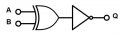
It is not an attack on your intellect it breathes logic gates in series( EX-OR, NOT. Someone is clever as me can achieve it. )Please forgive my feeble attempt at levity. Overturn the uncertainly principal NO. But to continue where the principal falters.
 
Last edited:

MrAl

Joined Jun 17, 2014
13,761
Two important points:
  • The universe can't be simulated
  • Time is not reversible


https://www.newscientist.com/articl...size-of-the-universe-cant-predict-everything/
I think that anyone that makes generalizations like that today did not look well enough into the history of science. When we look back, we see all sorts of very educated and smart people making predictions that turned out to be untrue. Newton concluded that the dancing start around the center of our galaxy would orbit Sagittarius A in a purely elliptical orbit. Then Mr Einstein came around and concluded that it was not purely elliptical but also the pseudo ellipse would rotate. Only recently Einstein had again been proven correct over Newton once again. It took the day of Einstein to predict it, and after all this time it took to prove it.

With time scales like this it is impossible to predict anything with absolute certainty because more information comes around as time goes on. I call this the Dunning-Kruger effect for scientists.
In short one of the things this says about us is that "dumb people dont know they are stupid so they make false conclusions". There is more to it than that though, but that's one way of looking at it.
But the term "dumb" is a relative term. Dumb compared to who or what else?
If we compare people from history, we find some came up with better predictions than others, so we might call the others dumb. But what about the people who were right. Compared to a super race of intelligent beings they would be considered dumb too, in fact the might be considered very dumb.

But what really gets me is that they have a decent amount of history to look back on before they make any conclusion, yet they somehow manage to make very far reaching conclusions anyway. Conclusions that they can only prove based on knowledge that they already have. If that knowledge is already flawed though (the dumb effect) then they reach a false conclusion, or at least a conclusion that is valid for today but not for tomorrow.
Some scientists realize this today but some of them still rely heavily on what they know today to predict what will happen tomorrow. Some however do not rely on that and i believe they are the ones with the most open minds that realize that they cant know everything right now.

Dont get me wrong. Some predictions about current events will always be very good. But if they are too far reaching i tend to just ignore them because they cant be proved or disproved until the time comes.
 

MrAl

Joined Jun 17, 2014
13,761
If I understand things correctly, a photon is everywhere it can be at the same time for its entire existence... from the photon's perspective, of course.... right?
The way i always like to explain it is that the photon exists in a "world of its own".
 

MrAl

Joined Jun 17, 2014
13,761
Dare I say such a thing(triple question marks HaHa)Heisenberg uncertainty principle is wrong, and quantum mechanics is at least incomplete.
ever since Heisenberg wrote down that irritating formula knowing exactly how precise a measurement you can obtain is very important
Instead of taking one large measurement of a particle (which disrupts the system and yields a ton of uncertainty)take a bunch of small measurements in an attempt to interact with the system as little as possible. Then stack those measurements together.
You can get a more accurate measurement of your particle test subject than the Heisenberg uncertainty principle allows.View attachment 204247
It is interesting that this comes up so much.
It begs the question, what exactly is a direct measurement?
Is even there any such thing?

Every time we make a measurement we are really comparing one thing to another thing, we dont know anything about the thing being measured directly it is always through some type of medium.
When we measure an object with a ruler we compare the ruler to the object being measured. We cant extract the measurement from the object itself without using something else that we compare to it.
If we bounce photons off of the object in an attempt to get a better reading, that might be more direct but it's still involving a second entity of some type that we have to interpret in order to make a correlation. Worse yet it interacts with the object so something about the object is changed before we get a chance to interpret and correlate. The best bet is to use something so small that it causes a change that is irrelevant to the measurement tolerance. The trouble is, we only have entities that are just so small and we cant seem to go any smaller than that, so at some point the box being measured is being hit by another box of the same size and so we lose the nice relationship we had with a smaller object being used to measure a larger object so that it does not influence the object in any way noticeable.
 

bogosort

Joined Sep 24, 2011
696
It is not an attack on your intellect it breathes logic gates in series( EX-OR, NOT. Someone is clever as me can achieve it. )Please forgive my feeble attempt at levity.
I didn't take it as an attack; merely a visual pun on my avatar (XOR gate). I thought that was the clever part. Maybe I'm missing something?

Overturn the uncertainly principal NO. But to continue where the principal falters.
The uncertainty principle is a recognition of a universal fact (one of the few we actually know). It cannot falter. If tomorrow a deity appeared over Earth and patiently explained to us exactly how the universe works, even it could not tell us what the position and velocity of an electron is before we measure it, because those classical notions do not exist.
 

Delta Prime

Joined Nov 15, 2019
1,311
If the observer affects the observed, how can one even make such a measurement of the disturbance of a measurement?
(Rhetorical question)
My point is the way one looks at things in the classical sense perhaps but how about new ways with the advances of technology using new methods question everything instead of tiptoeing through the tulips." I will see you all here last week for the second time"
That was a joke get it the irreversibility of time.
:cool:
 
Last edited:

Delta Prime

Joined Nov 15, 2019
1,311
You keep making the wrong assumption that uncertainty is related to measurement
Heisenberg’s uncertainty principle, which is often presented as a statement about the intrinsic uncertainty that a quantum system must possess. Yet Heisenberg originally formulated his principle in terms of the “observer effect”: a relationship between the precision of a measurement and the disturbance it creates, as when a photon measures an electron’s position. ;)
In the future I will not confuse a rhetorical question to any assumption. Thank you I sit corrected.
 
Last edited:

Delta Prime

Joined Nov 15, 2019
1,311
I regard the uncertainty principle as a fundamental fact about symmetry, really. E.g., translation invariance -> Fourier theory -> x and p -> HUP. Every step in that chain is very very natural. I’m not sure that “natural” and “fundamental” are precisely the same thing, but I guess what I mean is, I’m more sympathetic than you are to this point.And it’s also true that for many physics applications one doesn’t need to distinguish between the different preimages, which tends to reinforce the murkiness. :confused:
 
Last edited:

MrAl

Joined Jun 17, 2014
13,761
If not you would not be so well rehearsed.xoxox
Have you ever seen the sitcom Sanford and son I love what he calls his son Lamont.
And I really like Lamont. Meaning you.
What's you talkin bout Willis?
:)

Sorry i dont remember what Sanford used to call Lamont last time i saw an episode was years ago.
 
Top