The Great Remorse

WBahn

Joined Mar 31, 2012
32,925
Back to the original question in post#1: Do I ever regret leaving one job for another one??
I'd have to say -- maybe.

When I left the employer I had been with for fourteen years (and had become the senior engineer), it was to take what looked like was going to be a relatively stable position at the Air Force Academy continuing the research that my PhD was based on. But, as things turned out, my sugar daddy's discretionary funding, which was what they were using to sponsor our work, got yanked back in one of the government's budget tiffs a few years later. Since then, it's been one unstable job after another -- all of them enjoyable and interesting (some of them in the extreme). Oddly, the one exception (on the stability front) was a permanent full-time instructor position that, after two years, I left to go back to the Academy because they offered me twice what I was getting teaching. Real hard to say no to that, especially since the work was also very interesting. But, once again, their funding turned out to be far less stable than anyone had anticipated, but it backdoored me into an extended teaching gig there, all in single-year extensions with the expectation that it would not be renewed but that lasted for about five years until the position I was backfilling was reclaimed by the person that had left it temporarily to work a higher front-office position for a few years.

So, at the end of the day, I traded a very, very stable and enjoyable job for a series of very unstable but quite enjoyable jobs. I've asked myself if that was a good decision and, depending on what aspect I consider, I get different answers. But if I ask myself whether I would do the same thing again, even if I knew what the future would be like, the answer is yes with a caveat. I really wish I had saved for retirement more aggressively after leaving my first employer -- and those unstable jobs paid enough that I could have easily done that. As it is, we are basically on the cusp of having enough retirement savings (much more on the cusp than we were six months ago, too!).
 

MisterBill2

Joined Jan 23, 2018
27,652
Unlike a lot of folks, it seems, I did save the O.T. and other added compensation. At least after my first few "leaner" years. That appears to have been the good choice, although certainly inflation has stolen part of the value. And it certainly is THEFT, as the cause of inflation is well understood, and partly controlled. But THAT is a totally separate topic which may not even be appropriate for this thread.
 

Thread Starter

nsaspook

Joined Aug 27, 2009
16,340
Unlike a lot of folks, it seems, I did save the O.T. and other added compensation. At least after my first few "leaner" years. That appears to have been the good choice, although certainly inflation has stolen part of the value. And it certainly is THEFT, as the cause of inflation is well understood, and partly controlled. But THAT is a totally separate topic which may not even be appropriate for this thread.
I split the difference and invested some of mine in living life when it mattered to the then younger family. I have choices now, that's what's really valuable.
 

MisterBill2

Joined Jan 23, 2018
27,652
Saving was never a sacrifice at all, just a part of what I was and who I am. And the knowing that thinking something is true, or wanting it to be true, does not make it true.
 

Thread Starter

nsaspook

Joined Aug 27, 2009
16,340
Saving was never a sacrifice at all, just a part of what I was and who I am. And the knowing that thinking something is true, or wanting it to be true, does not make it true.
I always loved saving but it was always for spending later, not for all eternity. I've having this common talking session with my 90+ YO mom, My youngest brother (divorced and back living at home) helps her out but he's not her housekeeper and has a life outside that house. She has plenty of money, not worked in 20 years and is a retired vets surviving spouse with a government ID for base privileges. Yet, she doesn't want to spend a dime for a real helper even if it's subsidized, to spend much for here own enjoyment, or to gift. I keep telling her to spend money but a youth of hard-times is stuck in her head. My brother (who has POA for her financials) and I are NOT going steal from our mother and she knows that, but I just can't get her to spend money to enjoy the life she has left. It's a damn shame IMO but it's up to her, for now.

Saving is spending later. For her, later is NOW.
 
Last edited:

MaxHeadRoom

Joined Jul 18, 2013
30,688
Back to the original question in post#1: Do I ever regret leaving one job for another one??
In my case, I quit my UK (well paying) job, sold my house and moved to a new country!
I knew no one here, did not have a job here (Canada) and brought wife and two kids to the unknown.
Soon found the skills I had were very much needed, the rest is history, as they say !
 
Last edited:

Thread Starter

nsaspook

Joined Aug 27, 2009
16,340
https://www.deccanherald.com/business/new-grads-join-worst-entry-level-job-market-in-years-3578794
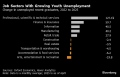
New grads join worst entry-level job market in years Every generation seems to think they’re entering the workforce at a difficult time—just ask those still-reeling 2008 grads who launched during the Great Recession—and they’re not entirely wrong.

1749599247462.png

But computer engineering majors—once among the most highly sought-after specialisations—have the third-highest unemployment rate for recent grads, at 7.5 per cent, after only anthropology and physics majors.
 

MisterBill2

Joined Jan 23, 2018
27,652
The secret seems to be to find a profession you enjoy where the demand exceeds the supply, and then be good at what you do. And never refuse a request to do a project for the company. That attitude puts one into the "indispensable" bracket rather solidly.
 

Thread Starter

nsaspook

Joined Aug 27, 2009
16,340
https://www.yahoo.com/news/ghost-students-hijacking-millions-colleges-112700195.html?guccounter=1
‘Ghost’ students are hijacking millions from colleges—and locking real human students out of classes
At one college, more than 400 different financial-aid applications could be tracked back to a handful of recycled phone numbers. “It was a digital poltergeist effectively haunting the school’s enrollment system,” said Burris.

The scheme has also proved incredibly lucrative. According to a Department of Education advisory, about $90 million in aid was doled out to ineligible students, the DOE analysis revealed, and some $30 million was traced to dead people whose identities were used to enroll in classes. The issue has become so dire that the DOE announced this month it had found nearly 150,000 suspect identities in federal student-aid forms and is now requiring higher-ed institutions to validate the identities of first-time applicants for Free Application for Federal Student Aid (FAFSA) forms.
I took a lot of nonsense classes to keep the VEGIB money rolling in (it was paying for my first house) but I did go to every class and got real grades.
 
Last edited by a moderator:

WBahn

Joined Mar 31, 2012
32,925
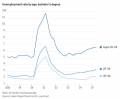
It's very difficult to derive much in the way of meaningful information, beyond COVID sucked.

The reason is that it treats all bachelors degrees as equal. But the job prospects for someone with a degree in electrical engineering are not the same as someone with a degree in Film and Television. A huge fraction of degrees are in very "fuzzy" majors and many of them have few job prospects in that field. So it only takes a few of those to dominate the unemployment statistics regardless of how good the situation might be for majors where a bit more thought went into picking it. Similarly, the huge drop between age categories may reflect a couple of years after graduating (typically at 22 or 23, so not a huge sample when the grouping is people 20 to 24) when people in majors with low job prospects still think that they might actually work in that field some day, but after a few years realize that they need to get jobs unrelated to their degrees to put food on the table. But since they are now employed, it makes the unemployment numbers look better for their higher age groups. These are just a couple of possible explanations and factors, and they may or may not hold water if the data were scrutinized more closely -- but that's the point, data like this makes any kind of useful scrutiny impossible.
 

MisterBill2

Joined Jan 23, 2018
27,652
It's very difficult to derive much in the way of meaningful information, beyond COVID sucked.

The reason is that it treats all bachelors degrees as equal. But the job prospects for someone with a degree in electrical engineering are not the same as someone with a degree in Film and Television. A huge fraction of degrees are in very "fuzzy" majors and many of them have few job prospects in that field. So it only takes a few of those to dominate the unemployment statistics regardless of how good the situation might be for majors where a bit more thought went into picking it. Similarly, the huge drop between age categories may reflect a couple of years after graduating (typically at 22 or 23, so not a huge sample when the grouping is people 20 to 24) when people in majors with low job prospects still think that they might actually work in that field some day, but after a few years realize that they need to get jobs unrelated to their degrees to put food on the table. But since they are now employed, it makes the unemployment numbers look better for their higher age groups. These are just a couple of possible explanations and factors, and they may or may not hold water if the data were scrutinized more closely -- but that's the point, data like this makes any kind of useful scrutiny impossible.
CERTAINLY W.B. makes a very good point about some statistics. The "B.A. degree in Elizabethan Literature" may be a fun thing for some person being sent off to school by very wealthy parents, but what sort of employment would it prepare anybody for??
I have wondered about that back in the times when I was looking at university course catalogs. That was part of my motivation to enroll in a Technical Institute, instead. Not only was the education much more toward my area of interest and experience, but also I did not suffer the presence of those "sent off to school" to get them out of the house. There might be fewer of those folks now since tuition costs are now about 100TIMES what mine were. Of course that is probably due to the college of engineering that I graduated from having been corrupted into a university offering every imaginable degree. Such a pity.
 

MisterBill2

Joined Jan 23, 2018
27,652
I only worked at one company that paid me well enough to put up with that sort of foolishness. And they did not operate that way. There were informal discussions that were always related to the project at hand and how to do things best. So things worked very well.
Of course, after three stints at major auto companies, I only considered employment with much smaller organizations, the ones with very few layers between me and the owners. Those were vastly more enjoyable, and paid better as well.
It was much better to be a fish in a pond than to be a guppy in the ocean.
 

WBahn

Joined Mar 31, 2012
32,925
Every technical job (so not counting early stints in fast food) involved working outside of normal business hours. Even as a co-op student at NIST, I was given keys to building and came in after hours to get work done or to tend to equipment that needed to run 24/7. It was not only part of the job, but I enjoyed both the flexibility and the responsibility involved. I never had much problem wrapping my personal life around my work life (some might point out that that was because my personal life was so sparse, and they'd have a point). But there's a key difference between my experience and the situations that I imagine they are talking about in that article, and that's the creep in expectations about availability to do work stuff outside of hours by people that otherwise don't want that to be the case. For me, I was always fortunate enough to have jobs where I was more than willing to be available because I enjoyed the work so much. I realized very early in life that I did not want to work at a job where I spent all day waiting for the work day to end, but would rather be where the end of the work day would come as a somewhat unwelcome surprise.

I actually think that my first actual, formal job after high school, as a dishwasher at a buffet restaurant, set the tone for me. Despite being a minimum wage, low-skill job, the work atmosphere that the manager was able to craft was such that most of us spent a lot of time there after work helping out because being there was so enjoyable. We would work all day on our normal shift, and then come back about an hour before close and help everything else close out so that we could then go out and spend time together, whether it was midnight movies, or bowling, or just hanging out at the gravel pits. In an industry where the majority of people don't last past three months before quitting, I was there a year and a half and, in that time, not a single one of us left. Then things shifted as the assistant manager was given more control (at the insistence of the district manager) and within about three months nearly all of us were gone because it just wasn't enjoyable enough to be worth the aggravation. As a result, I've always been pretty sensitive to the "vibe" of the workplace and sought out places that had a good one (which, admittedly, you can only get an estimate for until after you actually work there, but you learn to detect the signs, both good and bad, pretty quickly during the interview process).
 

Thread Starter

nsaspook

Joined Aug 27, 2009
16,340
https://finance.yahoo.com/news/auth...fice-is-at-an-inflection-point-201435253.html
We're at this inflection point now where companies really have to decide if they ever want to get people back. The longer you wait, the harder it is to ever get people to come back without a big fight.

Right now, people might be saying, ‘I will quit if I have to go back to the office,’ but it turns out they don't mean it. The reason, of course, is it's one thing to say that you will quit; it's another to actually walk away from a paycheck.

Lots of employers trumpeted the success of remote work not that long ago. What changed?

One thing that changed is the labor market softened. It's not the case that people are job hopping right now because there just aren't very many jobs offered. The number of jobs that are being offered with some kind of remote possibility is declining.
 
Top