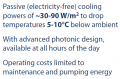
The future of air conditioning...

crutschow

Joined Mar 14, 2008
38,536
Interesting.
But achieving the large radiative area in a vacuum chamber with a large IR transparent window needed for reasonable heat radiation could be problematic to do at a practical cost.
I think the amount of heat energy radiated by this method is quite small on an area basis.
 

WBahn

Joined Mar 31, 2012
32,896
More typical pie-in-the-sky ivory-tower dreaming.

They go out of their way to thermally isolate the space being cooled using ten heat shields, superinsulation, and vacuum chambers pumped down to the microtorr range so that they can achieve the smallest parasitic heat load they can in an area about the size of a soup. They don't mention the cooling power they achieved, but it was probably in the sub-watt range by quite a bit. Then talk immediately starts about using this to cool large office buildings, even though the paper itself states that significant temperature reductions require ultra-low parasitic heat losses. In fact, in the presence of parasitic heat loss typical of "unsophisticated" experimental setups (which by most standards would be pretty damn good, just not ultra great), their approach achieves almost the same performance as other previously demonstrated radiative approaches (about a 10°C differential) -- and that's still for a sealed, isolated chamber. Quite a huge leap for any kind of thermal throughput like even a small air conditioner would need to handle.
 

#12

Joined Nov 30, 2010
18,224
Right. I call BS.
The "parasitic" heat in this case is millions of BTUs per hour.
There is no mention of BTUs per square foot of radiator surface.
Wouldn't it be lovely to have a magic heat window into outer space!
A square foot of magic IR radiator replaces 1000 square feet of air cooled radiator coils on top of a building...
but only into a clear sky...
We could put a dozen of these in the Sonoran desert and fix Global Warming.:D
ROFL!
 

Thread Starter

cmartinez

Joined Jan 17, 2007
8,783
Thanks all for your eye-opening opinions... boy, I'm glad I'm not the one looking for investors in this technology
 

Thread Starter

cmartinez

Joined Jan 17, 2007
8,783
No. Mr. Pragmatic found it a waste of time.

The mere mention of air conditioning was a red herring the size of Montana.
Nothing but click bait.:(
:( ... bummer.... perhaps I could get you interested in investing on very a very attractive piece of land on the moon instead? o_O:D
 

wayneh

Joined Sep 9, 2010
18,115
I found this interesting only because my dad used to tell me about an exam question he had in a chemical engineering class. It asked what is the highest temperature at which you can still get frost to form on a surface. I believe the answer was 40°F, after a few simplifying assumptions. Of course the only reason it is so high is because of black-body radiation to space. It's certainly a relevant phenomenon, but it's already in wide use!
 

Thread Starter

cmartinez

Joined Jan 17, 2007
8,783
I found this interesting only because my dad used to tell me about an exam question he had in a chemical engineering class. It asked what is the highest temperature at which you can still get frost to form on a surface. I believe the answer was 40°F, after a few simplifying assumptions. Of course the only reason it is so high is because of black-body radiation to space. It's certainly a relevant phenomenon, but it's already in wide use!
I'm guessing wind chill also plays a role? o_O
 

Tesla23

Joined May 10, 2009
560
This is just the opposite of the 'Sydney Tube' solar hot water collector, which is a tube in an evacuated tube, that gets VERY hot in sunlight. I saw a demo where oil in one was used to fry eggs. They are used all over the world now for solar hot water.

This cooling device is simply something that gets cold when exposed to the clear sky. It's a brilliant idea. I've no idea of what it costs to make, or it's lifetime, but the performance is interesting, from:

https://arpa-e.energy.gov/sites/default/files/Day 1 radiative cooling - Aaswath Raman.pdf
upload_2016-12-14_22-4-54.png

Your department of energy commissioned a study www.pnnl.gov/main/publications/external/technical_reports/PNNL-24904.pdf that suggests (in the executive summary) that for a 5000m^2 office building:

Relative to the VAV system, the proposed photonic radiative cooling system saves 103 MWh electricity in Miami, 55 MWh in Las Vegas, 50 MWh in Los Angeles, 24 MWh in San Francisco and 43 MWh in Chicago, per year. The saved electricity represents 50%, 45%, 65%, 68%, and 55% of the VAV system cooling electricity, respectively in the above five cities.

So it's not BS or junk science, the physics is sound, the economics are uncertain.
 

wayneh

Joined Sep 9, 2010
18,115
So it's not BS or junk science, the physics is sound, the economics are uncertain.
It's a very clever way to get more value out of the evacuated tubes in a solar collector of that type. I saw a prototype installation years ago but haven't seen much since. I think the players went out of business.
 

wayneh

Joined Sep 9, 2010
18,115
Well, to do what they did in the lab would be tough. But as noted, there has been a commercial product that comes very close, a black body radiator inside an evacuated clear tube.

One of the things limiting the efficiency of any air conditioner is the size of its heat exchanger. If I could run my hot freon lines somewhere over the house so that they could radiate to space at night, I would absolutely increase the efficiency of my A/C system. But piping and heat exchangers cost money.
 

#12

Joined Nov 30, 2010
18,224
Top