the flash as you call it is just a current flow indicator. Like the old flash charge light. While the current flows to charge the cap the led is on. When it’s done no more flow so it turns off.
The LED isn't breaking the circuit; it's completing the series circuit. Once the cap has charged the only current that can flow is miniscule leakage current. That passes through both the cap and the LED.
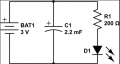
It has to be parallel as the diagram I posted. From what I saw doing a quick net search it does work. Interesting concept and thanks for bringing it up.
A capacitor will block DC currents, and the diode only allows current in one direction. That's why there's no way to discharge the capacitor in your circuit.
Caps do not block DC. You apply a DC voltage to a cap and it will charge up to the supply votage and no more. If you then attach an LED anode to the cap cathode and the LED cathode to the cap anode the cap will dissipate charge down to the threshold voltage of the LED. For example, I have an LED with a specified voltage range of 3.2 to 3.8 volts. The actual threshold voltage is 2.8 volts. If I charge an appropriate cap to 3.8 volts and then connect the LED to it the LED flashes and goes off. When you measure the charge in the cap it is not competely discharged but shows a voltage of 2.8 volts: the threshold voltage of the LED. Try it.
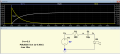
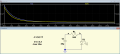
Perhaps this simulation will help to explain things :
Note: The voltage V(b) dropped by the LED D1 is fairly constant (~2V), so the voltage V(a,b) across the capacitor never reaches the supply voltage V+.
Perhaps this simulation will help to explain things : View attachment 182983
Note: The voltage V(b) dropped by the LED D1 is fairly constant (~2V), so the voltage V(a,b) across the capacitor never reaches the supply voltage V+.
You need an oscillator to make repeated flashing. A transistor or a 555 timer can be an oscillator.
You can buy a flashing LED that already has the flashing circuit inside it.
You need an oscillator to make repeated flashing. A transistor or a 555 timer can be an oscillator.
You can buy a flashing LED that already has the flashing circuit inside it.
That is what I saw when he first posted. This is how it is supposed to work. Quite a different matter than all in series. I can see this possible working but didn't try it in LTS.
That is what I saw when he first posted. This is how it is supposed to work. Quite a different matter than all in series. I can see this possible working but didn't try it in LTS.
I just knocked that one up. The LED is lit but not flashing. I didn't have a 2.2mF cap so I put a few together in parallel. Closest I could get was within 0.34 mF. Don't know if that's a problem. Anyway. I will do a few sums based on this layout see what they turn up. My LED was a 3.2 to 3.8 volt one. But 3v lights it up obviously. Tried it with a 1.8 -eo 2.2 red LED too. Same result. I need to get a 2.2 cap and give it another go before I can definitively say it doesn't work.

 Facebook
 Google
 GitHub
 Linkedin