test equipment question, ohms not accurate on multimeter

Jon Chandler

Joined Jun 12, 2008
1,605
You would find that having a frequency counter separate from a function generator is more flexible.

Why a frequency counter? A decent signal generator can output a clean sine wave at a known frequency. Measure the AC output voltage in steps across the frequency range and plot on log-log paper to see the results.

I suppose measuring input voltage at each frequency would be a good step to make sure it's constant.

Oh, and the output needs to be converted to dB to evaluate filter rolloff.

dB = 20 log(Vout/Vin)

Math. Them's the breaks.
 

Homebrew1964

Joined Nov 22, 2024
225
Why a frequency counter? A decent signal generator can output a clean sine wave at a known frequency. Measure the AC output voltage in steps across the frequency range and plot on log-log paper to see the results.

I suppose measuring input voltage at each frequency would be a good step to make sure it's constant.

Oh, and the output needs to be converted to dB to evaluate filter rolloff.

dB = 20 log(Vout/Vin)

Math. Them's the breaks.
I can't stand math, and dB i have no idea, i work in Volts when i want to know the strength of a signal
when i made my filter and tested it i used my scope to measure the volt drop...i don't know how to change dB to volts or vice versa and since i hate math i'm not in a great hurry to find out.....have i said i hate math???
 

MisterBill2

Joined Jan 23, 2018
27,639
Quite a few signal generator circuits do not deliver a constant amplitude as the frequency is changed. At least that used to be the case with the less expensive kits that I have built, years ago. And as for frequency: consider a panel with the non-linear calibration printed on it, covering about three decades of frequency on a scale that would be perhaps three inches long, or maybe five inches on some models. Now try to accurately read that to within 2% of being right.
And in response to post #82, plotting response in decibels is just a way of making it more convenient for those folks who ONLY UNDERSTAND Decibels.

Actual voltage ratios and responses are much harder to fudge, and also easier for non-math majors to understand.
OF COURSE, those measurements DO require a meter calibrated in actual volts. I understand that can be a problem for some folks with only decibels on Db meters.
 

MrChips

Joined Oct 2, 2009
34,862
dB is not volts.
dB is a ratio, for example, Vout / Vin.

0 dB = 1 : 1
-6 dB = 1 : 2 = 0.5
-12 dB = 1 : 4 = 0.25

For example, if your input is 1 V and the output is 0.25 V, that is -12 dB.
 

Jon Chandler

Joined Jun 12, 2008
1,605
have i said i hate math???

I do believe you've mentioned that in passing.

.... and dB i have no idea....
Filter response is logarithmic.

If a filter rolls off 6dB per octave....

A change of 6dB is a doubling of level (if positive) or a halving of level (if negative). A change of 20dB is a 10× change in level.

An octave is a 2:1 frequency span. 100Hz to 200 Hz is an octave. 200 Hz to 400 Hz is one octave.

Soooo.....

If you measure 1.0 volts output at 100 Hz and 0.5 volts at 200 Hz, the slope of the filter is –6dB per octave.

If you measure 1.0 volts output at 1000Hz and 0.25 volts at 2000 Hz, the slope of the filter is –12dB per octave.
 

MisterBill2

Joined Jan 23, 2018
27,639
I am totally aware that " dB is not volts "!! And I am also aware that it is a easy way to confuse beginners, because, as a ratio, it is not locked to a specific reference level. THAT is why we also have "VU" meters, which display dB above, or below, a standard power level at a specific impedance.

For plotting filter response, measuring voltage is a lot easier to provide accuracy without the "funny math" that allows confusing claims.
Besides that, Volts are exactly the same all over the world, on everybody's voltmeters. That is important sometimes.
 

Jon Chandler

Joined Jun 12, 2008
1,605
Besides that, Volts are exactly the same all over the world, on everybody's voltmeters. That is important sometimes.
I don't believe most DVMs, particularly of the hobbyist grade, have any funny math decibel scales. So, any results plotted in dB will have to use the log(base 10) math operation, which is, as far as I know, a reliable operation on scientific calculators.

dB = 20 log (Vout / Vin)

For Vin = 1 volt and Vout = 0.5 volt:

dB = 20 log (0.5 / 1) = 20 log (0.5) = 20 * -3.01 = - 6.0 dB. I don't hear any laughing and my calculator took the blink of an eye to make the calculation.

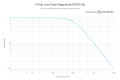
The standard way to display filter response curves is log (octaves, decades) vs. dB. The slope is simple to read from the graph,

1 KHz LP Filter Response Log log.png

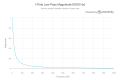
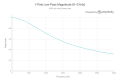
A linear plot (linear frequency vs Vout/Vin) makes it very difficult to characterize filter response.

1 KHz LP Filter Response Linear.png

Your mileage may vary.
 

Jon Chandler

Joined Jun 12, 2008
1,605
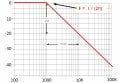
Using a log-log (actually semi-log 'cause dB) makes it easy to estimate filter response at any frequency.

The stating point is the cut-off frequency:

F = 1 / (2pi R C)

This point is the zero dB starting point.

From this point draw a line according to the degree of filter through the next octave or decade and continue to the end of the graph.

For the case shown, F = 1000 Hz and it's a single pole filter, so the response will be 20dB down at 10KHz. From here, the response at any frequency can be estimated.

Correction on graph: F = 1 / (2pi R C).
quick response estimate.jpg
 
Last edited:

Papabravo

Joined Feb 24, 2006
22,085
I can't stand math, and dB i have no idea, i work in Volts when i want to know the strength of a signal
when i made my filter and tested it i used my scope to measure the volt drop...i don't know how to change dB to volts or vice versa and since i hate math i'm not in a great hurry to find out.....have i said i hate math???
Engineering doesn't care if you love or hate math. That's sorta like being a carpenter and saying: "I hate wood". You'll learn everything you need to know about math, or you WILL FAIL at engineering as either a hobby or a career. You don't have to agree with me and my comment may seem harsh. Post again in 2031 and tell me if my prediction has legs. I wait with baited breath.
 

Homebrew1964

Joined Nov 22, 2024
225
Engineering doesn't care if you love or hate math. That's sorta like being a carpenter and saying: "I hate wood". You'll learn everything you need to know about math, or you WILL FAIL at engineering as either a hobby or a career. You don't have to agree with me and my comment may seem harsh. Post again in 2031 and tell me if my prediction has legs. I wait with baited breath.
If i hated wood, why would i be a carpenter?, that doesn't even make sense.

I am content to build and play with circuits built by other people who have done the hard part for me (designing), i am not nor will i ever be an electronics engineer, i am just a hobbiest who enjoys and is fascinated with electronics, i don't have the brains or IQ to go any further than that unfortunately, i also have ADHD which makes life hard at times.

I can handle basic ohms law and have just learned the frequency cut off equation but that's about it for me.
 
Last edited:

MisterBill2

Joined Jan 23, 2018
27,639
REgarding plotting on log scales: certainly, not plotting a filter response that covers the range of frequencies involved will always be unsatisfactory. Every time! Not plotting "the regions of interest" results in a plot that may be both accurate and useless. THAT is why we learned to find "poles" and "zeros" of functions. It was a handy trick for learning how things worked.
 

MisterBill2

Joined Jan 23, 2018
27,639
For both the hobbyist and the engineering professional, an actual understanding of the physics of what happens is very useful. That may include knowing what "the associated math" is, and, for the "pro", at least, being able to use "the associated math" to quantify what is happening.
 
Top