Tape echo unit dead motor...

Thread Starter

Ignoramus

Joined Jul 18, 2022
13
Hi everyone.
I have an 80s tape echo mixer amplifier unit with a bad motor I'd like to repair.
Motor was working but sparkling, so it would add sparkle noise to the signal. It was unusable that way.
I opened the motor and tried to repair by making new brushes, but unsuccessfully.

So now I need a new DC motor. The original had 4 wires coming out and 4 separate brushes, 2 on each side. I suppose 2 power the motor and the other 2 send some signal back to regulate the speed.

I measured blue and red give 21.2V and blue and black (or yellow) give 20.6. Other combinations 0V. I guess blue is + and red -. Maybe I'm wrong.

When I turn the motor speed pot, voltage stays the same. I don't know how it controls the speed.

I think the median motor speed should be around 4000rpm, I measured the pulleys and asked our friend Chet to calculate for me.

I'm wondering what kind of motor should I get as a replacement. Would it be possible to find a similar enough motor as a direct replacement? Or should I just take the 21v source and put a new motor and a controller inside. A PWM or voltage control...?


The unit sounds good, but it isn't very valuable, so the fix shouldn't be overly expensive...
I'd like to fix it, but still tempted to give up. It is big and disassembled now. So a bit in the way...

The schematic is unavailable. Unit is Solton Commander 2000

Not sure how to proceed...
I'd appreciate any help. Thanks
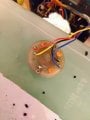
DSC_0351.JPGDSC_0350.JPG
 

KeithWalker

Joined Jul 10, 2017
3,603
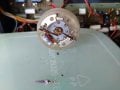
That is an unusual construction. I have no idea where the extra two wires go. Can you unscrew one of the brush spring holder plates so we can see how the extra wire is connected?
 

Thread Starter

Ignoramus

Joined Jul 18, 2022
13
Hi, thanks for your interest :)

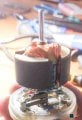
There are actually 4 brushes, 2 pairs of 1 on top of the another. No contact between any of them.
I suppose 2 were (+) and (-) which should power the motor, I think blue and red. And other 2 were maybe reading some signal and sending it back to the unit. Like a generator I suppose. So it would fine control the speed of the motor somehow.
On the rotor there are separate contact points for the lower pair and the upper pair. No continuity between any of them. I don't have a picture of a rotor. I can make it in a few days.

They are not typical brushes, like carbon set in a piece of metal.
But they are small copper plates, approx. 2x20mm which had carbon somehow glued on them. This carbon didn't give any continuity when I opened.
So I guess either someone before me opened it and put the brushes on the other side of the motor because the carbon lost continuity for whatever reason and made it work by making it metal to metal contact...

Or it was metal to metal in the beginning, and the carbon was glued on the other side for whatever reason...

I tried to solder a small metal ring with carbon inside of it, like diy brushes. It even worked when I used super glue, but it got too hot and fumed my room... So next 2 times without super glue we're just too weak.

IMG-20250222-WA0012.jpeg

But it was just too fiddly, I gave up after 3 tries... I could try it again and even if I would succeed not sure how long it would last.

So now I'm thinking, maybe the best solution would be to try to get an another motor. It seems impossible to source the original one... But not sure if it would have too unstable speed without this feedback from the motor to fine tune the speed...
I think it should turn around 4000rpm. Maybe my best bet would be a DC motor from an another reel to reel unit, or a cassette player if not too weak torque... I looked up brushless DC motors for RC cars, but they aren't very cheap and I'm not sure if they would work for my application...

Sorry, this is a bit hard to explain for me, I'm not a native speaker, so write too many words :)
 

KeithWalker

Joined Jul 10, 2017
3,603
OK, now I see how it is connected. I have never seen a motor like that before. Do the segments on the commutator contact both the drive and sense brushes, or are there two sets of electrically isolated segments?
 

Thread Starter

Ignoramus

Joined Jul 18, 2022
13
OK, now I see how it is connected. I have never seen a motor like that before. Do the segments on the commutator contact both the drive and sense brushes, or are there two sets of electrically isolated segments?
2 sets isolated, no continuity between them
 

MaxHeadRoom

Joined Jul 18, 2013
30,558
The motor looks like it could be a repulsion start- induction run motor,
A few more details needed, i,e, voltage? AC or DC?
Sparking on a comm based motor often indicates shorted winding!
 

KeithWalker

Joined Jul 10, 2017
3,603
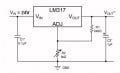
The echo unit probably has a steady constant torque when it is running, so you could probably control the speed of a replacement motor with a preset adjustable DC voltage source. Just set the control to get the right speed.
CV.jpg
 

Thread Starter

Ignoramus

Joined Jul 18, 2022
13
The echo unit probably has a steady constant torque when it is running, so you could probably control the speed of a replacement motor with a preset adjustable DC voltage source. Just set the control to get the right speed.
View attachment 349303
Thanks, I'll save this. So when I buy a motor I'll try it.
I'm thinking about getting a brushless motor at a rc hobby shop. But they are all pretty fast. I calculated and 4000rpm should be the max speed, not median. Going down to maybe 1000 or less. Not sure how slow until I try. It should be stable at all speeds... Not sure how important is stability in these rc car, boat etc motors.
Should these brushless motors work well at lower voltages?

Is there any numbers on the motor
It says NEO 1066 on the motor housing.
 

KeithWalker

Joined Jul 10, 2017
3,603
A brushless motor would not make a very good replacement. For the power you require, it would be physically much smaller and you would have a problem matching the shaft diameter as most brushless hobby motors have thicker shafts. You would also need a brushless motor speed controller for it.
 

Thread Starter

Ignoramus

Joined Jul 18, 2022
13
After realising that I have a malfunctioned auto reverse tape deck which is integrated into a hifi amp I'm using in the next room.
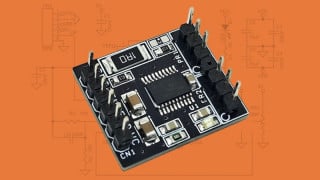
I salvaged the 12V motor from it and put it in the Solton unit. Along with a step down converter with a potentiometer so I can manage the speed with voltage...

It works good, the sound still isn't perfect. But I think after putting a new belt and a proper pulley on the motor it should be really good. Also better tape.
So the easy and free solution was in front of my nose the whole time...

Thanks everyone for your help
 
Top