Switching Polarity in Electromagnet.

Status
Not open for further replies.

MisterBill2

Joined Jan 23, 2018
27,651
As I consider the description much more carefully, it seems a lot like the description of a transformer. Transformers have been made and used that include magnetized cores to avoid saturation by DC current in a winding. Transformer technology is a quite mature field and there is a great deal of information available as to exactly how they function. There are also a number of textbooks available on the topic. I am suggesting that some study of the topic would allow far better descriptions of what is proposed, and that better descriptions always lead to better answers on the AAC website. Presently the whole thing is not as clear to me as it should be, and thus my responses may not all have been applicable. My mind-reading ability is very poor, I admit.
 

ebeowulf17

Joined Aug 12, 2014
3,307
If you really have 24 gauge magnet wire, it's about 40 feet per ohm. You might even have 26 gauge, which is 24'/Ω. So yeah, the resistance of your coil is probably more than 0.1Ω. You would also have an internal resistance in your power source. These would dramatically reduce the current. You could measure the actual voltage across the coil under load. But don't linger!
I think this is the next logical step. Either get accurate coil resistance measurements, followed by measurements of voltage across the coil under load (with those two, actual current draw can be calculated easily,) or add a low value, high precision, shunt resistor in series between the battery and one coil, then measure voltage and calculate current.

I strongly suspect that @wayneh is right and that total resistance (both coil and battery) is higher than previously estimated.

If the current is quite a bit lower, then the MOSFET selection and gate drive considerations all get much cheaper and easier. No reason to source parts for 800A switching if we're only really switching some small fraction of that.

As for people's fears of over-unity discussions, everyone is really jumpy around here. I get it - it's very tiresome talking to people with crackpot over-unity theories... but not everyone who's trying as new experiment is attempting over-unity. In this case I assumed the "inexhaustible supply" referred to solar cells, benefits from utilizing the earth's magnetic field, or some other natural resources which appear to be, for all practical purposes, inexhaustible. I saw nothing that immediately screamed over-unity. I think everyone needs to relax a little on that issue around here.
 

ebeowulf17

Joined Aug 12, 2014
3,307
Presumably the correctly rated H-bridge with MOSFETs may also be equipped with the appropriate heat sink, as long as one checks the fine print.
Oh, of course! I'm sure there are a few rotten apples out there, but all power MOSFETs I'm familiar with are designed to be easily mounted to suitable heat sinks, and they should have datasheets with sufficient specs to let you calculate heat sink requirements. If a MOSFET claims a particular amperage rating, it should be achievable, just not without external heat sinks.
 

wayneh

Joined Sep 9, 2010
18,118
In this case I assumed the "inexhaustible supply" referred to solar cells, benefits from utilizing the earth's magnetic field, or some other natural resources which appear to be, for all practical purposes, inexhaustible. I saw nothing that immediately screamed over-unity.
Ditto. I was surprised when OU was mentioned in this thread. I figured I had missed something. There might be crackpot ideas involved (no offense to the TS) but I don't think OU is one of them.
 

shortbus

Joined Sep 30, 2009
10,049
As for people's fears of over-unity discussions, everyone is really jumpy around here. I get it - it's very tiresome talking to people with crackpot over-unity theories... but not everyone who's trying as new experiment is attempting over-unity. In this case I assumed the "inexhaustible supply" referred to solar cells, benefits from utilizing the earth's magnetic field, or some other natural resources which appear to be, for all practical purposes, inexhaustible. I saw nothing that immediately screamed over-unity. I think everyone needs to relax a little on that issue around here.
Ditto. I was surprised when OU was mentioned in this thread.
Go back and read his response to me in post#24 and his description of what he want to do in the start of this thread.
And then tell me how all of this doesn't sound like OU. Don't look at the claims of 800A @ 12V, but how he describes what he is doing then his statement of inexhaustible energy. I think you guys are looking at the electrical side and not the proposed machine from the machine point of view. Using coils to turn electromagnets in a sphere to create AC from DC. I know of no way that physics allows such a thing to happen, at least not in the northern hemisphere, maybe things really do work different down under.
 

ebeowulf17

Joined Aug 12, 2014
3,307
Go back and read his response to me in post#24 and his description of what he want to do in the start of this thread.
And then tell me how all of this doesn't sound like OU. Don't look at the claims of 800A @ 12V, but how he describes what he is doing then his statement of inexhaustible energy. I think you guys are looking at the electrical side and not the proposed machine from the machine point of view. Using coils to turn electromagnets in a sphere to create AC from DC. I know of no way that physics allows such a thing to happen, at least not in the northern hemisphere, maybe things really do work different down under.
I've gone back and re-read post 24 as well as the early posts describing the apparatus.

I make no claims about understanding how the (deliberately) complex fields will interact, nor what output can be derived from them, but there's no mention in any of those descriptions of increasing, amplifying, harvesting, or creating energy. The only mention of inexhaustible energy referred to solar power. While solar power isn't technically inexhaustible, and it currently takes a fair bit of equipment to harness it, it will just keep on going until our sun burns up, which is hopefully a long, long time from now! It's as close to inexhaustible as anything we know of.

The thread starter didn't ask for advice on magnets or fields, only how to switch unreasonably large currents, so I'm focusing on that. Nevertheless, if l were to extrapolate from what we've heard so far, I'd say the thread starter is working on something more like an improved inverter. Right now many systems for making AC from DC are bulky, hot, expensive, and result in blocky square waves (or "modified" waves) with loads of unwanted harmonic content. If this helical magnet motion can generate "smoother" (more sinusoidal) waves with less energy lost as heat, that might be a worthwhile discovery. I have no idea if my extrapolations are right, but either way, it's none of my business.
 

-live wire-

Joined Dec 22, 2017
959
Go back and read his response to me in post#24 and his description of what he want to do in the start of this thread.
Using coils to turn electromagnets in a sphere to create AC from DC. I know of no way that physics allows such a thing to happen, at least not in the northern hemisphere, maybe things really do work different down under.
What about a DC motor spinning a motor that generates AC? Plus it may also produce free energy if they are connected. ;) Obviously a proper inverter would be better, but that might be possible.
 

-live wire-

Joined Dec 22, 2017
959
The best DC motors are maybe at most 80% efficient. The best AC generator motors tend to be 60% efficient. So that means at most .8*.6 = 48% efficiency.
 

Thread Starter

james31207

Joined Sep 19, 2018
72
If you really have 24 gauge magnet wire, it's about 40 feet per ohm. You might even have 26 gauge, which is 24'/Ω. So yeah, the resistance of your coil is probably more than 0.1Ω. You would also have an internal resistance in your power source. These would dramatically reduce the current. You could measure the actual voltage across the coil under load. But don't linger!
I originally calculated the resistance as R=[rho] x [length]/CSA use a value for resistivity for copper of 1.75 x 1/[10]9 Ohm.m, which I now find, somehow, at the same but recently up-dated 'Wikipedia' site, to be incorrect: [rho] is now 1.68 x 1/[10]8 Ohm.m, ~10 times greater. The resistance is now therefore of the order of 1 Ohm. (The 'Wikipedia' site on 'Electrical Resistance' also suggests that R=0.02 Ohms for 1 metre of copper wire of diameter 1 mm, which would give me a resistance of 1.2 Ohms for 15 m of wire). Anyway, I'll do the measurement later.

It seems clear now that the 12 V battery I'm using is delivering up to about 90 Amps; so if I'd realised that at the outset, things would have been less confusing--and I apologise for that. Thanks again for your efforts.
 
Last edited:

Thread Starter

james31207

Joined Sep 19, 2018
72
What about a DC motor spinning a motor that generates AC? Plus it may also produce free energy if they are connected. ;) Obviously a proper inverter would be better, but that might be possible.

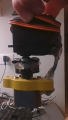
This guy 'Shortbus' seems, for some peculiar reason, to have a bee in his bonnet about 'over-unity' pretensions, which is quite ridiculous; and seems to derive in his improper attention to what I actually write. The magnets in the core of the device are permanent magnets, arranged as an ideal propeller, geometrically, a helix circumscribed by a sphere: one side North, one side South. The original idea was simply to drive this 'propeller', mounted on its vertical axis, around using a rotating magnetic field generated in surrounding electromagnets, 12 of them. This I can do through 135 degrees of rotation until a switch in polarity is necessary in the EMs. That is, having attracted the North side of the magnetic propeller to itself, the EM polarised South must switch polarity to repel it away, towards the next EM which is polarised South. The same thing, oppositely polarised is happening on the other side of the apparatus. Right. The EMs are powered by a simple 12 V battery, which needs to be replenished.

Now, what I want to find out is, if I wrap a copper winding around the core magnetic helix/ propeller in a particular way so that when that core is being driven around by the external field, that winding will be subject at all times to a continuous and varying magnetic field arising in the relation between the fields of the interior permanent magnets and the external field generated in the EMs, whether any current will be generated in that winding. I postulate that it will be alternating current--but I don't know that, nor whether any current at all will result. If it is AC, then I would be entitled to expect that it would possess properties peculiar to the manner of its induction, that being continuous. Alright. No 'free energy', no 'over unity', and, I beg your pardon sir, no need to study too much more quantum electrodynamics.
 

Thread Starter

james31207

Joined Sep 19, 2018
72
Why would you think a sphere would work any better for this than the normally used cylinder?

Why do you consider it is going to make AC by pulsing DC into a field made with permanent magnets?

Finally this is why I think you are trying to make some sort of device that will make more volts and current than is put into it. The, "get more out of what is put in" is the description of "over unity". Plain and simple. Do some more reading on how things work.

Mr. 'Shortbus', sir: you seem, for some peculiar reason, to have a bee in your bonnet about 'over-unity' pretensions, which is quite ridiculous; and seems due to your improper attention to what I actually write. The magnets in the core of the device are permanent magnets, arranged as an ideal propeller, geometrically, a helix circumscribed by a sphere: one side North, one side South. The original idea--and that idea was always to use a 'spherohelix'-- was simply to drive this 'propeller' around, mounted on its vertical axis, using a rotating magnetic field generated in surrounding electromagnets, 12 of them. This I can do through 135 degrees of rotation until a switch in polarity is necessary in the EMs. That is, having attracted the North side of the magnetic propeller to itself, the EM polarised South must switch polarity to repel it away, towards the next EM which is polarised South. The same thing, oppositely polarised is happening on the other side of the apparatus. Right. The EMs are powered by a simple 12 V battery, which needs to be replenished.

Now, what I want to find out is, if I wrap a copper winding around the core magnetic helix/ propeller in a particular way so that when that core is being driven around by the external field, that winding will be subject at all times to a continuous and varying magnetic field arising in the relation between the fields of the interior permanent magnets and the external field generated in the EMs--and that is a single integrated magnetic field--, any current will be generated in that winding. I postulate that it will be alternating current--but I don't know that, nor whether any current at all will result. If it is AC, then I would be entitled to expect that it would possess properties peculiar to the manner of its induction, that being continuous; and it is the nature of those properties in which I am interested. Alright. No 'free energy', no 'over unity', and, I beg your pardon sir, no need to study too much more quantum electrodynamics, and certainly not with respect to the design of this device.
 

Alec_t

Joined Sep 17, 2013
15,119
if I wrap a copper winding around the core magnetic helix/ propeller in a particular way so that when that core is being driven around by the external field, that winding will be subject at all times to a continuous and varying magnetic field
Will the winding rotate with the core or be static?
Whatever, if it's subject to varying magnetic fields then AC will be induced in it. The waveform will be highly dependent on the geometry of the apparatus.
 

wayneh

Joined Sep 9, 2010
18,118
I originally calculated the resistance as R=[rho] x [length]/CSA use a value for resistivity for copper of 1.75 x 1/[10]9 Ohm.m, which I now find, somehow, at the same but recently up-dated 'Wikipedia' site, to be incorrect: [rho] is now 1.68 x 1/[10]8 Ohm.m, ~10 times greater. The resistance is now therefore of the order of 1 Ohm. (The 'Wikipedia' site on 'Electrical Resistance' also suggests that R=0.02 Ohms for 1 metre of copper wire of diameter 1 mm, which would give me a resistance of 1.2 Ohms for 15 m of wire). Anyway, I'll do the measurement later.

It seems clear now that the 12 V battery I'm using is delivering up to about 90 Amps; so if I'd realised that at the outset, things would have been less confusing--and I apologise for that. Thanks again for your efforts.
No need to apologize - resolving discrepancies is how we gain understanding about what is really going on.

One word of advice - you should find out the specifications of your wire and abandon using approximate dimensions of 0.5mm or 1mm or whatever, unless of course that's truly what you have. Use the tables (or formulas used to create the tables) supplied by the industry that provide precise values for the dimensions and electrical properties. For instance if you know you have 26AWG magnet wire, communicating that fact alone tells us all the other properties because that's a highly defined entity. When you talk about 0.5mm wire, that raises question marks about what it really is. I understand that standards vary around the world and not everyone uses AWG. Perhaps others here can read as much into "0.5mm" as into 26Ga. I can't.
 

Thread Starter

james31207

Joined Sep 19, 2018
72
I think this is the next logical step. Either get accurate coil resistance measurements, followed by measurements of voltage across the coil under load (with those two, actual current draw can be calculated easily,) or add a low value, high precision, shunt resistor in series between the battery and one coil, then measure voltage and calculate current.

I strongly suspect that @wayneh is right and that total resistance (both coil and battery) is higher than previously estimated.

If the current is quite a bit lower, then the MOSFET selection and gate drive considerations all get much cheaper and easier. No reason to source parts for 800A switching if we're only really switching some small fraction of that.

As for people's fears of over-unity discussions, everyone is really jumpy around here. I get it - it's very tiresome talking to people with crackpot over-unity theories... but not everyone who's trying as new experiment is attempting over-unity. In this case I assumed the "inexhaustible supply" referred to solar cells, benefits from utilizing the earth's magnetic field, or some other natural resources which appear to be, for all practical purposes, inexhaustible. I saw nothing that immediately screamed over-unity. I think everyone needs to relax a little on that issue around here.
I have now checked, and the current delivered from this 12V car battery is in fact about 90 Amps at 10 Volts; and of course, had I realised this at the outset, there would have been less confusion. I apologise for that, citing only my lack of technical training and experience in my defence. So, the current to each coil in parallel is no more than about 8 Amps, and through an H-Bridge to 6 EMs around 50 A. Also, I've sent one of the EMs to the local university to have the resistance measured. It should still be about 0.1 Ohms; but this now seems immaterial.

When I mentioned an 'inexhaustible supply' from Solar cells, I'm imagining vast arrays of solar panels--in the deserts of Australia for example--generating DC where the main practical problem is storage of that output. The ordinary solution is large batteries which then require transportation etc., unless, as they will eventually be to some extent, they are incorporated into buildings etc..

What I thought long after imagining this apparatus as it is, and in the course of wondering what its actual purpose might be--presuming that some current, likely AC, is actually generated in the winding/armature of the rotor--, was that the form of the current might somehow be appropriate to the more efficient electrolysis of water than is traditionally possible. Were this true, then one would have a cheap efficient source of hydrogen gas, and a practical means of storing solar energy.

The basis of such a conjecture is that whatever the electrodynamics implicated in photosynthesis--and conversely mitochondrial reduction of oxygen gas to water--, they are certainly so subtle and efficient that they cannot yet be reproduced experimentally. There is a certain further basis in the physics of electron spin, but that is even more hypothetical. Eventually of course, either this experiment actually demonstrates something or it doesn't.

The odd thing is though that there is not really any need for any improvement in efficiency of electro-hydrolysis if one's source of DC is solar power, out in the deserts. I wonder then why the economy of locomotion at least is not being transformed to hydrogen, if you will bear with what is really only a rhetorical question; isn't it?
 

Thread Starter

james31207

Joined Sep 19, 2018
72
No need to apologize - resolving discrepancies is how we gain understanding about what is really going on.

One word of advice - you should find out the specifications of your wire and abandon using approximate dimensions of 0.5mm or 1mm or whatever, unless of course that's truly what you have. Use the tables (or formulas used to create the tables) supplied by the industry that provide precise values for the dimensions and electrical properties. For instance if you know you have 26AWG magnet wire, communicating that fact alone tells us all the other properties because that's a highly defined entity. When you talk about 0.5mm wire, that raises question marks about what it really is. I understand that standards vary around the world and not everyone uses AWG. Perhaps others here can read as much into "0.5mm" as into 26Ga. I can't.
Yes, I must make a quite embarrassing apology here. The wire I'm using is actually 1.5 mm diameter, and while I have recalculated the resistance using the corrected figure for resistivity to obtain the same approximate value for the resistance (~0.1 Ohms), the fact that the current through each EM coil is only about 8 to 10 Amps changes the picture considerably. I'm not sure why my recollection of the gauge was incorrect, but the apparatus itself is in a shed in the bush which I only visit periodically, in my time off; fortunately my brother checked a few things for me yesterday. The main new data though is the lower current, which as was suggested makes things a lot easier.
 
Last edited:

Thread Starter

james31207

Joined Sep 19, 2018
72
What properties have you conjectured so far, apart from amplitude, frequency, phase (relative to EM actuation and mechanical rotation angle) and harmonic content?
The principal conjecture is that whatever current, presumably AC, is generated, it will conduct more efficiently. What I suppose is that the coil-like nature of the winding itself ('90 degree laps', progressing with each full loop around the core) may imply some reduction in reactance and impedance; for example, the maximum voltage might coincide with the maximum rate of change in current, and that voltage might then collapse while the current maintains that transition; although so far this is just imaginative visualisation of what MIGHT occur. Of itself, such a property might somehow be useful, although at the modest levels of power generated, I'm not sure how.

And this is from one of the other replies. What I thought long after imagining this apparatus as it is, and in the course of wondering what its actual purpose might be--presuming that some current, likely AC, is actually generated in the winding/armature of the rotor--, was that the form of the current might somehow be appropriate to the more efficient electrolysis of water than is traditionally possible. Were this true, then one would have a cheap efficient source of hydrogen gas, and a practical means of storing solar energy.

The basis of such a conjecture is that whatever the electrodynamics implicated in photosynthesis--and conversely mitochondrial reduction of oxygen gas to water--, they are certainly so subtle and efficient that they cannot yet be reproduced experimentally. There is a certain further basis in the physics of electron spin, but that is even more hypothetical. Eventually of course, either this experiment actually demonstrates something or it doesn't.

The odd thing is though that there is not really any need for any improvement in efficiency of electro-hydrolysis if one's source of DC is solar power, out in the deserts. I wonder then why the economy of locomotion at least is not being transformed to hydrogen, if you will bear with what is really only a rhetorical question; isn't it?

To answer your other question, the winding is fixed onto the 'spherohelical core'--if you will excuse my invention of this geometric term--, and rotates with it. Every component of that continuous winding abuts a component of that permanent magnetic core. It is not really a transformer, as someone suggested, nor a motor, although the rotor is being driven: it is intended as a generator.
 
Status
Not open for further replies.
Top