Switching between 2 batteries using mosfets ~ not working!

Thread Starter

Rasil1127

Joined May 13, 2023
22
It's a similar device, but does not have rail-rail output as the LT6375 does (did you not see the part no. on the schematic?).
The LT6375 is built by Analog Devices.
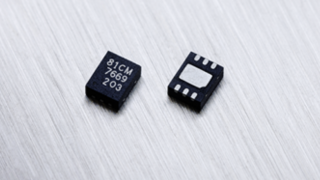
Ah I just saw now, sorry however LT6375 is not available in the uk for cheap. I was only able to get the ina117p for £4 each. Since I will be needing 2. The lt6375 costs around £12 each without postage and packaging. Is there a way I could use the ina with modification or it’s just not possible with this circuit.
 

Thread Starter

Rasil1127

Joined May 13, 2023
22
It should work, but since it's not rail-rail, you would likely need to use a plus and minus supply for its power.

Can you get a INA132, which is designed to work from a single supply.
Nope, still around £10 order for ina117p just arrived so i can test it out. that plus and minus supply cant we use a resistor divider to power it?

Also the plus and minus is confusing me, is it asking for -15v and +15v or GND and 15v?
 
Last edited:

crutschow

Joined Mar 14, 2008
38,522
cant we use a resistor divider to power it?
I'm puzzled as to why you would buy a component without first understanding how it would work (or not work) in your application. :rolleyes:

No, a divider won't help.
With a single supply, the output can only go down to about 3V above ground, since it doesn't have a rail rail output (below for ±15V supply):
Don't see a good workaround for that other than providing a plus and minus (two separate supplies to ground) for the device.

1684255400513.png
 
Last edited:

Thread Starter

Rasil1127

Joined May 13, 2023
22
I'm puzzled as to why you would buy a component without first understanding how it would work (or not work) in your application. :rolleyes:

No, a divider won't help.
With a single supply, the output can only go down to about 3V above ground, since it doesn't have a rail rail output (below for ±15V supply):
Don't see a good workaround for that other than providing a plus and minus supply to the device.

View attachment 294342
Ah, sorry my bad i just had saw it and bought it in advance so it can get here quickly. i guess if it won't be able to work i still have to find another method. Again, i don't know how this component works i apologise if i make a mistake here or ask a dumb question.. however you said it can go down to 3v above ground with a single supply, is there a chance it could work still? since my adc is 3.3v on the esp32 and i was going to use a resistive divider anyway to lower the voltage.
 

crutschow

Joined Mar 14, 2008
38,522
it can go down to 3v above ground with a single supply, is there a chance it could work still? since my adc is 3.3v on the esp32 and i was going to use a resistive divider anyway to lower the voltage.
You would need to offset the difference amp output by +3V, and then add another op amp to cancel the 3V offset.
All in all, rather messy.

Suggest you just buy a small DC-DC converter to generate the minus supply voltage.
 

Thread Starter

Rasil1127

Joined May 13, 2023
22
Possibly, but I don't have time to work on that right now.
i decided to create -15v and +15v since it would be easier and you wouldn't have to come up with some new circuit.

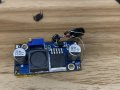
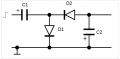
I have xl6009e1 dc dc step up converter which i modified to carry -15 and +15v using this diagram for removing the +15.

12v goes into the converter and +16.3v comes out on its normal rail however -15v comes out on the second rail (i assume its lower because of diode drop), i hope this is sufficient since the ina117p can have +-20v as its input. i understand this voltage may not be clean, i cannot check that since i don't have an oscilloscope. but it is using the same method any off-the-shelf would use.

C1:50v 22uf
C2:16v 220uf
D1: 1N4148
D2: 1N4148
 

Attachments

crutschow

Joined Mar 14, 2008
38,522
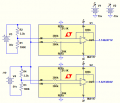
I have successfully connected both of the chips with their supply. and their input is from a resistor divider however the problem is that one of them on its own working correctly but when 2 batteries are connected one of the batteries voltage dip. this reading is in volts
Since I'm, not clarivoyant, I can't really help without seeing a complete schematic of what you have.
 

crutschow

Joined Mar 14, 2008
38,522
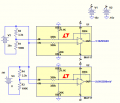
This is the sim of the basic difference circuit;
I see no significant difference in the the 36V output when I change V4 from 0V to 51v.

But note that the connection is different then what you used.
Your connection does exhibit your noted problem, perhaps due to some sneak path.
The plus side of the battery is common in the circuit, so the low resistance of the voltage divider should go to that.
I did not make that clear in my previous post.

1684365366256.png
1684365408330.png
 
Last edited:

Thread Starter

Rasil1127

Joined May 13, 2023
22
This is the sim of the basic difference circuit;
I see no significant difference in the the 36V output when I change V4 from 0V to 51v.

But note that the connection is different then what you used.
Your connection does exhibit your noted problem, perhaps due to some sneak path.
The plus side of the battery is common in the circuit, so the low resistance of the voltage divider should go to that.
I did not make that clear in my previous post.

View attachment 294422
View attachment 294423
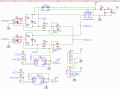
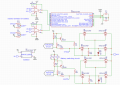
Hi, i ended up using your circuit like this and just adjust in software for the offset. your circuit is working great! i thank you for spending the time to help me. i also wanted to experiment with INA132 like you suggested it only requires positive input, however, it is not working correctly. 1 on its own works well but then if I have 2 of them to measure both batteries only one works and the other one doesn't. both are tested. someone else suggested that it may be an issue with the absolute potentials of IN- and IN+ falling outside the INA132's common-mode input voltage range which is true, because i get some weird voltages when probing across IN-, IN+ and chip ground. around 9v, 6v... full schematics: Screenshot 2023-06-22 194136.png
 
Last edited:
Top