Surface Mount Resistor Value

Thread Starter

HBN

Joined Mar 26, 2014
9
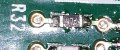
I am trying to identify a surface mount resistor value for a project.

Is the picture below a "47D" which would be 301kΩ or "472" which would be 4.7kΩ or something else. Sorry about the lighting. It was hard to get a good shot with proper lighting and magnification.
 

Attachments

#12

Joined Nov 30, 2010
18,224
That sure is hard to read! How much resistance does it show on an Ohm meter?

ps, the solder joint on the left seems wrong.
 

Thread Starter

HBN

Joined Mar 26, 2014
9
138k ohm. Can I measure resistance in circuit?

The marking look like "47d" - small d
There are some other resistors on the board which are marked "34d" - small 'd" again.

The small "d" isn't complete though.

I'll try to post a better picture.
 

#12

Joined Nov 30, 2010
18,224
138k ohm. Can I measure resistance in circuit?
Fairly often, you can't. For a guaranteed proper reading, you have to unsolder at least one end of the resistor.
In this case, a surface mount resistor is not going to cooperate. You will have to unsolder both ends.
 

Thread Starter

HBN

Joined Mar 26, 2014
9
Managed to get a "34d" SMD removed and measured.

It was 221kΩ.

Apparently the first two letter "34" equate to 221 and the third letter "d" (small d) is the multiplier or 1000. D= 1000x.

My confusion was seeing a small "d" marking. I guess they use a small "d" to avoid confusion with an "0" or "O".

A "47d" is 301kΩ.

Thank you for the help.
 

#12

Joined Nov 30, 2010
18,224
These markings and their results are outside the scope of my experience.

That's a nice way of saying, "Where in the world did anybody come up with a numbering system like that?" 474 means 470k Since when does 47 mean 301???
 

#12

Joined Nov 30, 2010
18,224
Wow! A 3 digit numbering system. Such an improvement over a 4 digit numbering system!

(This method describes 1% resistors.)
 
Last edited:

#12

Joined Nov 30, 2010
18,224
One more way to obfuscate the circuits, as far as an old fart is concerned.:mad:

All that back and forth checking to translate something we used to be able to read like English.
 

ErnieM

Joined Apr 24, 2011
8,415
One more way to obfuscate the circuits, as far as an old fart is concerned.:mad:

All that back and forth checking to translate something we used to be able to read like English.
I'm "meh" on both the EIA-96 marking method system and the need for it. It does allow marking on one size down from the present limit: I try to use size 0805 and up because these have a value marking.

I hate that I now need a sheet of paper or an interweb to read a resistor value.

All in all, I am glad I learned something.
 
Last edited:

AnalogKid

Joined Aug 1, 2013
12,129
I forgot about EIA-96. Haven't seen it yet in our inventory.

The problem is speed. When you're making one million resistors per hour (!), the marking method has to be quick plys readable. 4 digits was barely ok on 0805 parts. There are at least 4 sizes smaller than that, and I've seen markings on two of them. I don't like EIA-96 because it isn't cyclic, but I grudgingly understand the need for it.

ak
 

ErnieM

Joined Apr 24, 2011
8,415
Makes me wonder why so many capacitors are not marked at all.
SMD caps come straight from the world of hybrid microcircuits, just change the termination metal and off you go. They have been that industry’s standard for several decades before using a SMD was common, an industry that traditionally never put a reference designation on anything (it needs room!) and never marked a component anyway (why when you screen on your own resistors?). Chips *sometimes* have a part number, but you need a 50x power microscope to see it.

One analog guru I once worked with (now retired to Florida and I've lost touch) would purposely choose caps of different voltage ratings just to get different sizes for different values so a visual inspection would show placement problems: no “pick & place” for hybrids, it was all done manually, mostly with tweezers under a microscope.
 
Last edited:
Top