Superglue for securing SMD parts prior to hand soldering?

Thread Starter

AlbertHall

Joined Jun 4, 2014
12,622
I often have problems hand soldering SMD parts, specifically getting the position right and not moving while soldering.
Could I use a tiny dot of superglue to secure the part in place prior to soldering?
 

MrChips

Joined Oct 2, 2009
34,663
For resistors, etc., I put down a tiny bit of solder on one pad before placing the component. I never have to use glue.

If you must, I would be inclined to try a tiny dot of contact cement.
 

WBahn

Joined Mar 31, 2012
32,736
Tweezers have a habit of pinging the components into space. I've got some reverse tweezers coming to try out.
You want a good set of tweezers. Also, people tend to squeeze with much more force then they need to -- the fact that they are flinging off into space is a strong indicator that too much force was being used. Just squeeze as much as is needed to hold the component, no more -- there should be almost no elastic energy stored in the tweezer arms that can be turned into kinetic energy of a flying component.
 

WBahn

Joined Mar 31, 2012
32,736
1206 resistors, capacitors, SOT23, SOIC ICs mostly
These small components lend themselves to putting a tiny amount of solder on one pad and then heating that pad while positioning the part in place with the tweezers. That one soldered leg will hold it nicely. It even works very nicely with things like large quad flat packs by tacking down one pin near a corner and then a pin on the other corner.
 

Thread Starter

AlbertHall

Joined Jun 4, 2014
12,622
These small components lend themselves to putting a tiny amount of solder on one pad and then heating that pad while positioning the part in place with the tweezers. That one soldered leg will hold it nicely. It even works very nicely with things like large quad flat packs by tacking down one pin near a corner and then a pin on the other corner.
Yes, that is the technique that (I try to) use.
I hope the reverse tweezers will help.
 

nsaspook

Joined Aug 27, 2009
16,260
Yes, that is the technique that (I try to) use.
I hope the reverse tweezers will help.
IMO you should practice with good regular squeeze SMD tweezers because you do need learn the feel of holding the parts while moving the parts to be proficient at SMD part soldering. Good tweezers allow you to modulate the holding force predictably so there is little need to over-clamp (and send it flying) a part from fear of dropping or tenting while soldering.

My reverse tweezers in the kit never get used.
 

Ian0

Joined Aug 7, 2020
13,103
Don't use superglue - it stinks.
Get a good hot-air rework station. Tin the pads, heat the area with the hot air, hold the part in place with tweezers and release it when the solder wets it.
Don't hand-solder MLCC capacitors I have had far too many fail after hand-soldering. After a small amount of time they stop being capacitors and suddenly decide to be resistors of about 30Ω shorting out the power supply.
 

samunal

Joined Jul 3, 2024
26
usually in case of leadless packages we can use some glue below the component to fix, but most of them have ground pad beneath. Moreover my soldering approach with the SMT packages having small leads, is to solder one pin first then adjust and position the component then solder and fix it properly. You can also go with SMT stencil services.
 

Ya’akov

Joined Jan 27, 2019
10,226
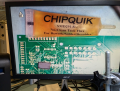
No clean tacky flux from a company like Kester, Chipquick, or MG Chemicals is kind of glue for your components. It is designed to retain the position of the parts for hand or hot air soldering and is safe for the components and PCB.

It is “no clean” because it could be left in place—but you will probably want to clean it. You can get water soluble versions but IPA (Isopropanol, not beer) will work well.

Tacky flux is really quite a useful thing, try it.
 
Top