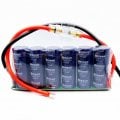
Welcome to AAC.i forgot to mention that the capacitors are 2.7v 800f
And the capacitance of the 6 in series is 133F.i forgot to mention that the capacitors are 2.7v 800f
There are commercial capacitor-based jump starters that work very well. But they aren’t just a bunch of caps and a fuse.Exponential decay is a fearsome impediment in this application. I am extremely dubious of claims that this might be a good idea. I actually think it could be dangerous.

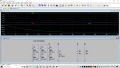
"Boosted"????? Does that mean that the battery was not able to turn the engine over at all??? Or does it mean something different from that?? It has become very clear to me that some folks attach entirely different meanings to words, and so I am asking for a clarification. Some of those differences are quite a lot.I boosted my car a few times with 18V drill batteries so this could work in a pinch if you have some way to charge each capacitor to 2.7V or some multiple. I don't know how to model a starter motor but there appears to be sufficient energy in this bank to turn over my car once or twice on a warm day. Paired with a solar panel, this could be handy if the details are worked out.
View attachment 311943
My 05 Civic has a parasitic load which randomly appears. I think it is has to do with the subwoofer wiring routed by the previous owner. Anyway, I would come out to find the battery discharged to 11.5-12V and the car would not start on that."Boosted"????? Does that mean that the battery was not able to turn the engine over at all??? Or does it mean something different from that?? It has become very clear to me that some folks attach entirely different meanings to words, and so I am asking for a clarification. Some of those differences are quite a lot.
A few years back I had a winter incident with my car at an airport parking lot, after a five day trip away. the weather while I was gone had stayed well below freezing the whole time.
I tried to start it, and there was not enough to turn over the engine on a 5 second try.
So I abandoned the effort and spent many minutes digging the snow away from the front so I would be able to get a jump start. Then, before walking the long trip to get the battery cart for the jump start, I tried once again. The battery had warmed up just a bit and it had enough to do a feeble crank, which was all it needed.
So the difference between a start and a no-start may be a small amount
One thing I learned, on sub-zero days, was that if the thing didn't want to start, turn on the headlights for a couple of minutes to warm up the battery. That worked on a number of occasions. The battery had the necessary energy stored, but the internal resistance was too high at the temperature to deliver the needed current."Boosted"????? Does that mean that the battery was not able to turn the engine over at all??? Or does it mean something different from that?? It has become very clear to me that some folks attach entirely different meanings to words, and so I am asking for a clarification. Some of those differences are quite a lot.
A few years back I had a winter incident with my car at an airport parking lot, after a five day trip away. the weather while I was gone had stayed well below freezing the whole time.
I tried to start it, and there was not enough to turn over the engine on a 5 second try.
So I abandoned the effort and spent many minutes digging the snow away from the front so I would be able to get a jump start. Then, before walking the long trip to get the battery cart for the jump start, I tried once again. The battery had warmed up just a bit and it had enough to do a feeble crank, which was all it needed.
So the difference between a start and a no-start may be a small amount
Sometimes ya gotta do what ya gotta do.My 05 Civic has a parasitic load which randomly appears. I think it is has to do with the subwoofer wiring routed by the previous owner. Anyway, I would come out to find the battery discharged to 11.5-12V and the car would not start on that.
I got stranded one day and all I had was a Ryobi PBP006 18V 2Ah 36Wh battery and a pair of jumper cables. I did some rough math and figured the current would be close to what the power tools draw. There were sparks but it took about 2 minutes before the car would start. I wasn't willing to push the battery more than that in fear of a fire. There was no heat and the battery appears to be ok.
Not surely if I did any damage to the battery or vehicle but it was worth more to me to get home. I wouldn't use this as my primary backup but it does work.
My friend asked me to boost him yesterday but before I got around to doing it, his truck started up after resting for 10 minutes.One thing I learned, on sub-zero days, was that if the thing didn't want to start, turn on the headlights for a couple of minutes to warm up the battery. That worked on a number of occasions. The battery had the necessary energy stored, but the internal resistance was too high at the temperature to deliver the needed current.
I don't know if it would on today's cars with modern headlamps. This was on a '75 Bronco with the old-fashioned sealed beam headlights, which took about 15 A to 20 A, IIRC. It was enough to do the trick several times. Of course, in addition to the headlamps, all of the running and parking lights were on, too. I don't recall if I turned on the high beams or not -- way too long ago, but I might have.My friend asked me to boost him yesterday but before I got around to doing it, his truck started up after resting for 10 minutes.
I didn't think headlights alone would be enough current to heat up the battery.
| Thread starter | Similar threads | Forum | Replies | Date |
|---|---|---|---|---|
| R | Super Capacitor in Receiver | General Electronics Chat | 19 | |
| L | Super Capacitor Discharge Circuit | General Electronics Chat | 16 | |
| K | Super capacitor over voltage | General Electronics Chat | 18 | |
| K | Super capacitor analysis | Homework Help | 6 | |
|
|
Super Capacitor Jump Starter Circuit | Power Electronics | 15 |