Hi Eric, thanks for helping me.Hi N03,
Welcome to AAC.
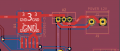
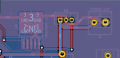
Do you have a photo that you could post of the PCB, front and back?
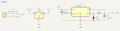
What is the design current in the 3.3v, load.?
E


I also think it's short wiring but I don't know why. I posted the PCB front and back photo above, could you please check it?A likely short in the wiring. The schematic does not help since it does not show a short.
I understand but the 7805 only got broken when I solder LM2596s. Before that I test 7805 independently with 12V source and it works normally(though it dissipates lots of heat), so I don't think that's the reason.Hi,
As you may know the 7805 can only dissipate about 2.5 Watts without an heat sink, so a drop from 12V to 5V at 10Amps is 7V *10A = 70Watts.
E
Hi, N03,I understand but the 7805 only got broken when I solder LM2596s. Before that I test 7805 independently with 12V source and it works normally
Yes, I notice that. I didn't design this PCB. The one who designed this PCB told me that he used two regulators to compensate for the excess amount of heat dissipation. He said that it will produce lots of heat to drop from 12V straight to 3.3V so he wanted to drop step by step, from 12V to 5V then from 5V to 3.3V.Why are you reducing the voltage via an inefficient linear regulator before reducing it further with an efficient switching regulator?
How much current do you need at 5V and at 3.3V?
Oh nice, I will look over it. Thanks!I have used the 7805 for many years. When I first used it, it didn't work. I was told to add a capacitor across the Input - to GND. Sure enough, that fixed it. Turns out, it is also in the datasheet.
"If the device is more than six inches from the input filter capacitors, an input bypass capacitor, 0.1 μF or greater, of any type is needed for stability."
I would also recommend adding one on the output. The datasheet shows a 0.22uF on the Input and a 0.1uF on the Output.
The idea is sound, but he got it backwards. The drop from 12 o 5 is where the most power is lost, for two reasons:Yes, I notice that. I didn't design this PCB. The one who designed this PCB told me that he used two regulators to compensate for the excess amount of heat dissipation. He said that it will produce lots of heat to drop from 12V straight to 3.3V so he wanted to drop step by step, from 12V to 5V then from 5V to 3.3V.
I will try to eliminate 7805 and stick with LM2596S. Thanks!
Yes, I notice that. I didn't design this PCB. The one who designed this PCB told me that he used two regulators to compensate for the excess amount of heat dissipation. He said that it will produce lots of heat to drop from 12V straight to 3.3V so he wanted to drop step by step.
I will try to eliminate 7805 and stick with LM2596S. Thanks!
Yes, I understand now. Thank you so much for your great help, guys!The idea is sound, but he got it backwards. The drop from 12 o 5 is where the most power is lost, for two reasons:
1. Both the current used at 5V and that used at 3.3V goes through that regulator.
2. The voltage drop is 7V vs 1.7 from 5 to 3.3.
Using a switching regulator from 12 to 5 followed by a linear one 5 to 3.3 is reasonable. The other way around is silly,