SUCCESS STORIES: Repair thermoelectric cooler

Steveorama

Joined Feb 9, 2021
14
I'm not convinced those are "blown". That sort of violence usually leaves pieces and char marks. Those look like jumpers that were cut or something like that.
Thanks for your reply... I was told it was connected the wrong way round and something went pop. I'm not an engineer but I've connected a meter and there's continuity coming in but nothing across those two. As the symbol there is for diodes I thought maybe they've just blown and can be replaced?
 

Steveorama

Joined Feb 9, 2021
14
I'm not convinced those are "blown". That sort of violence usually leaves pieces and char marks. Those look like jumpers that were cut or something like that.
Do you think it could be 2 diodes to prevent backfeed that got fried by a reverse connection? If so can you recommend what to use to replace?
I'm guessing around 14/15v and 8a as those would be the maximum it would be fed by a battery and the most it draws?
 

Thread Starter

wayneh

Joined Sep 9, 2010
18,180
Do you think it could be 2 diodes to prevent backfeed that got fried by a reverse connection? If so can you recommend what to use to replace?
I'm guessing around 14/15v and 8a as those would be the maximum it would be fed by a battery and the most it draws?
Maybe, but in that case they shouldn’t have blown doing the thing they were designed to do. Voltage ratings on diodes can be much higher without adding much expense. It’s the amperage rating that is critical, and those are too small for more than 2A or so. There shouldn’t have been any current! And again, I’ve never seen one blown clean off the board without a scorch mark. Not denying it’s possible...

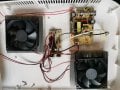
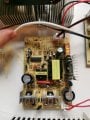
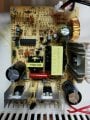
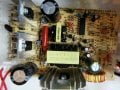
Maybe a good picture of the entire board would help someone spot something.
 

Steveorama

Joined Feb 9, 2021
14
Maybe, but in that case they shouldn’t have blown doing the thing they were designed to do. Voltage ratings on diodes can be much higher without adding much expense. It’s the amperage rating that is critical, and those are too small for more than 2A or so. There shouldn’t have been any current! And again, I’ve never seen one blown clean off the board without a scorch mark. Not denying it’s possible...

Maybe a good picture of the entire board would help someone spot something.
On thanks. I've put one in the original post but I'll get some more.
 

Steveorama

Joined Feb 9, 2021
14
On thanks. I've put one in the original post but I'll get some more.
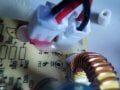
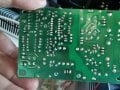
Here a few more... I'm hoping somebody can help me out please! I'm new here and this thread looked like a similar board.
 

Attachments

Steveorama

Joined Feb 9, 2021
14
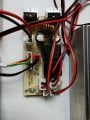
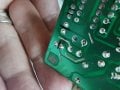
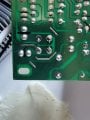
Here's the underside of the board in the area of the 12v in /out and those two diodes(?). There's some marks there so I'm convinced that's what's burned out. I guess I need advice on what to replace with please? Do your boards above have that sort of reverse feed protection and what values are they /would you recommend. This cooler is rated @ 72w.
Let's hope that's the only thing that's fried.
 

Attachments

Thread Starter

wayneh

Joined Sep 9, 2010
18,180
Do your boards above have that sort of reverse feed protection ...
No, I don't think so. Most or all of the coolers in this thread ar AC powered with no need to protect against the user making a reverse connection.

A more-or-less standard, general purpose, generic diode is the 1N400x series. It's rated to 1A continuous and a reverse voltage ranging from 35 (1N4001) to 700V (1N4007). They're only a few cents each. You could try them and "see what happens". If they get too hot, you could get ones with higher current ratings. Schottky diodes are often used for reverse polarity protection, because of the lower voltage drop they provide. eg.: 1N5819

It's possible they were rated to a low current intentionally, so they would sacrifice themselves catastrophically and act like fuses. That is after all exactly what seems to have happened. But this makes no sense to me: If they normally conduct no current, then removing them should not impede function. Maybe they caused a fuse to blow somewhere else.
 
Last edited:

Steveorama

Joined Feb 9, 2021
14
No, I don't think so. Most or all of the coolers in this thread ar AC powered with no need to protect against the user making a reverse connection.

A more-or-less standard, general purpose, generic diode is the 1N400x series. It's rated to 1A continuous and a reverse voltage ranging from 35 (1N4001) to 700V (1N4007). They're only a few cents each. You could try them and "see what happens". If they get too hot, you could get ones with higher current ratings. Schottky diodes are often used for reverse polarity protection, because of the lower voltage drop they provide. eg.: 1N5819

It's possible they were rated to a low current intentionally, so they would sacrifice themselves catastrophically and act like fuses. That is after all exactly what seems to have happened. But this makes no sense to me: If they normally conduct no current, then removing them should not impede function. Maybe they caused a fuse to blow somewhere else.
Ok thanks... I thought they might have to be rated to max load. There is 12v at one end and nothing at the other in both so it does seem like they act like fuses for fuck ups! . Looks like they are the list point before the 12v goes to the second board, either getting 12dc from one input or the inverted 12v from the other mains 220v ac input.
 

Steveorama

Joined Feb 9, 2021
14
Ok thanks... I thought they might have to be rated to max load. There is 12v at one end and nothing at the other in both so it does seem like they act like fuses for fuck ups! . Looks like they are the list point before the 12v goes to the second board, either getting 12dc from one input or the inverted 12v from the other mains 220v ac input.
As they're the link to the board with the fans and peltiers I figured they have to be able to take at least the 8 amp max load?
 

Thread Starter

wayneh

Joined Sep 9, 2010
18,180
As they're the link to the board with the fans and peltiers I figured they have to be able to take at least the 8 amp max load?
They didn't seem that big. And, it would be wasteful to have diodes in the power loop. I'm not at all sure of anything here, just my 2¢.
 

Steveorama

Joined Feb 9, 2021
14
They didn't seem that big. And, it would be wasteful to have diodes in the power loop. I'm not at all sure of anything here, just my 2¢.
Update, I tried the 1A Ones and it worked! Back up and running, thanks very much for your help. Wasn't sure how hot would be too hot... I did have a small ir thermometer but can't find it! If they are too hot to touch I guess that will be bad ? Will check in a bit but so far so good.
 

Thread Starter

wayneh

Joined Sep 9, 2010
18,180
Yes, if they are merely hot, that might be worrisome but possibly ok. If they’re flesh-searing hot, that’s definitely a problem. But I bet you’re good to go.
 

Steveorama

Joined Feb 9, 2021
14
Yeah, I can touch but not for long. I used 1amp 20v rated but an wondering if they need to be a higher voltage rating as those have thicker wire. I didn't think they're on the 220 side of the board so figured 20v quid do it. I've got some 40v that might be better.
 

Thread Starter

wayneh

Joined Sep 9, 2010
18,180
Yeah, I can touch but not for long. I used 1amp 20v rated but an wondering if they need to be a higher voltage rating as those have thicker wire. I didn't think they're on the 220 side of the board so figured 20v quid do it. I've got some 40v that might be better.
It's the amperage that makes the heat. Move to a 2A or more if you're concerned.

If you can do it safely, measure the voltage across the diode. Use the AC setting. That may give an idea of the voltages there.
 

Steveorama

Joined Feb 9, 2021
14
Maybe. There's not much point to a diode if there's only DC. But your meter will still read on the AC range if it is. Reverse the leads if it doesn't.
I've measured the temp with an ir thermometer and they're not getting above 28c so all is fine I'd say... I haven't measured the voltage as its a bit tricky getting in there and I don't want to fuck it up again . Must only be 12 to 12.5 volts though as that's all that's going on?
Thanks again for your help, it seems it lives again
 
Thread starter Similar threads Forum Replies Date
SgtWookie Off-Topic 4
Top