Substituting BD139-10 for 2SC1885, okay?

Thread Starter

13hm13

Joined Jun 1, 2023
75
This is for a 1976 Kenwood KA-3500 integrated amp which I am troubleshooting. (The troubleshooting is for a different issue; see my other Reddit thread about that if you're curious)

The 2SC1885 is part of the Class A biasing circuit, and is not defective. But the weak legs broke while I removed for testing .

2SC1885 is no longer manuf'd (its one of those TO-92L cases).

BD139-10 all I have in the parts bin at the moment. It is not direct replacement for the 2SC1885. But it's the closest that I have to the 2SC1885 at the moment.

QUESTION: is the BD139 close enough to 2SC1885 to work merely ADEQUATELY in the topology of the KA-3500?

See links below for references, schematics and datasheets:

2SC1885:
https://alltransistors.com/transistor.php?transistor=12509

BD139:
https://alltransistors.com/transistor.php?transistor=24713

KA-3500 SM:
https://www.audioservicemanuals.com/k/kenwood/kenwood-ka/160998-kenwood-ka-3500-service-manual

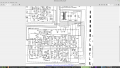
Part of schematic: Qe5 and Qe6 are both 2SC1885, one for each channel.
 

Attachments

Thread Starter

13hm13

Joined Jun 1, 2023
75
Below are some specs that might be useful, all from
https://alltransistors.com/
I specifically have the BD139-10 in my spare parts bin.


BD139 Datasheet, Equivalent, Cross Reference Search

Type Designator: BD139

Material of Transistor: Si
Polarity: NPN
Maximum Collector Power Dissipation (Pc): 12 W
Maximum Collector-Base Voltage |Vcb|: 80 V
Maximum Collector-Emitter Voltage |Vce|: 80 V
Maximum Emitter-Base Voltage |Veb|: 5 V
Maximum Collector Current |Ic max|: 1 A
Max. Operating Junction Temperature (Tj): 150 °C
Transition Frequency (ft): 50 MHz
Forward Current Transfer Ratio (hFE), MIN: 40
Noise Figure, dB: -
Package: TO126

===============

BD139-10 Datasheet, Equivalent, Cross Reference Search

Type Designator: BD139-10
Material of Transistor: Si
Polarity: NPN
Maximum Collector Power Dissipation (Pc): 12 W
Maximum Collector-Base Voltage |Vcb|: 80 V
Maximum Collector-Emitter Voltage |Vce|: 80 V
Maximum Emitter-Base Voltage |Veb|: 5 V
Maximum Collector Current |Ic max|: 1 A
Max. Operating Junction Temperature (Tj): 150 °C
Transition Frequency (ft): 50 MHz
Forward Current Transfer Ratio (hFE), MIN: 63

Noise Figure, dB: -
Package: TO126

================

2SC1885 Datasheet, Equivalent, Cross Reference Search

Type Designator: 2SC1885

Material of Transistor: Si
Polarity: NPN
Maximum Collector Power Dissipation (Pc): 0.75 W
Maximum Collector-Base Voltage |Vcb|: 150 V
Maximum Collector-Emitter Voltage |Vce|: 150 V
Maximum Emitter-Base Voltage |Veb|: 5 V
Maximum Collector Current |Ic max|: 0.1 A
Max. Operating Junction Temperature (Tj): 150 °C
Transition Frequency (ft): 100 MHz
Collector Capacitance (Cc): 3 pF
Forward Current Transfer Ratio (hFE), MIN: 150
Noise Figure, dB: -
Package: TO92
 

WBahn

Joined Mar 31, 2012
32,702
A lazy, low-effort and useless reply.
Someone needs to seriously help the previous two repliers out.
You asked if one transistor was a suitable sub for another. BobTPH not only answered your question, but explained why, namely that one is a small-signal transistor and the other is a power transistor.

There is no need to berate someone that is trying to help you, particularly if you want others to decide that it is worth their time to try to help you.

As for whether the wrong type of transistor will work "adequately" in that circuit, that depends on what YOU deem to be "adequate". There's no way for anyone else to know whether you will find it good enough for what you are doing.
 

Thread Starter

13hm13

Joined Jun 1, 2023
75
You asked if one transistor was a suitable sub for another. BobTPH not only answered your question, but explained why, namely that one is a small-signal transistor and the other is a power transistor.

There is no need to berate someone that is trying to help you, particularly if you want others to decide that it is worth their time to try to help you.

As for whether the wrong type of transistor will work "adequately" in that circuit, that depends on what YOU deem to be "adequate". There's no way for anyone else to know whether you will find it good enough for what you are doing.
Maybe I'm god testin' how smart y'all really THINK you are?
Look at the thorough and comprehensive write up in the TS and follow up posts.
Don't y'all smartypants think I would not have found the AudioKarma thread? It's the FIRST one that comes up in a search for the 2SC1885 device. And, havin' been at AAC for years ... this dump is the LAST last place I search.
One of many possible, logical, and God-approved answers would be NTE399.

All About Circuits is Much Ado About Nothin *'. And not EVEN that.

* Much Ado About Nothing is a comedy by William Shakespeare thought to have been written in 1598 and 1599.
 

Ian0

Joined Aug 7, 2020
13,097
Qe5 and Qe6 are the voltage-amplifier stage transistors.
In an audio power amp, the VAS needs the characteristics of a small-signal transistor (high gain, high speed), but needs to dissipate quite a bit of power - usually about 1 Watt.

The extended package TO92 case was ideal for the purpose - the Japanese made them specifically - it allows a small-signal transistor to dissipate the necessary power.

If you replace it by a small power transistor with lower fT it will affect the frequency response of the loop, and it may well send it unstable.
The BD139 has quite good fT and hfe for a small power transistor: you might be lucky using it as a replacement, or you might turn your amp into a high-frequency oscillator which blows up its power transistors.

If it oscillates and survives the experience, you might get it stable by increasing the value of the capacitor across base and collector.
 
Top