Substitute for variable capacitors and variable inductors for tuning stage

MisterBill2

Joined Jan 23, 2018
27,501
OK, so the tuned circuit is to be part of a receiver, and the goal is for it to be small. What sort of receiver tuning range is required? AND how small is the receiver supposed to be? How selective does the receiver need to be? And what sort of signal is it intended to receive? A receiver has a lot of specifications The first needing definition is the frequency to be received.
 

MisterBill2

Joined Jan 23, 2018
27,501
There are also direct conversion receivers that only need an oscillator and quite a few other parts. They down convert the RF signal by effectively cancelling the carrier frequency. The claim is that they sound very good. And they are sort of simpler.
BUT we still need to know what frequency or range of frequencies. the TS wants to receive. That makes a bit of difference.
 

Thread Starter

DaniKowa

Joined Sep 23, 2020
218
There are also direct conversion receivers that only need an oscillator and quite a few other parts. They down convert the RF signal by effectively cancelling the carrier frequency. The claim is that they sound very good. And they are sort of simpler.
BUT we still need to know what frequency or range of frequencies. the TS wants to receive. That makes a bit of difference.
Hi,

Up to 10Mhz . Better up to 100Mhz.
 

Thread Starter

DaniKowa

Joined Sep 23, 2020
218
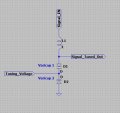
I want also to consider the use of varicap tuning stage. What i don't understand is if the varicap haves the same stability than variable capacitor in fine tuning.

tune.jpg
 
Last edited by a moderator:

MisterBill2

Joined Jan 23, 2018
27,501
OK, this must be a top secret project since the TS will not tell us eithher the frequency or the tuning range.
Is it possible that the TS has no idea about what range?
I do not assist secret projects .
 

Audioguru again

Joined Oct 21, 2019
6,826
Post #24 shows a wide and an extremely wide tuning range. If he holds his breath while carefully tuning he will still miss the station he wants by a long shot.
The FM broadcast band in most countries is from 88Mhz to 108MHz and 100 station frequencies can fit into that band.
 

MrAl

Joined Jun 17, 2014
13,702
I want also to consider the use of varicap tuning stage. What i don't understand is if the varicap haves the same stability than variable capacitor in fine tuning.

View attachment 239896
The capacitance of a varactor varies with temperature. Most oscillator circuits that use varactors also have a phase locked loop to keep the oscillator section stable at one particular frequency.
You can tune the varactor by hand with a pot and DC supply voltage but without frequency stabilization you will most likely have to keep adjusting it as it drifts over time as light air currents bring different temperatures to the circuit. You can always experiment with this though.
 

MisterBill2

Joined Jan 23, 2018
27,501
OK, now we have an upper frequency , we still have no lower frequency.
The mot efficient way to start a design projectis to know what the item being designed is supposed to do.
For small and simple and low power nothing will surpass a singlr coil-capacitor tuned circuit feeding some sort of detector scheme. That will work fairly well to receive AM signals.
But with such a wide tuning range it gets back to being complicated.
The TS needs to understand a lot more of the basics first.
AND, thr fact is that for a resonant circuit, STILL an inductance and capacitance are currently the most effective.
 

Thread Starter

DaniKowa

Joined Sep 23, 2020
218
The capacitance of a varactor varies with temperature. Most oscillator circuits that use varactors also have a phase locked loop to keep the oscillator section stable at one particular frequency.
You can tune the varactor by hand with a pot and DC supply voltage but without frequency stabilization you will most likely have to keep adjusting it as it drifts over time as light air currents bring different temperatures to the circuit. You can always experiment with this though.
Probably this is the reason using variable capacitors instead the varactors . How i can implement a phase locked loop in the circuit above?
 

MisterBill2

Joined Jan 23, 2018
27,501
Probably this is the reason using variable capacitors instead the varactors . How i can implement a phase locked loop in the circuit above?
A phaselocked loop is effectively an oscillator system, that normally serves as a signal source for some purpose. Since we are not really given the purpose of the whole quest, but seeing that the frequency span is very large, the short answer is simply "NO!"

There is no way to simply emulate a series resonant circuit with a phase-locked loop oscillator circuit. And even if it could be done, it would be neither simple nor compact, and certainly it would consume power, since it would not be a passive circuit like the one shown.
One more detail is that the simple version of a PLL system will not cover a wide range of frequencies. Not even an octave under most conditions. Certainly there are many PLL SYSTEMS that can cover a wider range but they are not at all simple, nor small.
 

Audioguru again

Joined Oct 21, 2019
6,826
I have an FM "radio" that scans stations using a varactor tuning diode. The radio was sold at The Dollar Store and is so cheap that the radio is free if you pay two bucks for the two button battery cells it comes with. Its sound is tinny and with high distortion. Its scanning misses many stations. It is overloaded by strong local stations and cannot receive normal or distant stations.
 

MisterBill2

Joined Jan 23, 2018
27,501
I have an FM "radio" that scans stations using a varactor tuning diode. The radio was sold at The Dollar Store and is so cheap that the radio is free if you pay two bucks for the two button battery cells it comes with. Its sound is tinny and with high distortion. Its scanning misses many stations. It is overloaded by strong local stations and cannot receive normal or distant stations.
That single varactor diode controls the local oscillator which sort of sets the receive frequency of that rather poor receiver. And the tuning range is only about 25% of the frequency. and certainoy no PLL system involved. Probably no signal-frequency tuned circuits, only the local oscillator is varied.
 

MrAl

Joined Jun 17, 2014
13,702
Probably this is the reason using variable capacitors instead the varactors . How i can implement a phase locked loop in the circuit above?
Another way to generate a wide range of frequencies is to use a frequency generator chip made just for this purpose. You control it by sending it digital words. The variability is unbelievable with a 32 bit word you get a really large number of frequencies. This would be controlled with a microcontroller chip or board.

I can give you the basics on the PLL and VCO combo and maybe find you some reference circuit to look at to get an idea what it takes to create a circuit like this.

The main idea is that you have a local oscillator that is controlled by the PLL (Phase Locked Loop). The PLL has a reference frequency input typically from a crystal oscillator. The phase of the crystal oscillator is compared to the digitally divided down local oscillator phase (and thus frequency) and the output of the PLL adjusts the frequency of the local VCO using that phase comparison to generate a VCO control signal. When the phases o the two oscillators matches the PLL output only varies slightly up and down keeping the VCO frequency very nearly constant.
By dividing the local oscillator frequency using digital dividers you can generate a wide spectrum of frequencies.

There is a block diagram here, scroll down about half the page to see "Block Diagram"::
https://en.wikipedia.org/wiki/Phase-locked_loop

You are going to have to study this in detail if you wish to design a circuit like this but I'll see if i can find a reference design as that is what you really need to get started.

Another way to generate constant frequencies is to use two crystal oscillators and mix the signals. You get the sum and difference frequencies. Obviously the number of frequencies are still limited by the number of crystals that can be selected unless you combine this with a PLL with VCO circuit also.
 
Last edited:

Thread Starter

DaniKowa

Joined Sep 23, 2020
218
I have an FM "radio" that scans stations using a varactor tuning diode. The radio was sold at The Dollar Store and is so cheap that the radio is free if you pay two bucks for the two button battery cells it comes with. Its sound is tinny and with high distortion. Its scanning misses many stations. It is overloaded by strong local stations and cannot receive normal or distant stations.
Indeed any cheap radio use a variaple caps anyway. Another point to var caps. I seem to untdertstad the var capacitor its more stable than varactor.
 

Thread Starter

DaniKowa

Joined Sep 23, 2020
218
Another way to generate a wide range of frequencies is to use a frequency generator chip made just for this purpose. You control it by sending it digital words. The variability is unbelievable with a 32 bit word you get a really large number of frequencies. This would be controlled with a microcontroller chip or board.

I can give you the basics on the PLL and VCO combo and maybe find you some reference circuit to look at to get an idea what it takes to create a circuit like this.

The main idea is that you have a local oscillator that is controlled by the PLL (Phase Locked Loop). The PLL has a reference frequency input typically from a crystal oscillator. The phase of the crystal oscillator is compared to the digitally divided down local oscillator phase (and thus frequency) and the output of the PLL adjusts the frequency of the local VCO using that phase comparison to generate a VCO control signal. When the phases o the two oscillators matches the PLL output only varies slightly up and down keeping the VCO frequency very nearly constant.
By dividing the local oscillator frequency using digital dividers you can generate a wide spectrum of frequencies.

There is a block diagram here, scroll down about half the page to see "Block Diagram"::
https://en.wikipedia.org/wiki/Phase-locked_loop

You are going to have to study this in detail if you wish to design a circuit like this but I'll see if i can find a reference design as that is what you really need to get started.

Another way to generate constant frequencies is to use two crystal oscillators and mix the signals. You get the sum and difference frequencies. Obviously the number of frequencies are still limited by the number of crystals that can be selected unless you combine this with a PLL with VCO circuit also.
Thanks!
 

MisterBill2

Joined Jan 23, 2018
27,501
Way back towards the start of this thread the TS mentioned both "simple" and "small", and a PLL package that they could build is neither of those.
 
Top