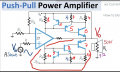
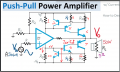
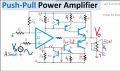
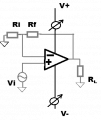
@panic mode explained it pretty well. Just walk through what is happening as you go from small-output to large-output, to overloaded-output.Hello Panic mode , I am trying to analize this situation in a more basic way.
Suppose the output is reduced current is starts flowing towards -Vs(R10) which increases the voltage drop across Q8 and RE,11 so Ic8 is increased..
How can I deside regarding the Vbe of Q7 from this?
Thanks.
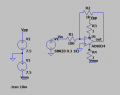
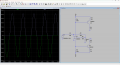
View attachment 365070


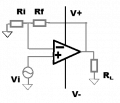
you are simulating using just an OpAmp (very low current), which is also without load connected to its output. so current you are sensing is very small (mA). and since your resistors are only 1 Ohm, voltage drop across them will be in mV. you may want to bump those R3,R4 values to perhaps 100 Ohm. then you will get something usable and matching the original post.
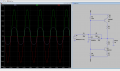
then it should quickly become apparent that adding Q1 does mean business - BJT output current is significantly larger than what OpAmp could do on its own.
if that output current was fed to a speaker (Rload) you would see massive power gain... at least on positive half wave (for now).
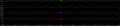
View attachment 365102
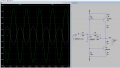
suppose we add the other side:
View attachment 365105
notice that there is a discontinuity at zero. that is expected because both transistors only turn on when OpAmp current exceeds some threshold. for an audio amp that would be unacceptable distortion...
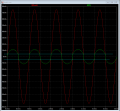
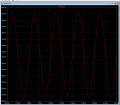
so we combine the three currents (R3,R5,R6) an we see something like this. note that now current through R5 becomes distorted too. and it has to be because the load current is matching input signal (thanks to feedback).
View attachment 365106
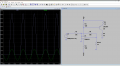
just to be sure, compare input and output. they are out of phase because you opted to connect signal to inverting input
View attachment 365107