Facebook
 Google
 GitHub
 Linkedin

I've had it with Microchip ... they have excellent products, but sometimes they make unwanted and logic-defying changes to their policies and products ...
Anyway ... I am migrating a project that I've been working on from using the PIC16LF1825 to the far more capable PIC16LF18446 which, among other advantages, has double the program memory capacity, much more RAM available registers and uses a single page of code for its entire 14KB capacity.
Now, some of Microchip's datasheets are fairly decent, like the one for the PIC16LF1825. The datasheet is neatly organized and has a nice and clear Memory Map table of sorts, which has proven to be extremely useful for me. And many others of their datasheets are organized in a similar way, which makes them easier to read and quick to browse through when one is in a hurry to verify specific things.
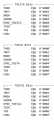
But the datasheet for the PIC16LF18446 is different from the rest. It has an unnecessarily different structure, and does not have a Memory Map. Instead, it has a detailed list at its end (and not at the beginning, as I think it should) that shows each register individually, which is fine by me ... but, I repeat, no Memory Map is anywhere to be seen ... Why the author chose not to include a Memory Map is beyond me, it being such an invaluable tool. So in my desperation, I put together a map myself in an Excel sheet because I knew I couldn't do optimal assembly code without it.
Here's a link for the PIC's datasheet, and I've attached a my version of its memory map for anyone that might be interested. It's the least that I can do for a place that has done so much for me.
Anyway ... I am migrating a project that I've been working on from using the PIC16LF1825 to the far more capable PIC16LF18446 which, among other advantages, has double the program memory capacity, much more RAM available registers and uses a single page of code for its entire 14KB capacity.
Now, some of Microchip's datasheets are fairly decent, like the one for the PIC16LF1825. The datasheet is neatly organized and has a nice and clear Memory Map table of sorts, which has proven to be extremely useful for me. And many others of their datasheets are organized in a similar way, which makes them easier to read and quick to browse through when one is in a hurry to verify specific things.
But the datasheet for the PIC16LF18446 is different from the rest. It has an unnecessarily different structure, and does not have a Memory Map. Instead, it has a detailed list at its end (and not at the beginning, as I think it should) that shows each register individually, which is fine by me ... but, I repeat, no Memory Map is anywhere to be seen ... Why the author chose not to include a Memory Map is beyond me, it being such an invaluable tool. So in my desperation, I put together a map myself in an Excel sheet because I knew I couldn't do optimal assembly code without it.
Here's a link for the PIC's datasheet, and I've attached a my version of its memory map for anyone that might be interested. It's the least that I can do for a place that has done so much for me.
Attachments
-
58.1 KB Views: 6
Last edited: