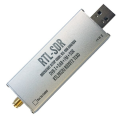
There are also great console programs like the ADS-B decoder dump1090 that let's you watch the transponders of aircraft as they fly over, and rtf_433 that is a data decoder for things like key fob remotes and TPS sensors, as well as a bunch of other things. It targets 433.92MHz, but you can tune to 315MHz (some car remotes), 915MHz (ISM band data), or anywhere else for that matter.
There are also great console programs like the ADS-B decoder dump1090 that let's you watch the transponders of aircraft as they fly over, and rtf_433 that is a data decoder for things like key fob remotes and TPS sensors, as well as a bunch of other things. It targets 433.92MHz, but you can tune to 315MHz (some car remotes), 915MHz (ISM band data), or anywhere else for that matter.
Seeing a 2GHz signal with a few (2.4) MHz bandwidth is magnitudes easier than having a device with 2GHz measurement quality bandwidth. I have a 6GHz HackRF One 20MHz bandwidth with a cost of hundreds more.
Because the SDR is not sampling at the 4+ GHz that would be needed to have the scope you are talking about.
It is mixing the RF signal with a local oscillator signal to shift it down to a MUCH lower frequency. This is then usually downshifted again to baseband and then sampled with a (relatively speaking) slow A2D. The RTL-SDR has a maximum guaranteed sample rate of just 2.56 MHz and only seven bits of effective resolution.
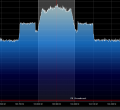
OK here's another question, this is a local FM station and it seems to occupy a very large frequency span:
Is this right? does that station need 400 MHz? or even the narrower part that's 200 MHz? Isn't a FM broadcast channel meant to use no more than 200 KHz?
Is this right? does that station need 400 MHz? or even the narrower part that's 200 MHz? Isn't a FM broadcast channel meant to use no more than 200 KHz?
Because the SDR is not sampling at the 4+ GHz that would be needed to have the scope you are talking about.
It is mixing the RF signal with a local oscillator signal to shift it down to a MUCH lower frequency. This is then usually downshifted again to baseband and then sampled with a (relatively speaking) slow A2D. The RTL-SDR has a maximum guaranteed sample rate of just 2.56 MHz and only seven bits of effective resolution.
OK I see. we're primarily interested in the modulating signal in the case of these SDR devices and that is as you both point out, a much lower frequency that's being sampled.
Is this right? does that station need 400 MHz? or even the narrower part that's 200 MHz? Isn't a FM broadcast channel meant to use no more than 200 KHz?
I know you've already worked out your error but the thought of an FM broadcast station needing an order of magnitude more bandwidth than the entire allocated band is scary.
If we start broadcasting in the THz band, that's different.
I know you've already worked out your error but the thought of an FM broadcast station needing an order of magnitude more bandwidth than the entire allocated band is scary.
If we start broadcasting in the THz band, that's different.
Yes, there are some scary things going on. I studied radio formally (as part of a two year full time course in electronics and telecommunications) in college in the very early 80s and it was my hobby for at least six years prior I had no money but had several old tube radios and built several basic radios too, I used to "DX" a lot in a disused back kitchen, unheated, with a long wire running around the perimeter of the yard.
I got a QSL card once too, from Korea if I recall!
The stuff going on today is mind blowing, I recall making a radio from a ZN414 made by the UK's Ferranti, today I'm fiddling around with an nRF24L01 and yesterday I was reading about Nordic's newer chips, it is stunning how things have changed.

 Facebook
 Google
 GitHub
 Linkedin