Facebook
 Google
 GitHub
 Linkedin
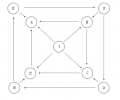
concerning the attached machine:
each arrow may represent multiple arrows (for different inputs), it is unknown exactly which inputs produce which outputs
and lead to which state. the number of inputs and outputs is finite but unknown.
which of the following can be said for certain about the minimization of the machine
(using moore algorithm)?
a. If the initial state is H, "I" is the only state to be minimized
b. If the initial state is A I is the only state to be minimized
c. If the initial state is C only 4 states will be minimized
d. If the initial state is B the machine cannot be minimized
e. if the initial state is I the machine cannot be minimized
the correct answer is a, I couldn't figure out why though.
your help will be very appreciated.
each arrow may represent multiple arrows (for different inputs), it is unknown exactly which inputs produce which outputs
and lead to which state. the number of inputs and outputs is finite but unknown.
which of the following can be said for certain about the minimization of the machine
(using moore algorithm)?
a. If the initial state is H, "I" is the only state to be minimized
b. If the initial state is A I is the only state to be minimized
c. If the initial state is C only 4 states will be minimized
d. If the initial state is B the machine cannot be minimized
e. if the initial state is I the machine cannot be minimized
the correct answer is a, I couldn't figure out why though.
your help will be very appreciated.
Attachments
-
 11 KB Views: 5
Last edited: