Facebook
 Google
 GitHub
 Linkedin

I have a friend who owns a company that manufactures pigment additives for concrete. Some of the colors that he makes, like black, gray, red and yellow are all made from the same thing: iron oxide. So yeah, what you say makes complete sense to me. It's all about particle size.That is exactly what I tried to say. Newly exposed metal surfaces oxidize quickly. Normally, the reaction of that surface oxidation generates some heat and that heat is dissipated by the bulk of the metal and the thickness of that oxidation is a few hundred nano-meters thick in the the first seconds after the cut.
The smaller a metal particle gets, the higher it's surface area to volume ratio is.
At some point, the surface area to volume gets so high that the heat that dissipates into the particle when the surface oxidizes can turn the particle red hot.
When the micron-scale particle is red hot (molten), the cast iron rusts (oxidizes) all the way through the particle.
since iron oxide is much less dense and has a higher melting point than iron, the particle grows in size like popcorn popping. And that popped piece of metal quickly blows apart into nano particles that are so small they can hang in air like smoke for a long time. Smoke is just a bunch of particles that are so small that air currents can keep them suspended in a way that seems to defy gravity.
I also wanted to assure you that, even though the color of the dust is not the traditional red rust of iron oxide that you'd see on an old car, it is still oxidized iron.
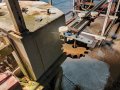
In the end, I was trying to say, your dust doesn't seen like any cast iron turnings because they are so fine and oxidizing as they leave the saw wire
I hadn't thought about the "popcorn effect" that you've described, though. Very interesting stuff.
Last edited: