Strange problem with battery eliminator for digital camera.

Thread Starter

Anacapala

Joined Sep 30, 2020
16
It would not be a resistance issue, but rather a "contacting the wrong thing" issue.
If it was contacting the wrong thing, wouldn't that show as a change of resistance? It would have to be a voltage-dependant resistance, but why would that only show with the adapter and not with ordinary batteries? There's nothing else in that compartment that could make a connection. It's really strange.
 

LesJones

Joined Jan 8, 2017
4,511
Measure the resistance between the two spring contacts in the camera. Measure the resistance between each spring contact and the flat metal surrounding it and also the flat metal surrounding the other spring contact. Measure the resistance between the wires to your dummy battery with the ends of the springs pressed against a clean metal plate. Insert your dummy battery into the camera and again measure the resistance between the wires to your dummy battery. Report ALL of these readings.

Les.
 

Thread Starter

Anacapala

Joined Sep 30, 2020
16
Measure the resistance between the two spring contacts in the camera. 45.5kOhm in one direction, 1.6kOhm in the other.
Measure the resistance between each spring contact ... 45.5kOhm in one direction, 1.6kOhm in the other.
and the flat metal surrounding it. Zero.
and also the flat metal surrounding the other spring contact. 45.5kOhm in one direction, 1.6kOhm in the other, for both.
Measure the resistance between the wires to your dummy battery with the ends of the springs pressed against a clean metal plate. 1.3Ohm for very light pressure, 0.5Ohm when pushed flat.
Insert your dummy battery into the camera and again measure the resistance between the wires to your dummy battery.
1.7kOhm in one direction, 45.5kOhm in the other.
(The resistance varies a bit for some readings because I need probe extensions to get to the contacts at the bottom of the chamber.)
 

LesJones

Joined Jan 8, 2017
4,511
I don't understand your last sentence in brackets. " (The resistance varies a bit for some readings because I need probe extensions to get to the contacts at the bottom of the chamber.) "
Why to you need probe extensions to connect to the wires from your dummy battery ?
Another test you could do is to insert the normal two AA cells but do not close the battery cover. With your meter set to the current range connect the meter leads between the exposed ends of the cells and switch the camera on. Note the current reading.
(The meter is now replacing the link between the cells that would normally be provided by the battery cover.)
From the test you have done so far it does not look like the ends of the springs are being shorted by the battery contacts.

Les.
 

MisterBill2

Joined Jan 23, 2018
27,570
Once again,it seems that somehow the pressure of the larger springs is the problem. That is the difference between using the batteries and using the battery eliminator connection adapther. I am not able to do a mechanical analysis of the structure of the camera and thus I can not provide a detailed explanation .
OR, it may be that the impedance of the external supply is such that whatever is producing that very short current spike does not witch off as intended. so possibly a capacitor across the battery commection points on theadapter may help.
 

KeithWalker

Joined Jul 10, 2017
3,607
I have re-read all of the comments in this thread. It appears that using that assembly with those particular springs for dummy battery contacts will not work for some unknown reason. The obvious answer is to replace your assembly with two separate dummy cells with contacts that physically resemble battery terminals.
 

Alec_t

Joined Sep 17, 2013
15,121
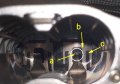
CameraContacts.jpg

It looks to me that your adapter spring (represented by the white circle) would short-circuit prongs a to surround b, whereas insulator strips c would prevent a battery +ve terminal from doing that.
 

MisterBill2

Joined Jan 23, 2018
27,570
Reasonably, since the camera appears to function correctly with the two batteries but not with the adapter and external supply, the reasonable conclusion is that it is either the adapter or the external power supply. Several sugestions point at the adapter, one other possibility would be the external voltage supply or the wiring between..
 

Thread Starter

Anacapala

Joined Sep 30, 2020
16
I don't understand your last sentence in brackets. " (The resistance varies a bit for some readings because I need probe extensions to get to the contacts at the bottom of the chamber.) "
Why to you need probe extensions to connect to the wires from your dummy battery ?
Another test you could do is to insert the normal two AA cells but do not close the battery cover. With your meter set to the current range connect the meter leads between the exposed ends of the cells and switch the camera on. Note the current reading.
(The meter is now replacing the link between the cells that would normally be provided by the battery cover.)
From the test you have done so far it does not look like the ends of the springs are being shorted by the battery contacts.

Les.
I don't need the probe extensions to connect to the wires from the dummy batteries. I do need probe extensions to get to the contacts at the bottom of the chamber. The point of this test was presumably to eliminate the dummy battery from the measurement.

Normal power consumption of the camera with standard batteries is about 400mA, much less than I am seeing with the dummy battery inserted and the camera switched off.
 

Thread Starter

Anacapala

Joined Sep 30, 2020
16
Once again,it seems that somehow the pressure of the larger springs is the problem. That is the difference between using the batteries and using the battery eliminator connection adapther. I am not able to do a mechanical analysis of the structure of the camera and thus I can not provide a detailed explanation .
OR, it may be that the impedance of the external supply is such that whatever is producing that very short current spike does not witch off as intended. so possibly a capacitor across the battery commection points on theadapter may help.
That what it seems like, but nothing I can find indicates that it could actually be the case. Judging by what is required to close the case, the pressure of the springs in the adapater is actually less than the pressure exerted by the batteries themselves. But in any case I still get the large current flow if I only push the adapter into the case far enough to lightly touch the contacts.

The impedance of the whole circuit would change as a result of the additional connections, but I can't imagine it would be any different than the normal fluctuation in battery characteristics that would occur with different batteries (Nicad/NiMH etc) and different states of charge. I will have a go at inserting the capacitor.
 

Thread Starter

Anacapala

Joined Sep 30, 2020
16
It looks to me that your adapter spring (represented by the white circle) would short-circuit prongs a to surround b, whereas insulator strips c would prevent a battery +ve terminal from doing that.
That's where I started, because the structure looks similar to the arrangement on the cap that prevents backwards batteries. But the surround is a zero resistance to the prongs, and although it's not actually visible I believe they are the same piece of metal. The insulator strips you refer to are actually cutouts in the metal surround - there is no raised plastic in that slot (like there is in the cap) and nothing to stop the springs pressing down to a flat surface (although I don't believe either the adapter or the batteries press that far.) It's all very strange.
 

MisterBill2

Joined Jan 23, 2018
27,570
When all of the reasonable explanation fail, it may be time to investigate the less reasonable and harder to believe explanations.
And when I mentioned impedance I was not considering the resistance of those connecting springs, but rather the effective impedance of the external source, including lead resistance and regulator response time.
 

Thread Starter

Anacapala

Joined Sep 30, 2020
16
When all of the reasonable explanation fail, it may be time to investigate the less reasonable and harder to believe explanations.
And when I mentioned impedance I was not considering the resistance of those connecting springs, but rather the effective impedance of the external source, including lead resistance and regulator response time.
I am using a battery pack as the source, as that seemed most similar to installed batteries, so the impedance would only be different due to the extra wiring.

But I believe that I have solved it.

The camera does indeed draw 800-900 mA at power up. I now believe this is to charge a supercap which is used to keep the date etc alive (and power the power-on button?). It happens for a varying period, but at least 5s. When I tested with the installed pack I didn't wait long enough to see it ease back to zero, because it seemed so incorrect, and the wires actually got quite warm. When I tested with installed batteries I wasn't quick enough to spot it, because I knew it was working correctly with the batteries and I made sure that the probes were properly connected etc before reading the meter.

This behavior might not be quite normal - the camera is old and the supercap might be drawing more current for longer than originally designed - I don't know how long these devices typically last. It is likely also part of the reason that I wanted to replace the internal batteries in the first place.

So I now plug in the external supply, leave it plugged in, and don't need to worry about the surge on initial connection!

Thank you to all who responded. I apologise if my replies to the suggestions seemed negative, but I had already eliminated most of the suggestions before I posted, which is why I called it strange.
 
Top