Storing Static affected ICs

Thread Starter

Mozee

Joined Jul 23, 2016
87
Hello friends.
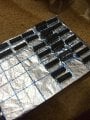
I was reading about Static charges and how it could destroy Static sensitive ICs and Iremember reading somewhere that having all IC pins shorted out is the best way to store them. Now that I can't find the inductive styrofoam (the black one for stiring those ICs) I used a normal styrofoam and wrapped an aluminium foil around and jused it to store my ICs.. Would this be a good workaround? Any better Ideas?
 

Attachments

ericgibbs

Joined Jan 29, 2010
21,442
hi Mozee,
That is the method I use, polystyrene ceiling tile wrapped with aluminium baking foil.
Push the legs of the IC's thru the foil into the tile
It is a good idea to ground the foil to earth.
In that way every time you handle the tiles you and the tile are grounded

E
 

Thread Starter

Mozee

Joined Jul 23, 2016
87
First of all,Sorry for the typos, using a smartphone on forums is pain in the neck and I can't seem to find the Edit button.

Thank you @ericgibbs , but should I ground it to earth?

In our place we have to wires only and no grounding, only the Nutral and The Live mains wires in all sockets, I know it is not good but how do I ground anything if that was the case here?
 

#12

Joined Nov 30, 2010
18,224
Ack! Normal styrofoam is among the most horrible causes of static electricity!:eek:
Have you ever tried breaking some of it up and then trying to escape from the little bits that stick to you?
Better to just use the aluminum foil than to add styrofoam.

Now that I'm done with my panic attack...
Save all the bits of black foam you get, use the anti-static bags which parts arrived in, and ground yourself before opening any parts containers. I have used a graphite spray intended for lubricating locks. Spray it in the plastic drawers, wait for it to dry, wash with kitchen detergent, and Viola'...you have a partially conductive coating without any grease or solvents in it.

As for ground, I think everybody has some of our planet nearby, and that is the original source of, "ground". Connecting to a water pipe that is connected to a buried water system is good. If that isn't convenient, you can bury some pipe, or metal rod, or copper wire yourself.
 

Thread Starter

Mozee

Joined Jul 23, 2016
87
@#12 thanks for reminding me.. Seriously, I totally forgot about that bad habbit of styrofoam because I was enjoying placing these ICs and have an easy access to them this way.
Wouldn't it help if the entire block of styrofoam is wrapped with the aluminium Foil? I mean like working as a faraday cage or so?!! How would it get charged then?
 

ericgibbs

Joined Jan 29, 2010
21,442
hi,
Without some way of having a Earth ground, you run the risk of ESD damage to any IC's you may handle while working on projects.
In the UK we have a 3 pin mains supply system. L,N and E-arth.
If I had to to provide an earth path, I would run a wire to a copper 'rising' water pipe.
That means a copper water pipe that is supplying the property from the local utility company, usually partly buried in the ground.

If that is not possible you could run a wire to a piece of copper pipe that is hammered into the soil outside your house.

Its important that you have a series current limiting resistor in the grounding wire, say 470k or 1meg ohm.
This to protect you in the event of you touching a live terminal and the grounding wire, while you are working on a project.

Do you follow what I mean.??

E
 

ericgibbs

Joined Jan 29, 2010
21,442
hi #12,
Used this method commercially, for over 40 years, NEVER lost an IC device due to ESD during that time.... your fears are ungrounded, [ pun intended]

Eric
 

#12

Joined Nov 30, 2010
18,224
hi #12,
Used this method commercially, for over 40 years, NEVER lost an IC device due to ESD during that time.... your fears are ungrounded, [ pun intended]

Eric
If you say so, but it isn't intuitive to me, so I decided to be afraid of styrofoam for anti-static storage.
 

ericgibbs

Joined Jan 29, 2010
21,442
hi #12,
The other handy result of storing IC's in that way, is that 1cm thick poly tiles carrying the IC's can be stacked one on top of another.
The tiles are wrapped all around with alum' foil.
E
 

Thread Starter

Mozee

Joined Jul 23, 2016
87
Thank you for this really important advice.. Thank you both of you guys!

I am not an expert in all this so I would like to ask about and understand two things.
1-why would I need this resisto if the current is intended to be passed to ground, why would I supress it?

2- this one might not be related but I have noticed, in some posts, people talking aboit a common ground that can be an issue when say for example when connecting two circuits one uses a USB connected to computer and the other is a circuit running using mains !!
What could go wrong?
 

ericgibbs

Joined Jan 29, 2010
21,442
hi,
By adding a series current limiting resistor you are not 'suppressing it', any static charge will quickly discharge thru the resistor.
Without the resistor, if you touched say the Live mains wire with one hand and the grounding wire with the other the current flowing thru you would NOT be limited.
NOTE: all ESD wrist band protection MUST also have a series limiting resistor to ground.

For 2. in some cases the ground of one piece of equipment may not be as the same ground potential as another piece of equipment, so current can low in the 'common' wire linking the equipments. This can cause various problems.

E
 

Thread Starter

Mozee

Joined Jul 23, 2016
87
hi,
By adding a series current limiting resistor you are not 'suppressing it', any static charge will quickly discharge thru the resistor.
Without the resistor, if you touched say the Live mains wire with one hand and the grounding wire with the other the current flowing thru you would NOT be limited.
NOTE: all ESD wrist band protection MUST also have a series limiting resistor to ground.

For 2. in some cases the ground of one piece of equipment may not be as the same ground potential as another piece of equipment, so current can low in the 'common' wire linking the equipments. This can cause various problems.

E
Thank you for answering, really appreciate it.
Is there a scientific name for the second case I stated? Or any commenly used abbreviation explaining it, so than I can google it and learn more about it.

Thanks in advance.
M.
 

dl324

Joined Mar 30, 2015
18,327
Any better Ideas?
Store them in antistatic tubes or bags. Used bags are sometimes available from local sources near me, but I just keep the tubes and bags that come with my purchases.

You don't need to worry about grounding anything while they're being stored. Having all pins at the same potential (shorted) prevents ESD damage. However, you should ground yourself before handling parts; that's SOP.

The black antistatic foam is still available, at Jameco for instance. It deteriorates after a decade or two and can cause corrosion on the leads and/or leave residue that needs to be scraped away.

I have some blue antistatic trays for storing parts. They called them bug trays or something like that. Couldn't find any sources with Google, so they may have been discontinued.

One final note. ESD damage may not be immediately evident and may result in a device operating outside of specs until eventual failure. The only way to know for certain is to decap the device, but that's a destructive process. Consider yourself fortunate if a device with ESD damage fails immediately.
 
Last edited:

hp1729

Joined Nov 23, 2015
2,304
Hello friends.
I was reading about Static charges and how it could destroy Static sensitive ICs and Iremember reading somewhere that having all IC pins shorted out is the best way to store them. Now that I can't find the inductive styrofoam (the black one for stiring those ICs) I used a normal styrofoam and wrapped an aluminium foil around and jused it to store my ICs.. Would this be a good workaround? Any better Ideas?
Jameco electronics carries the black foam. 12" x 24" x 1/4" thick, about $12.00 as I recall. That's about $0.04 per square inch and you can get four 16-pin chips in a square inch. Is $0.01 per IC reasonable.
 

Thread Starter

Mozee

Joined Jul 23, 2016
87
Store them in antistatic tubes or bags. Used bags are sometimes available from local sources near me, but I just keep the tubes and bags that come with my purchases.

You don't need to worry about grounding anything while they're being stored. Having all pins at the same potential (shorted) prevents ESD damage. However, you should ground yourself before handling parts; that's SOP.

The black antistatic foam is still available, at Jameco for instance. It deteriorates after a decade or two and can cause corrosion on the leads and/or leave residue that needs to be scraped away.

I have some blue antistatic trays for storing parts. They called them bug trays or something like that. Couldn't find any sources with Google, so they may have been discontinued.

One final note. ESD damage may not be immediately evident and may result in a device operating outside of specs until eventual failure. The only way to know for certain is to decap the device, but that's a destructive process. Consider yourself fortunate if a device with ESD damage fails immediately.
Yes i guess shorting out all pins will put them at 0V potential but I think that grounding is a proper way to work with such things. IMHO Grounding is an important prenciple that needs to be taken in consideration.
 

Thread Starter

Mozee

Joined Jul 23, 2016
87
Jameco electronics carries the black foam. 12" x 24" x 1/4" thick, about $12.00 as I recall. That's about $0.04 per square inch and you can get four 16-pin chips in a square inch. Is $0.01 per IC reasonable.
Only if i was able to order stuff online in my country :(
 

dl324

Joined Mar 30, 2015
18,327
Yes i guess shorting out all pins will put them at 0V potential
Not necessarily. It puts them all at the same potential. If antistatic bags and tubes required grounding to provide effective ESD protection, how would manufacturers ship their product?
but I think that grounding is a proper way to work with such things. IMHO Grounding is an important prenciple that needs to be taken in consideration.
You can believe and do whatever you want. We can't force you to do what we think is correct or what you think is incorrect. You asked for advice/suggestions; what you do with them is up to you.
 

MrChips

Joined Oct 2, 2009
34,812
If you follow through this thread you will find some conflicting and confusing advice and opinions.

Here are the best practices, IMHO.

1. Short the IC pins together in black conductive foam. Not all black conductive foam is suitable. The ones with a dull appearance that also break apart easily will attract moisture and eventually corrode the IC pins. Get the foam that is shinier and doesn't break apart.

Moisture and humidity helps to reduce ESD. But it also causes corrosion. If you live in a place with high humidity, store components in zip-lock bags along with packets of silica gel. Of course, reuse the anti-static bags that the components were shipped in. Save the desiccant packets sent with the components or with other items (e.g. shoes, electronics). Regularly rejuvenate the packets of desiccant by leaving in a warm oven for a few hours.

If you cannot easily obtain conductive foam, aluminum (or aluminium) foil is your next option. Wrapping aluminum foil around foam is better than nothing. Make sure you change the foil when the holes get too big.

btw - you should also be protecting transistors, regulators and other electronic components in a similar manner.

2. You do not have to ground the storage cabinet. You do need to ground your body. Use an anti-static wristband and an anti-static mat on your workbench. If you have no ground connection, create your own by running a grounding wire to a cold water tap or a grounding rod hammered into the ground.

3. Making a claim that you never lost a component because of ESD, regardless of what ever handling practice is in place, is displaying ignorance of the damage caused by ESD. As Dennis says, consider yourself fortunate if the component fails outright if it is subjected to ESD. It would be better to replace a $2 component now rather than have the system fail out in the field.
 
Top