Stereo amp

Thread Starter

TieBravo

Joined Aug 21, 2021
60
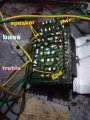
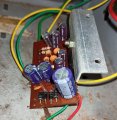
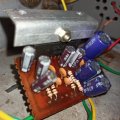
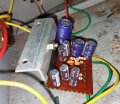
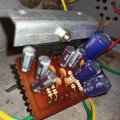
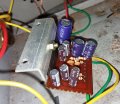
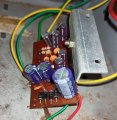
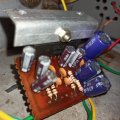
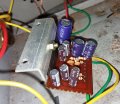
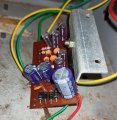
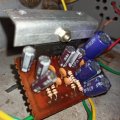
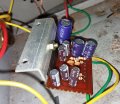
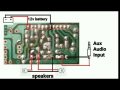
Hello can i make this simple amplifier into a stereo one? 3 potentiometers used each of 100k, one is volume (and with aux, gnd wire), second is bass (4.7k resistor and 103uf cap), third is treble (104uf cap).
 

Attachments

MisterBill2

Joined Jan 23, 2018
27,508
Indeed, you need another amplifier. BUT you will be better off finding aN EXISTING STEREO amplifier in some piece of equipmment, such as a car cassette player with a worn out transport mechanism, or possibly an old 8-track player.
 

AnalogKid

Joined Aug 1, 2013
12,127
Indeed, you need another amplifier. BUT you will be better off finding aN EXISTING STEREO amplifier in some piece of equipmment, such as a car cassette player with a worn out transport mechanism, or possibly an old 8-track player.
Note that both of those examples will have some form of NAB frequency equalization built-in, and not work well as a general-purpose audio amplifier.

ak
 

MisterBill2

Joined Jan 23, 2018
27,508
I think this TS also posted about that transistor stereo amp that ran 12 volts thru the speakers. So any shape of frequency response will be good enough.
Now converting that amp into stereo? Yes, but it will cost a lot more.

Sort of like converting the Corvette into a Mustang. Very expensive and a bad idea as well.
 

MisterBill2

Joined Jan 23, 2018
27,508
Actually that might possibly BE a stereo amp, given the number of pin connections for the IC that we are not shown. Certainly that device will need an adequate heat sink if you want the amplifier to last for more than a minute of use..
And do not ben those leads much because when they break off the game is over.
 

Audioguru again

Joined Oct 21, 2019
6,826
Maybe we will never see which amplifier ICs are mounted on that heatsink.
I see the pins of TWO 5-pins ICs on the pcb (separated with a green dot) so maybe it has a second amplifier as a spare?

If it has two amplifiers in a bridged output then they will probably be in a single IC for good DC offset matching.

I wonder if the volume and tone controls are mono or stereo?
 

Thread Starter

TieBravo

Joined Aug 21, 2021
60
Maybe we will never see which amplifier ICs are mounted on that heatsink.
I see the pins of TWO 5-pins ICs on the pcb (separated with a green dot) so maybe it has a second amplifier as a spare?

If it has two amplifiers in a bridged output then they will probably be in a single IC for good DC offset matching.

I wonder if the volume and tone controls are mono or stereo?
These are the components
 

Attachments

Thread Starter

TieBravo

Joined Aug 21, 2021
60
Maybe we will never see which amplifier ICs are mounted on that heatsink.
I see the pins of TWO 5-pins ICs on the pcb (separated with a green dot) so maybe it has a second amplifier as a spare?

If it has two amplifiers in a bridged output then they will probably be in a single IC for good DC offset matching.

I wonder if the volume and tone controls are mono or stereo?
Here is yhe volume circuit
 

Attachments

AnalogKid

Joined Aug 1, 2013
12,127
Now that we have something to work with . . .

Electrically, it is possible to do what you want. Mechanically, it will be very difficult.

The 6283 has two audio amplifiers in it, but in your circuit they are connected together to form a BTL amplifier - Bridge-Tied Load. This uses two amplifiers to drive one speaker in a way that increases the maximum power possible with the supply voltage. On paper, you can separate the two amplifiers so that they each amplify a different signal.

However, it will take a bunch of trace cuts and jumpers, and several new components. Plus additional volume and tone control potentiometers for the added channel. Overall, this is a lot of surgery for a device that can be replaced with a $5 module from ebay.

ak
 

Thread Starter

TieBravo

Joined Aug 21, 2021
60
Now that we have something to work with . . .

Electrically, it is possible to do what you want. Mechanically, it will be very difficult.

The 6283 has two audio amplifiers in it, but in your circuit they are connected together to form a BTL amplifier - Bridge-Tied Load. This uses two amplifiers to drive one speaker in a way that increases the maximum power possible with the supply voltage. On paper, you can separate the two amplifiers so that they each amplify a different signal.

However, it will take a bunch of trace cuts and jumpers, and several new components. Plus additional volume and tone control potentiometers for the added channel. Overall, this is a lot of surgery for a device that can be replaced with a $5 module from ebay.

ak
I...☹☹☹ I made it..... I won't buy☹☹☹☹ i make☹
 

Thread Starter

TieBravo

Joined Aug 21, 2021
60
Now that we have something to work with . . .

Electrically, it is possible to do what you want. Mechanically, it will be very difficult.

The 6283 has two audio amplifiers in it, but in your circuit they are connected together to form a BTL amplifier - Bridge-Tied Load. This uses two amplifiers to drive one speaker in a way that increases the maximum power possible with the supply voltage. On paper, you can separate the two amplifiers so that they each amplify a different signal.

However, it will take a bunch of trace cuts and jumpers, and several new components. Plus additional volume and tone control potentiometers for the added channel. Overall, this is a lot of surgery for a device that can be replaced with a $5 module from ebay.

ak
Would this work?
 

Attachments

Top