Stepper motor solution for a coil winding machine.

Thread Starter

emtor

Joined Feb 7, 2022
10
I know nothing about micro controllers, but have some experience with steppers and the drive modules. That said I can't imagine just a micro, by its self being able to drive a stepper. To my pea brain, it would be easier to use a driver, and if you need to control the driver, give the signals to it, from the micro.
Sounds to me like You can't really use an automated system.
I would, however, still recommend using a Stepper-Motor for Rotating the Coil-Former.
This makes it very easy to setup a very accurate "Turns-Counter",
and, Stepper-Motors will run at ridiculously slow and steady speeds with zero problems.
.
.
.
Yes, I agree, a fully automated system would be very difficult to make, but as for using stepper motors I'm all in.
I did find something that seems to be well worth investigating further.
Someone has made a coil winder using what seems to be an Arduino Nano.
https://curiousscientist.tech/blog/coil-winder-project-part-4
Looking at the code is scary and far out of reach for me should I be forced to write the code myself.
I have played with php-scripting and databases and have also managed to crack trial software making them full versions by altering the assembler code, but this took weeks and was not easy, so I do get an idea of how much torture writing complicated code would make me endure.
I'll check out the above mentioned project to see if it's useful for my needs.
 

LowQCab

Joined Nov 6, 2012
5,101
Just for Ideas ............
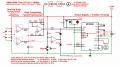
Here's a Speed-Controller for a Custom-MIG-Welder Wire-Feeder using a Stepper-Motor.
.
.
.Speed Control Circuit 1 FLAT .png
 

LowQCab

Joined Nov 6, 2012
5,101
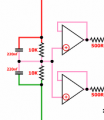
They insure that the Voltage at that point will remain at exactly 1/2 of
whatever the Supply-Voltage is when the Circuit first has Power applied to it.
It probably won't make a bit of difference in this Circuit's start-up behavior,
but it's simply a "best-practices" type of thing.
It will insure virtually instantaneous operating stability on Power-Up,
but the Motor doesn't start running until the Button is pressed,
which will be some length of time after Power-Up in any case.

You could probably completely leave-out the
Supply-Splitter Op-Amp and not notice the difference in operation.
.
.
.
 

Thread Starter

emtor

Joined Feb 7, 2022
10
I have found a series of very detailed instructions on how to build a coil/transformer winder powered by Arduino using stepper motors.
Code for the Arduino is also included,-and everything is completed, tested and it works.
I'll go for this solution, and thanks a lot for all the input.
 

shortbus

Joined Sep 30, 2009
10,049
A Screw-Motor from a Floppy-Drive is not going to have nearly enough Power,
but there are plenty of adequate examples available.
So you think a NEMA 17 stepper motor doesn't have the power to guide a wire? The motors I took out of old floppy drives were both NEMA 17 in size. Many people even use a NEMA 17 for their mini CNC mills. The wire guide just has to have enough power to move the wire across the coil, the winder spindle its self is where the power is larger not the guide. A "dancer arm" will be or should be used to keep the tension from the spool of wire being used, not the guide.
'
'
'
'
'
 

MaxHeadRoom

Joined Jul 18, 2013
30,713
Incidentally NEMA rating is not a motor torque sizing parameter, it refers to the mounting standard, e.g. I have a Oriental stepper motor catalogue that show listing of motors of one particular NEMA size with 10 per listing ranging from 54oz-in to 187 oz-in. As an example;)
 
Top