Facebook
 Google
 GitHub
 Linkedin
Hi All,
Appreciate a sanity check here. I am looking to implement a simple circuit switch on/off an LED based on the signal level of an opto sensor.
This is the opto sensor: OPB830W51Z
https://www.mouser.co.uk/ProductDetail/Optek-TT-Electronics/OPB830W51Z?qs=iblIa22dKKTyyQ8HOTK3ZA==
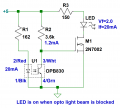
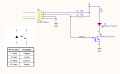
The concept is that when the opto sensor beam is not broken, the transistor in the opto sensor will be open which in turn pulls the SIGNAL level down to ground. The result is that the base of Q1 is not switched high and the circuit for D1 is not complete - so D1 is off.
When the opto sensor beam is broken, the transistor in the opto will switch off which in turns pulls the SIGNAL level up to 5V via R2 (10K pull up). As SIGNAL is pulled high is applies a positive bias to the base of Q1 switching it on. This then allow current to flow through D1 switching it on.
Does this make sense?
Here is my suggested circuit design:
Appreciate a sanity check here. I am looking to implement a simple circuit switch on/off an LED based on the signal level of an opto sensor.
This is the opto sensor: OPB830W51Z
https://www.mouser.co.uk/ProductDetail/Optek-TT-Electronics/OPB830W51Z?qs=iblIa22dKKTyyQ8HOTK3ZA==
The concept is that when the opto sensor beam is not broken, the transistor in the opto sensor will be open which in turn pulls the SIGNAL level down to ground. The result is that the base of Q1 is not switched high and the circuit for D1 is not complete - so D1 is off.
When the opto sensor beam is broken, the transistor in the opto will switch off which in turns pulls the SIGNAL level up to 5V via R2 (10K pull up). As SIGNAL is pulled high is applies a positive bias to the base of Q1 switching it on. This then allow current to flow through D1 switching it on.
Does this make sense?
Here is my suggested circuit design: