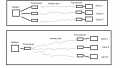
The original Ethernet ran on coax in a bus, this persisted for a long time until UTP versions using hubs appeared.
I think you are conflating layers of the OSI model. TCP/IP doesn't have any particular PHY requirement. You could even use RFC1149 which can be in a hub or star topology, though the author says it is usually hub based.
Physical topologies are independent of the protocols they transport.
Why are you trying to reinvent star networks instead of using something that already exists? What will it be used for?
The original Ethernet ran on coax in a bus, this persisted for a long time until UTP versions using hubs appeared.
I think you are conflating layers of the OSI model. TCP/IP doesn't have any particular PHY requirement. You could even use RFC1149 which can be in a hub or star topology, though the author says it is usually hub based.
Physical topologies are independent of the protocols they transport.
Why are you trying to reinvent star networks instead of using something that already exists? What will it be used for?
Ah, sorry I think I didn’t explain myself clearly.
What I am really looking for are what star network (wired, not wireless) are available at the moment. And then I can choose one that is suitable for me.
The best I can come up with is using RS485 at 9600 (or lower) so I don’t have reflections problem. Then implement my own protocols, if I can’t find a suitable one that is already available.
Or, using RS485 again, but using MUX to form a star network. Again, need to implement my own protocols if I can find one that is already available and suitable.
I am working on a project that need star wired network. Data rate is very slow, 9600 is fast enough already. Need to be able to run 2-300 meters over twister pair. That’s why I am thing the two options above.
Ethernet is probably too expensive for us.
I am hoping to find something that is already available, and it can do what we want.
A trap is using RS485 as a 2 wire network and having the "ground" of the various devices not connected. We had an installation in a wire drawing factory that gave a lot of trouble with grounds floating well above the common mode voltage of the drivers. running the RS485 cable as shielded twisted pair and connecting all the grounds fixed it.
If you want fully isolated networks (a good idea) have a look at MornSun devices... https://www.mornsun-power.com/html/product/RS-485-Transceiver-Module.html
Just note that on the devices I have used, the T/R switching polarity is reversed with respect to "standard" RS485 drivers.
And terminating the legs is not hard. Make provision for it if you are doing boards. Mine have a termination resistor and a link to enable it.
A trap is using RS485 as a 2 wire network and having the "ground" of the various devices not connected. We had an installation in a wire drawing factory that gave a lot of trouble with grounds floating well above the common mode voltage of the drivers. running the RS485 cable as shielded twisted pair and connecting all the grounds fixed it.
If you want fully isolated networks (a good idea) have a look at MornSun devices... https://www.mornsun-power.com/html/product/RS-485-Transceiver-Module.html
Just note that on the devices I have used, the T/R switching polarity is reversed with respect to "standard" RS485 drivers.
And terminating the legs is not hard. Make provision for it if you are doing boards. Mine have a termination resistor and a link to enable it.
We have used both Star and just one long line. A lot depends on the installation. For some big ones, I developed an 8 line repeater so each leg had its own driver and could be isolated via a switch if there was a fault so as not to kill the rest of the network.
A 300M line should be pretty reliable, but add checksums to your data packets so the slave knows it is correct. We had one installation that was pretty noisy and only an 8 bit checksum so once every few weeks, a node would "go away". That took a long time to figure out but was over that time a corrupted (packet + the noise) = a valid packet and changed the slave baud rate. A 16bit checksum fixed that.
We have used both Star and just one long line. A lot depends on the installation. For some big ones, I developed an 8 line repeater so each leg had its own driver and could be isolated via a switch if there was a fault so as not to kill the rest of the network.
A 300M line should be pretty reliable, but add checksums to your data packets so the slave knows it is correct. We had one installation that was pretty noisy and only an 8 bit checksum so once every few weeks, a node would "go away". That took a long time to figure out but was over that time a corrupted (packet + the noise) = a valid packet and changed the slave baud rate. A 16bit checksum fixed that.
Have you done one RS485 master with multiple slaves in a star network? What sort of speed and distance have you achieved? I am assuming you don’t have termination resistor on each slave?
I forget the speed reached as I am the hardware side of things. Others put the magic into it.
At the end of each arm, have a termination resistor.
Each of our units has one installed but enabled by fitting a link.
I forget the speed reached as I am the hardware side of things. Others put the magic into it.
At the end of each arm, have a termination resistor.
Each of our units has one installed but enabled by fitting a link.
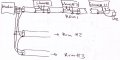
You can use a mixture of both.
It can be one arm or a multiple as in a star.
It usually is a good idea to have a termination resistor at the ends but if the arms are short, that may not be needed.
Note the network is 2 wire PLUS shield common. NOT just 2 wire.
And may need a termination at the master to.
You can use a mixture of both. View attachment 173492
It can be one arm or a multiple as in a star.
It usually is a good idea to have a termination resistor at the ends but if the arms are short, that may not be needed.
Note the network is 2 wire PLUS shield common. NOT just 2 wire.
And may need a termination at the master to.
If you have a long leg on the network, say >200M, you may need a termination on it. And any other long led too. Try it and see. If it works well without terminations, go for it. The terminations are there to prevent reflections, and should be the same 120R as the characteristic impedance of the cable. The signal will be loaded down a bit but that is ok. Clean signals are what you are looking for and the driver chips only need over 200mV differential signal to work.

 Facebook
 Google
 GitHub
 Linkedin